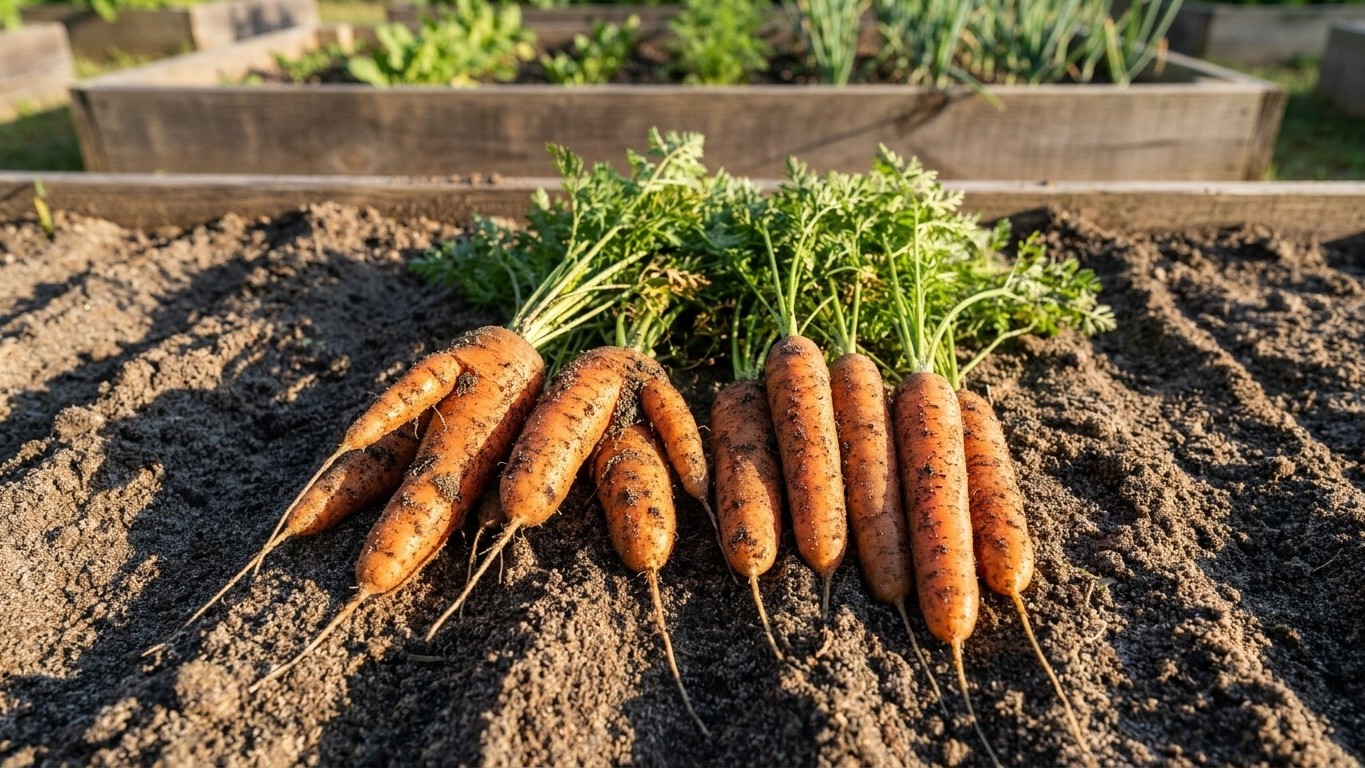

Georgia’s representative soil, the Tifton series, is 84 percent sand with only 6 percent clay, which sounds like ideal carrot country. But sand alone doesn’t guarantee straight roots. The pH runs acid, organic matter is thin, and none of that describes your actual backyard. Here’s what changes the answer.
The short answer
The soil USDA lists as representative of Georgia is the Tifton series, an Ultisol, which is a category of old, heavily weathered, leached soil that’s naturally acid and short on nutrients. The surface horizon runs about 84 percent sand, 6 percent clay, and 9 percent silt, with organic matter around 0.8 percent and a surface pH near 5.5, slightly acid. It’s classified as well drained.
For a carrot, that texture is mostly good news. Carrots want deep, sandy, well-drained ground, and 84 percent sand with only 6 percent clay is about as far from the heavy, rock-hard clay that forks roots as Georgia ground gets. A root growing through loose sand doesn’t hit the resistance that splits it into two legs the way a dense clay pan does. Drainage classed as well drained also means water moves through instead of sitting around the root and inviting rot.
The catch is what that texture doesn’t fix. Organic matter at 0.8 percent is low, and carrots do best in soil rich in it. Thin organic matter means the ground dries fast, loses nutrients quickly, and can crust over a newly sown row before the seed ever cracks. A pH near 5.5 is also more acid than most vegetable crops prefer, though the source here gives no target pH for carrots specifically, so treat that number as a flag to test, not a verdict.
The fix, where it’s needed, is the same one Utah State University Extension gives for any heavy or difficult ground: work in compost generously and double dig the bed so roots aren’t fighting compaction lower down. In sandy Tifton-type ground, the compost matters more for holding moisture and feeding the plant than for breaking up clay, since there’s little clay to break up. Where a yard has been graded, filled, or sits over a different mapped series entirely, a raised bed sidesteps the guesswork.
None of this describes your particular ten feet of garden. Georgia spans hundreds of soil series, and Tifton is simply the one USDA names as representative of the state as a whole, not a survey of every county. River bottoms run heavier and richer. Piedmont clay in the north looks nothing like a coastal plain sand. A lot cut and filled during construction can have compacted subsoil sitting inches under a thin veneer of topsoil bought in bags. This is a starting point for what the region’s ground tends to do, not a diagnosis of your bed.
The test that settles it in your own garden
- Dig a hole where you plan to sow. Go down at least a foot, straight-sided if you can manage it, so you can see the soil in layers rather than just what’s on top.
- Look at the depth of loose, workable soil before you hit a hard layer, rock, or clay pan. Carrots need that depth to run straight; a shallow ceiling of hardpan a few inches down will fork or stub a root no matter what the surface looks like.
- Check for stones and buried debris. Pull out anything solid you find in that top foot. A root doesn’t need much to be deflected sideways.
- Feel the texture between your fingers. Rub a moist handful and note whether it feels gritty (sandy), smooth and slick (clay), or somewhere between. This tells you more about your actual bed than any state-level figure can.
- Watch how water drains. Fill the hole, let it drain once, then fill it again and time how long it takes to disappear. Water still standing after several hours points to compaction or clay that a sandy state average won’t have warned you about.
When to sow here
Carrots are sown directly in the ground, never started indoors and transplanted, so every count here runs from the seeding date, not from any later planting-out. Two figures matter: the soil has to be at least 40 F, and germination happens best somewhere in the 55 to 65 F range. Timing sits around the local last spring frost window.
- Start with the frost window. NOAA’s 1991-2020 climate normals put the last spring 32 F freeze, as recorded at the Atlanta-area station used here, somewhere between March 11 and March 29.
- Count back two to three weeks from that window. That puts a realistic outdoor sowing date somewhere in the second half of February through the first half of March, depending on where in that range your particular spring lands.
- Check the ground itself before you trust the calendar. Soil needs to have warmed to at least 40 F for the seed to have any chance; a cold, wet February will push the safe date later no matter what the frost window suggests.
- Aim for the 55 to 65 F band for the best germination, which in practice often lands a little after the earliest possible sowing date rather than right at the frost window’s edge.
- Remember the caution built into the frost dates. Atlanta’s own numbers reflect an urban airport with a heat-island effect. Gardens in north Georgia and the mountains will freeze weeks earlier in fall and stay cold weeks longer in spring, while the coastal plain runs milder than these dates suggest.
What goes wrong here
- Forking in heavy or rocky ground. Even where the regional average leans sandy, a compacted layer, buried rock, or clay-heavy pocket in your own bed will split a root in two. The remedy is the same one for any difficult soil: heavy compost worked in and a full double dig before sowing, or a raised bed filled with loose, worked soil if the ground underneath can’t be fixed.
- Poor germination during a hot spell. Carrot seed germinates best between 55 and 65 F. A stretch of unseasonably warm weather right after sowing, which Georgia springs deliver often enough, can push soil temperature past that band and leave a thin, spotty row. Sowing on the earlier end of the recommended window, and watering to keep the seedbed cool and moist, helps more than sowing later.
- Splitting from uneven watering. A carrot root that dries out, then gets a heavy soak, tends to swell too fast and crack. Sandy soil like the state’s representative series drains fast and dries fast between rains, which raises the odds of exactly this cycle. A steady, even watering schedule rather than occasional deep soaks after a dry stretch is the fix.
- Crusting over a thin-organic-matter surface. At around 0.8 percent organic matter, a bare sandy surface can bake into a crust after a hard rain, and fine carrot seedlings can struggle to push through it. Mixing compost into the top inch or two before sowing, and keeping that layer lightly moist until germination, prevents the crust from forming in the first place.
Checking this against your own county
Everything above describes the soil USDA names as representative of Georgia and the frost pattern recorded at one station. Your county’s extension office can pull soil survey data specific to your actual parcel and tell you which series is mapped there, which is a different question than what the state as a whole looks like.
The UGA Cooperative Extension is the state’s land-grant extension service and the right place to start, whether that means a soil test, a local frost record, or a county agent who has walked ground near yours.
Common questions
Does Georgia’s sandy soil mean I don’t need to test my own?
No. The Tifton series is what USDA lists as representative of the state, but it’s one series among hundreds mapped across Georgia. Your yard could sit on something entirely different, especially if it’s been graded, filled, or sits in a river bottom or heavier upland pocket.
Can I sow carrots earlier than the frost window suggests if the soil feels warm?
Soil temperature is the harder limit. If it’s reliably at or above 40 F and trending toward the 55 to 65 F germination range, an earlier sowing can work, but a late cold snap can still damage a young stand, so watch the forecast as closely as the calendar.
Why did my carrots come up thin and patchy?
A hot spell right after sowing pushing soil past the 55 to 65 F germination range is one common cause. A crusted surface from low organic matter baking after rain is another. Both point back to seedbed conditions rather than the seed itself.
Is compost enough, or do I need a raised bed?
That depends on what your own dig-and-feel test turns up. Utah State University Extension recommends compost and double digging for heavy soil; where the ground stays compacted or rocky at depth even after that work, a raised bed filled with loose soil sidesteps the problem instead of fighting it every season.