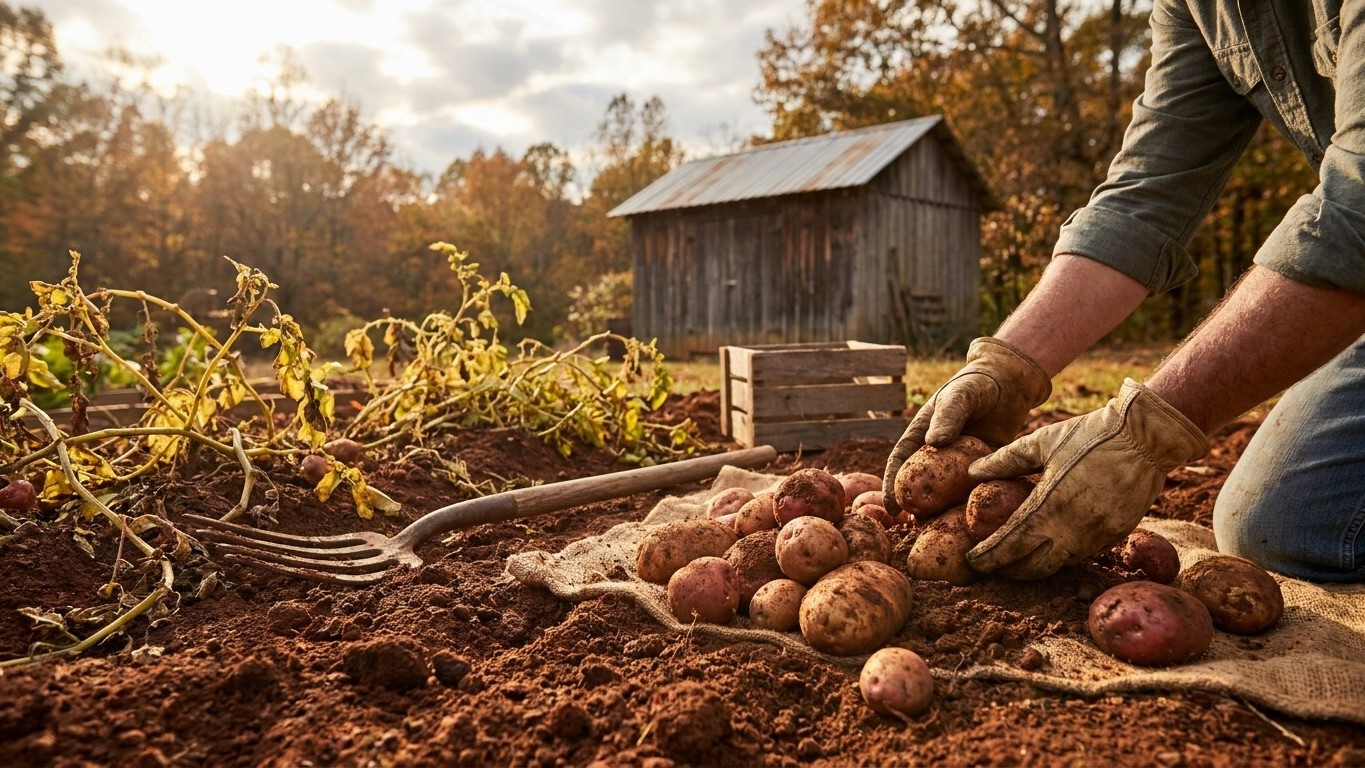

Dig your potatoes before the ground freezes and before the first fall frost settles over the vines, then cure them at 55-60 F for two to three weeks before moving them into a dark, 40-45 F storage spot. In much of Alabama, that frost doesn’t show up until early to mid-November, and winters here rarely freeze solid, so the real challenge isn’t cold. It’s finding a space that stays cool enough, not one that stays warm enough.
The short answer
Two figures do most of the work here. The first fall frost across the reference station used for Alabama’s climate normals falls somewhere between November 2 and November 16, based on NOAA NCEI’s 1991-2020 data. That’s a wide window, and it moves earlier the farther north and the higher in elevation your garden sits. The second figure matters more once the crop is out of the ground: the coldest month’s mean minimum runs 33.1 F, according to the Huntsville reference station in the same NOAA NCEI dataset. That’s a nightly average, not a record low, and it tells you something specific: Alabama’s coldest month dips just below freezing on an average night, but it doesn’t stay there.
Put those two numbers together and the harvest calendar writes itself. Vines typically decline and tubers finish sizing well ahead of that November frost window, so most home growers are pulling potatoes in late summer or early fall, while daytime temperatures are still warm and the ground hasn’t cooled much. That’s workable for digging. It’s less workable for storage, because the target range for holding potatoes, 40-45 F according to Utah State University Extension, sits noticeably above that 33.1 F mean minimum.
What that mismatch means in practice: an unheated garage, shed, or breezeway in most of Alabama will not hold a steady 40-45 F through the winter. It will swing. Some nights it tracks close to that mean minimum, some days it climbs well past 45 F, especially in a metal shed with any sun exposure. The mean minimum of 33.1 F is cold enough that a truly unheated, uninsulated structure can flirt with freezing on the coldest nights, but it’s not cold enough, or consistent enough, to serve as reliable potato storage on its own. Freezing ruins tubers just as fast in Alabama as it does anywhere else. The bigger risk here, though, is the opposite problem: a space that never gets cold enough, and lets stored potatoes sprout weeks or months early.
The practical takeaway is that Alabama growers need a space they can moderate, not one they can leave alone. A basement, an interior closet against an exterior wall, or an insulated room does more work here than raw outdoor cold ever will.
Curing, and where
Curing heals the small cuts and abrasions that happen during digging, and it toughens the skin so tubers hold up in storage. Utah State University Extension sets the target at 55-60 F with high humidity, held for two to three weeks. In Alabama, that temperature band is common at harvest time, but finding it indoors, with enough humidity and without direct heat, takes some thought. Here’s a workable order of operations.
- Dig on a dry day and let the soil air off the tubers. Alabama’s harvest window usually falls in warm weather, so skip the temptation to hose potatoes clean. Brush off loose soil and let them sit in shade for an hour or two before moving them anywhere.
- Pick a shaded, out-of-the-way spot with steady air, not steady sun. A covered porch on the north or east side of the house often lands close to the 55-60 F range during Alabama’s early fall mornings and evenings, even when afternoons run warmer. Direct sun on a porch or in a greenhouse will overshoot the target fast.
- Consider the garage only if it stays shaded and ventilated. An attached garage with a window cracked can work in October, once daytime highs have eased. Earlier in the season, a closed garage can climb well past 60 F by midafternoon, which slows curing and can encourage rot instead of toughening skins.
- A basement, where one exists, is often the most reliable option. Basements are less common in Alabama than in colder states, but where they exist, they tend to hold steadier temperatures and higher ambient humidity than an above-ground room, which suits the curing target well.
- Spread tubers in a single layer, out of direct light, with something like burlap or a loosely woven cloth over them. Airflow matters as much as humidity. A sealed container during curing traps moisture and invites rot.
- After two to three weeks, check skins. If they no longer scuff easily under light thumb pressure, curing is done and it’s time to move tubers to their winter storage spot.
Where curing tends to fail in Alabama is timing against the calendar. Growers who dig in the heat of late summer, before nights cool off, often find their curing spot running 65-70 F or higher, well above the 55-60 F target, which speeds up moisture loss and shortens the storage life that curing is supposed to protect.
Storing through this winter
Once cured, potatoes want darkness and a steady 40-45 F, per Utah State University Extension, or a slightly cooler and more humid 38 F at 95 percent humidity, per the University of Maine Cooperative Extension. Both ranges sit above Alabama’s coldest-month mean minimum of 33.1 F, and that gap is the whole story of winter potato storage in this state.
A space that tracks close to the outdoor mean minimum on the coldest nights, an uninsulated shed or an exterior closet with no heat source, risks brushing against freezing during the coldest snaps of the season. Freezing turns starches to sugars and breaks down cell structure, leaving tubers soft, sweet-tasting, and unfit for the table once thawed. That’s a real risk on the handful of nights each winter when Alabama sees hard cold, even though the season overall runs mild by national standards.
Far more common, though, is the opposite failure: a storage space that never gets close to 40-45 F at all. Alabama winters spend plenty of days well above that range, and an attached garage, a sunroom, or an insulated shed can sit in the 50s or 60s for stretches at a time. Warmth is what wakes potatoes up. Sprouting, shriveling, and soft rot all move faster the warmer the storage space runs, and a tuber that sprouts in December has already started drawing down the reserves that were supposed to carry it to spring.
The practical middle ground for most Alabama households is an interior space that can be closed off from the rest of a heated house, an unheated closet on an exterior wall, a cellar where one exists, or a well-insulated section of a garage that gets partitioned off from cold drafts and dark to block light. Cardboard boxes or paper bags, not sealed plastic, let a little air move while keeping light out, and stacking tubers no more than a few layers deep avoids the pressure bruising that shows up at the bottom of a full bin. Checking stored potatoes every couple of weeks and pulling any that have gone soft keeps a single rotting tuber from spreading to the rest of the bin.
What goes wrong here
- Digging too early, while soil and air are still hot. Potatoes pulled in the peak of Alabama’s late-summer heat go straight into a curing environment that’s running well above the 55-60 F target, which shortens skin-setting and storage life. Waiting for cooler mornings, even a few weeks later, gives curing a better shot at working as intended.
- Curing in full sun on a porch or patio. Direct sun raises surface temperature on tubers far above the surrounding air reading, greening skins and cooking the outer layer even when the thermometer nearby looks reasonable. Shade, not just shelter, is the requirement.
- Storing in a garage that swings with the weather. Alabama’s mild winter days push garage temperatures well past 45 F on sunny afternoons, then back down at night, and that swing is harder on stored potatoes than a steady, cooler number would be. An interior room with less temperature swing beats an attached garage most winters.
- Assuming mild winters mean no freeze risk. A 33.1 F mean minimum in the coldest month is an average, not a floor. Cold snaps below that average do happen, and an uninsulated outbuilding with no thermal mass around it can drop to freezing on those nights even though most of the season stays well above it.
- Storing in a humid, unventilated space. Alabama’s ambient humidity runs high much of the year, and a sealed bin or unventilated closet traps that moisture around the tubers, encouraging the rot that appropriate airflow and occasional checking are meant to prevent. If any sign of fungal disease showed up on the vines before harvest, an appropriate fungicide applied per label directions ahead of digging reduces the rot organisms that humidity later feeds.
Common questions
Do I need to worry about frost before I’ve finished digging? The first fall frost across Alabama’s reference climate station falls between November 2 and November 16, based on NOAA NCEI’s 1991-2020 normals, but that date shifts earlier at higher elevation and in more northern counties. Check your own county’s typical timing rather than relying on a single statewide figure.
Can I store potatoes in an unheated shed all winter? It depends on how much that shed swings with the weather. Alabama’s coldest month averages a nightly minimum of 33.1 F, cold enough that an uninsulated shed can approach freezing on the coldest nights, and warm enough on many other days that the same shed drifts well above the 40-45 F storage target. A space with some insulation and no direct sun performs far more consistently.
What happens if potatoes freeze in storage? Freezing breaks down the cell structure and converts starches to sugars, leaving tubers soft and sweet-tasting once thawed. There’s no reversing it, which is why a storage spot that can dip toward freezing on the coldest Alabama nights needs some buffer, whether that’s insulation, a interior location, or simply moving the bin to a warmer room during a hard cold snap.
How do I know curing is finished? Utah State University Extension’s window is two to three weeks at 55-60 F with high humidity. Rather than watching the calendar alone, check the skins: once they resist scuffing under light thumb pressure, curing has done its job and tubers are ready to move into darker, cooler winter storage.