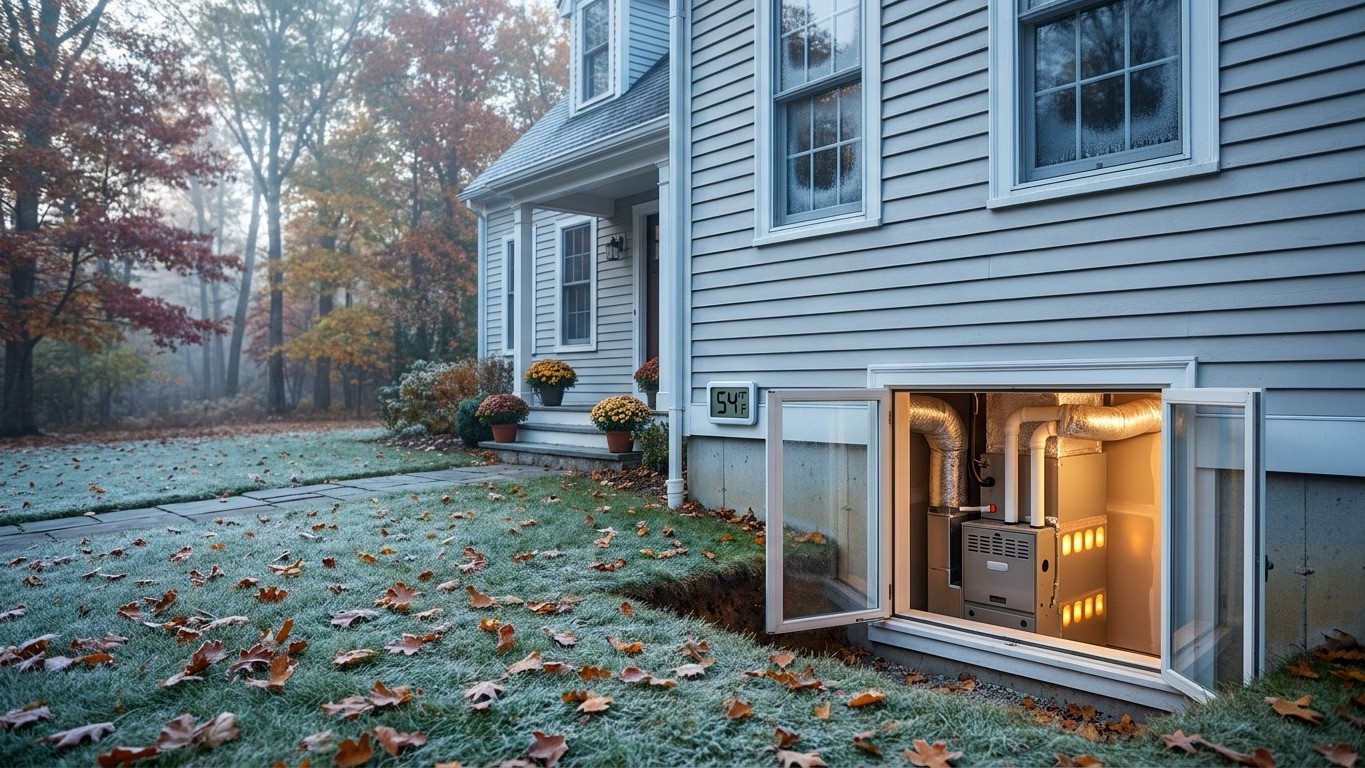

Most Massachusetts homes start heating in October, when the statewide reference station at Boston Logan sees its normal mean temperature drop to 54.8 F, below the 65 F line used to count heating degree days. The season runs about eight months, peaking in January, and doesn’t fully release its grip until June.
When the heating season starts in Massachusetts
October is the month the numbers turn. At Boston Logan International Airport, the National Oceanic and Atmospheric Administration’s 1991-2020 Climate Normals show the average mean temperature slipping to 54.8 F that month, the first time since spring it falls below the 65 F base NOAA itself uses to calculate heating degree days. That’s the mechanism behind “heating season starts in October” — it isn’t a rule anyone invented, it’s just the point where the math flips from cooling to heating.
January carries the heaviest load, with 1,086 heating degree days in the thirty-year normal, the coldest month in that record. The season stretches across roughly eight months before the mean climbs back above 65 F in June. None of this means the furnace waits politely for October 1. A monthly normal is an average smoothed over three decades of Octobers; some years bring a hard frost in the third week of September, others coast into November on a warm spell. Treat the month as a planning window, not a start date.
Monthly heating degree days at Boston Logan
| Month | Heating Degree Days |
|---|---|
| January | 1,086 |
| February | 930 |
| March | 828 |
| April | 496 |
| May | 234 |
| June | 50 |
| July | 4 |
| August | 5 |
| September | 71 |
| October | 326 |
| November | 608 |
| December | 908 |
Read this table as a shape, not a checklist. It shows a state where demand builds gradually through fall, holds hard through the depth of winter, and tapers off slower than it arrived — March still logs 828 degree days, nearly as much as November. That long, cold middle stretch is what a Massachusetts winter feels like from a furnace’s point of view.
How hard the winter works here
Boston Logan averages about 5,545 heating degree days a year on the 65 F base, against roughly 802 cooling degree days. That lopsided ratio, nearly seven heating days for every cooling day, tells you this is a heating-dominated climate where the furnace or boiler does most of the annual work and the air conditioner is a summer sideline.
Degree days work as a rough stand-in for fuel use: a winter with twice the degree days of another asks a similar house for roughly twice the fuel to hold the same indoor temperature. The number by itself doesn’t say whether a season is long and mild or short and brutal — two places can post the same annual total by very different routes. The monthly table above answers that question for Massachusetts: it’s not a single brutal month driving the total, it’s a long, steady run from October through April with January as the peak.
That steadiness matters for how a house is used, not just how it’s built. A furnace here isn’t cycling on for a few frigid weeks and shutting down — it’s expected to run, at some level, for the better part of two-thirds of the year. Equipment gets more wear, filters clog faster, and small inefficiencies compound over more months than in a climate with a shorter, sharper winter.
What most homes in Massachusetts actually heat with
The U.S. Energy Information Administration’s Residential Energy Consumption Survey shows a state built around two main systems, split fairly evenly between forced air and hydronic heat.
| System / Fuel | Share of Homes |
|---|---|
| Furnace | 55% |
| Steam or hot-water boiler | 26% |
| Central heat pump | 2% |
| Natural gas (fuel) | 53% |
| Fuel oil or kerosene (fuel) | 24% |
| Electricity (fuel) | 17% |
| Propane (fuel) | 3% |
The furnace’s dominant share doesn’t make it the right choice for every house; it mostly reflects what fuel was cheap and what technology was standard when Massachusetts’s housing stock went up. A triple-decker wired for steam heat in 1920 was never going to get a heat pump retrofit by default, and that history still shows up in today’s numbers.
A forced-air furnace heats a room fast and pairs easily with central air conditioning, but it depends entirely on a duct network that’s easy to ignore and expensive to fix once it’s failing. The one maintenance item that gets skipped most often, and punishes homeowners hardest, is the air filter: a clogged filter starves the system of airflow, forces the blower to work harder, and can shorten the life of the whole unit. The quarter of Massachusetts homes running steam or hot-water boilers face a different set of quirks — radiators that need bleeding, and a system that reacts slowly to a thermostat change, for better or worse.
Run it once before you need it
Every furnace and boiler in Massachusetts fails on the same schedule: the first genuinely cold night, when every HVAC technician within fifty miles is already booked solid. The fix is to run the system, on purpose, weeks before that night arrives — sometime in October, while the phones are still quiet.
- Turn it on for a short cycle and listen. Run the system for ten or fifteen minutes and pay attention to grinding, rattling, or a burner that won’t catch cleanly. Odd noises are the cheapest diagnostic you’ll ever get.
- Expect a burnt-dust smell on first firing. A summer’s worth of dust settling on the heat exchanger burns off in the first few minutes and produces a faint smell that fades on its own. It’s normal once, at the start of the season, not every time the system kicks on afterward.
- Check the filter. A furnace filter clogged with a summer of dust chokes airflow before the season even starts; swap it now rather than mid-January.
- Clear the space around vents, radiators, or the outdoor heat pump unit. Furniture pushed against a vent, or a bike leaning on a radiator, blocks the very airflow the system is trying to deliver.
- Test the carbon monoxide alarm. Any fuel-burning furnace or boiler can produce carbon monoxide if it malfunctions, and a working alarm is the one safeguard that costs nothing to check. Press the test button, confirm it sounds, and move on.
- Know when to stop and call a professional. Persistent odd smells, a system that won’t stay lit, or visible damage around the unit are signs to bring in a technician before the cold snap, not during it.
Even a furnace that passes every check on this list can still lose a startling share of its output before it ever reaches a room. As the U.S. Department of Energy puts it, “in a typical house, about 20%-30% of the air that moves through the duct system is lost due to leaks, holes, and poorly connected ducts.” That’s air conditioned at real cost, leaking into a basement or attic instead of a living room, and it’s a separate problem from anything a filter change or a thermostat setting can fix.
What turning it down is actually worth
The Department of Energy is specific about what a thermostat setback buys you: “You can save as much as 10% a year on heating and cooling by simply turning your thermostat back 7-10 F for 8 hours a day from its normal setting.” That’s a yearly figure, tied to a specific setback and a specific number of hours, not a per-degree rule that scales up or down with how far you turn the dial.
In a state where the furnace or boiler is doing real work for roughly eight months of the year, that setback has a lot more hours to act on than it would in a climate with a six-week winter. A programmed pullback overnight or during a workday in Massachusetts is working against a longer stretch of cold months than in most of the country, which is exactly why the habit is worth building before the season, not after the first heating bill arrives.