
Yes, insulation keeps a Massachusetts home cooler, but the state’s summer is short by national standards. Boston averages just 10.2 days a year above 90°F, and the whole state sits in a cold-dominated climate zone. That changes the math: insulation still matters for July afternoons, but winter heating is where the bigger savings live.
The short answer for Massachusetts

Ten days. That’s roughly what the Boston reference station logs each year at 90°F or hotter, based on the 1991-2020 NOAA Climate Normals. Compare that to a Gulf Coast city with two or three months of triple-digit heat index days, and the picture is clear: Massachusetts summers are real, but they’re brief. A handful of hot stretches, usually clustered in July and early August, rather than a season-long siege.
That number matters because it tells you where to put your attention and your money. The entire state falls under IECC climate zone 5A, a single designation with no county exceptions. That’s a rare bit of simplicity, most states split into three or four zones depending on which county you’re in, and homeowners have to hunt down a map to figure out which row of a table applies to them. Massachusetts residents skip that step entirely. Zone 5A is a cold, moist climate, and it drives the same insulation targets whether you’re in Berkshire County or on Cape Cod.
What that zone designation really signals is a heating-dominated climate with a modest cooling season layered on top. In a place like this, insulation’s primary job, measured in dollars, is keeping furnace and heat pump costs down from November through March. But the same barrier that blocks heat loss in January blocks heat gain in July. So the honest framing isn’t “insulation doesn’t matter for summer here.” It’s “insulation matters here mostly for winter, and the summer benefit comes along for free.”
If you own a home with a hot, stuffy second floor during those ten-or-so scorcher days, insulation is still a legitimate fix, and often the cheapest one available compared to upsizing air conditioning equipment. But don’t expect it to transform a Massachusetts summer the way it would in a state where 90-degree days number in the hundreds. The return on investment here is real, just distributed differently across the calendar than in a warmer state.
What happens above the ceiling
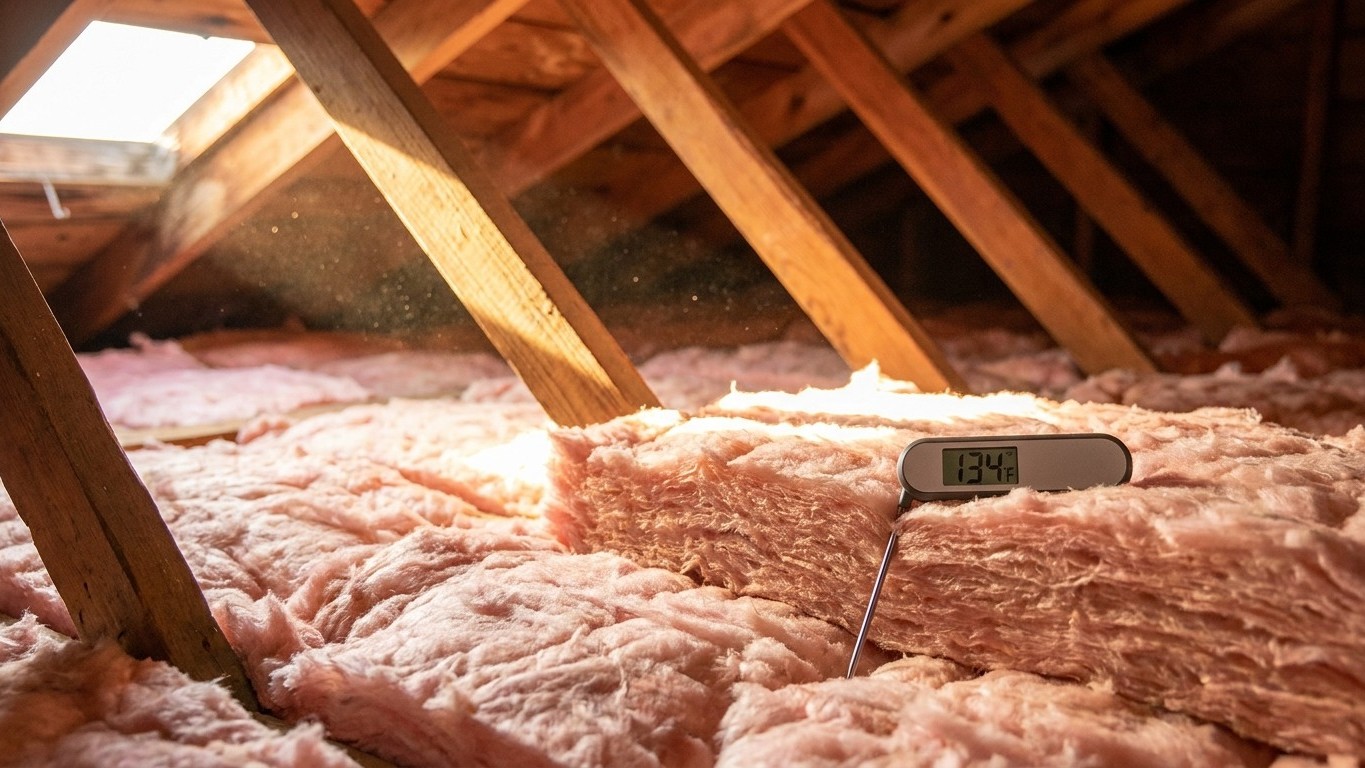
On a sunny July afternoon, an asphalt shingle roof deck can heat up to well over 140°F, even when the outdoor air temperature is a comfortable 85°F. That superheated roof deck radiates and conducts heat directly into the attic space below it, and an uninsulated or under-insulated attic can easily hit 130°F to 150°F inside. Everything under that attic floor, the ceiling drywall, any ductwork running through the space, boxes of holiday decorations, sits baking under that heat load all day.
Here’s the part that surprises a lot of homeowners: the insulation doing that job is the exact same material recommended for winter. There’s no separate “summer insulation” product. Fiberglass batts, blown cellulose, spray foam, they all work by resisting the flow of heat, and heat flow doesn’t care which direction it’s moving. In January, warm air inside the house tries to escape upward into a cold attic. In July, that flow reverses, and scorching attic heat tries to push down into the living space. The R-value of your attic insulation resists both.
That’s why sealing and insulating an attic is often called the single improvement that pays off in both seasons at once. You’re not choosing between a winter upgrade and a summer upgrade. It’s one job, done once, that quietly works year-round.
What ENERGY STAR recommends for Zone 5A
ENERGY STAR’s retrofit guidance for existing wood-framed homes groups Massachusetts under the row covering “Zones 6, 5 and 4C.” For that row, the recommended attic insulation level is R60 if the attic is currently uninsulated, or R49 if it already has 3 to 4 inches of existing insulation. The floor insulation target for the same zone grouping is R30. These are the ENERGY STAR figures for retrofitting an existing home, not new-construction code minimums, and they apply to attic and floor assemblies specifically, not to walls.
Since the whole state shares one climate zone, this is the row that applies statewide, no county lookup required. That’s one less thing to figure out before starting a project.
What homes in Massachusetts cool with
Central air isn’t the default cooling method in most Massachusetts homes, at least not according to the U.S. Energy Information Administration’s 2020 Residential Energy Consumption Survey. Air conditioning of some kind reaches 87% of homes surveyed in the state, but only 32% of homes run a central air-conditioning system. The rest, a larger share at 58%, rely on individual equipment: window units, wall units, ductless mini-splits, or portable air conditioners. Half of homes surveyed also use ceiling fans to help manage comfort without running compressors as hard.
Those percentages describe households surveyed, not every house standing in the state, and the gap between “has air conditioning” and “has central air” is where the real story sits. In a state with a short, punchy cooling season and a lot of older housing stock, it often makes more financial sense to cool one or two rooms with a mini-split or window unit than to duct and condition an entire house for ten hot days a year.
That equipment mix changes how insulation connects to cooling comfort. In a home where central air ductwork runs through the attic, those ducts sit inside the hottest space in the building, often 130°F or more during a heat spell. Ceiling insulation does nothing to protect ducts that are already inside the attic; sealing and insulating the ducts themselves is a separate project, and worth pursuing if that’s your setup. Readers dealing with attic ductwork should look at the duct insulation guides on this site for that specific fix.
For the majority relying on window units, wall units, or mini-splits, the insulation that matters most is the envelope of the room being cooled, not the whole-house attic system. A mini-split working against a poorly insulated wall or an uninsulated ceiling above it is fighting a losing battle no matter how efficient the unit is rated. Readers running that kind of equipment should check the room air conditioner guides on this site for equipment-specific advice.
What the heat asks for that the cold does not
Two tools show up specifically in hot-climate conversations, and neither one is standard-issue for a state built around a cold winter.
- Radiant barriers reflect radiant heat rather than resisting conducted heat the way traditional insulation does. A radiant barrier carries no R-value of its own, and it isn’t a substitute for attic insulation. It earns its keep specifically under a sun-loaded roof deck in a climate with long, intense cooling seasons, think Arizona or Florida, where attic temperatures climb for months, not days.
- Vapor movement reverses direction in summer. In a hot, humid climate, moisture in the air pushes from outside toward the cooler indoor space, which is why the model energy code doesn’t require an interior vapor retarder in its warmest zones. Massachusetts, sitting in a cold zone, follows different vapor logic tied to its winter heating season instead. That’s a separate, more detailed question, and it’s covered on this site’s vapor barrier page for Massachusetts rather than settled here.
Given a summer measured in roughly ten hot days a year, a radiant barrier isn’t the priority purchase for a Massachusetts attic. That’s a tool built for a much longer, much hotter cooling season. The dollars here are better spent hitting the ENERGY STAR attic and floor targets already listed above, insulation that earns its cost back across a genuinely cold winter and takes the edge off the handful of scorchers in between.
What the work is worth
ENERGY STAR’s own estimate frames the payoff plainly: “EPA estimates that homeowners can save an average of 15% on heating and cooling costs (or an average of 11% on total energy costs) by air sealing their homes and adding insulation in attics, floors over crawl spaces, and accessible basement rim joists.”
Both numbers matter, and they’re not interchangeable. The 15% applies specifically to combined heating and cooling costs, not the whole utility bill. The 11% applies to total energy costs, a broader category that includes everything from water heating to appliances and lighting. Quoting one figure without its denominator turns an accurate number into a misleading one.
The reason this figure fits a Massachusetts home so well is built into how it’s worded: it covers heating and cooling together, not one season in isolation. That’s the whole point of thinking about insulation as a year-round investment rather than a seasonal one. A homeowner insulating an attic in Massachusetts isn’t buying a winter fix that happens to help in summer, or a summer fix with a winter side effect. It’s one improvement, modeled across both halves of the year at once.
Two caveats worth keeping in mind. First, these are averages drawn from energy modeling of a “typical” existing U.S. home, not a guarantee for any specific house, including one in Massachusetts with its own age, layout, and existing insulation levels. Second, the estimate covers work done in attics, floors over crawl spaces, and accessible basement rim joists specifically. It doesn’t extend to wall insulation, window replacement, or door upgrades, those are separate projects with their own separate math.