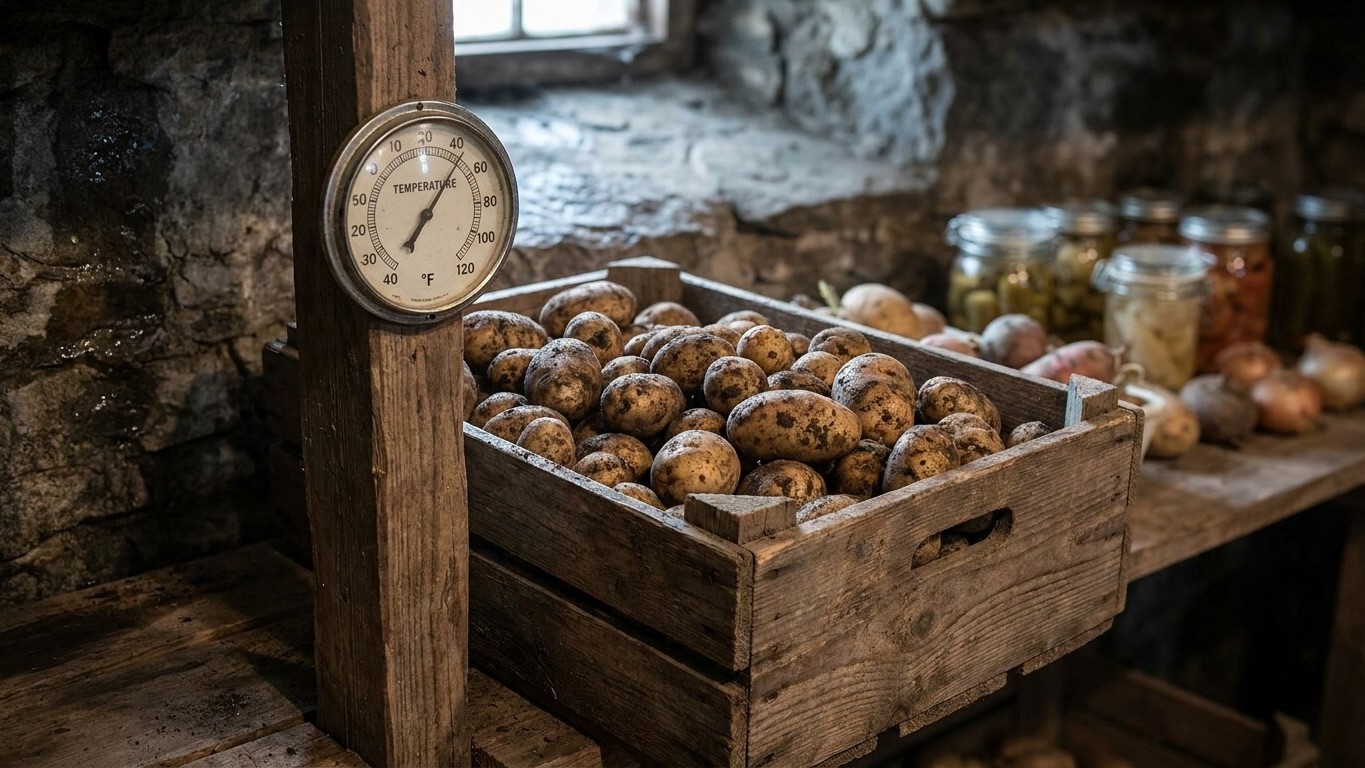

Arkansas gardeners dig their potatoes before the first fall frost, which arrives statewide between November 7 and November 20. After that, the crop needs curing in a cool, humid spot for two to three weeks, then storage somewhere dark that holds 40-45 F. The tricky part in this state isn’t the digging. It’s finding a space that stays cold enough in January without ever freezing.
The short answer
Two numbers frame everything about growing and keeping potatoes in Arkansas. The first fall frost lands somewhere between November 7 and November 20, according to NOAA NCEI’s 1991-2020 Climate Normals for station USW00013963. The second is the mean daily minimum temperature of the state’s coldest month: 30.9 F, per NOAA NCEI Climate Normals referenced to Little Rock. That’s not a record low. It’s the average low on a typical night in the depth of winter, and it’s the figure that decides whether a storage space works.
Put those together and the picture is clear. Potatoes come out of the ground sometime in the weeks leading up to that November frost window, while the soil is still workable and before hard cold sets in. What happens after harvest is where Arkansas growers run into trouble. A mean minimum of 30.9 F means that on an average night in the coldest stretch of winter, an uninsulated, unheated structure in this state will sit right at or below freezing. Not every night, but often enough that potatoes left in a bare garden shed or an open carport are gambling with frost damage for weeks at a stretch.
That number also rules out the opposite failure. Storage needs 40-45 F, and a fully unheated space in Arkansas’s coldest month won’t reliably sit that high either. It’ll swing below it on cold nights and possibly climb well above it on a mild afternoon, since Arkansas winters aren’t steady the way a walk-in cooler is. So neither “just leave them in the garage” nor “keep them in a warm mudroom” solves the problem on its own. The space that works is one with enough mass or insulation to buffer both directions: a basement, a partially below-grade room, or an insulated structure with some supplemental heat on the coldest nights. Open-air, single-wall outbuildings are the ones that fail here, not because Arkansas winters are brutal, but because they’re inconsistent enough to swing past both edges of the safe range in the same week.
Curing, and where
Curing is the step that toughens potato skins and heals over any nicks from digging, and it has a narrow target: 55-60 F with high humidity, held for two to three weeks, according to Utah State University Extension. In Arkansas, that window falls in the weeks before the first fall frost, when daytime air is often still mild and can run warmer than 60 F, especially early in that harvest stretch. Finding 55-60 F outdoors on a sunny Arkansas afternoon in late October or early November isn’t guaranteed, which is why the location Matters More Than the calendar here.
- Dig potatoes on a dry day, once the soil has had a chance to firm back up after the last watering, and brush off loose dirt without washing the tubers.
- Move them out of direct sun immediately. A shaded porch, breezeway, or the north side of a garage keeps them out of the afternoon heat that can push past the 60 F ceiling.
- Check the space with a thermometer over a day or two before committing the whole harvest to it. An attached but unheated garage often lands closer to 55-60 F than a detached one in early fall, since it borrows some warmth from the house.
- Spread the tubers in a single layer, or in shallow crates, so air moves around them rather than trapping moisture against the skin.
- Hold humidity high by covering loosely with burlap or damp cloth rather than plastic, which traps too much moisture and invites rot.
- Leave them undisturbed for two to three weeks, checking periodically that the space hasn’t crept above 60 F on unseasonably warm days or dropped sharply if an early cold snap arrives ahead of the average frost window.
A basement can work too, but many Arkansas basements run warmer than 60 F in early fall since they hold onto summer heat longer than the outside air does. Cracking a window or door for airflow during curing week can pull that number down into range.
Storing through this winter
Once cured, potatoes want a dark space at 40-45 F, per Utah State University Extension, or 38 F at 95 percent humidity, according to the University of Maine Cooperative Extension. Arkansas’s coldest month averages a nightly minimum of 30.9 F, which sits well below both of those targets. That gap is the whole story of winter potato storage in this state: the outdoors gets colder than potatoes want, but indoor, heated spaces usually run warmer than they want. Neither extreme is the answer.
A basement or root cellar-style space tends to be the best fit, since below-grade areas are insulated by the surrounding soil and don’t track the outdoor swings the way an aboveground shed does. Many Arkansas basements settle somewhere in the 45-55 F range through winter without any heat source at all, which is close enough to the 40-45 F target that a small adjustment, like cracking a window on milder days, can bring it into range. An insulated garage with no direct heat is the harder case: it may hold reasonably steady through a mild stretch, then drop toward that 30.9 F average minimum during a hard cold snap, which is low enough to injure tubers if it lingers.
Freezing is the failure that’s easy to overlook because it doesn’t always look dramatic. Potatoes held below freezing develop a sweetish, watery texture and often turn dark when cooked, and there’s no reversing that once it happens. On the other end, any space that stays above roughly 45-50 F for weeks will encourage sprouting, softening the tubers and shortening how long they’ll keep. The safest approach in Arkansas is to check the storage space with a thermometer at least weekly through the coldest months, since the swing between a mild January afternoon and a hard freeze overnight can be wide enough to cross both thresholds in the same week.
What goes wrong here
- Digging into wet, warm soil. Arkansas falls can bring humid stretches right up to frost, and lifting potatoes from damp ground leaves skins soft and prone to rot before curing even starts. Wait for a dry day and let the soil surface firm up first.
- Curing in air that’s too warm. Early fall afternoons here can still push past the 55-60 F range Utah State University Extension recommends, softening skins instead of toughening them. Move the harvest to shade, or into an attached garage, and check the temperature rather than assuming it’s cool enough because summer has technically ended.
- Storage that freezes overnight. With the coldest month averaging a 30.9 F nightly minimum, an uninsulated shed or detached, unheated garage will dip below freezing on a normal winter night, not just an unusual one. Move stored potatoes to a basement or insulated space before the first hard cold snap, not after.
- Storage that stays too warm. A heated mudroom or an insulated but climate-controlled garage often sits well above 45 F all winter, and potatoes respond by sprouting early. If the space feels comfortable to stand in for long stretches, it’s too warm for the tubers.
- Fungal and pest pressure from humid soil. Arkansas’s humidity can carry disease pressure into the growing season; where that risk shows up, an appropriate fungicide or appropriate insecticide, applied as labeled, is the standard response, separate from anything done at harvest or in storage.
Common questions
When should I dig potatoes in Arkansas?
Aim to have the crop out of the ground before the first fall frost, which falls between November 7 and November 20 across the state. Digging earlier, on a dry day, gives skins more time to set before that cold arrives.
Can I store potatoes in an unheated garage all winter?
Only if the garage is insulated enough to stay above freezing on cold nights. Arkansas’s coldest month averages a nightly minimum of 30.9 F, which means a bare, single-wall garage will likely dip below freezing repeatedly through winter, damaging stored tubers.
What temperature is too warm for potato storage?
Utah State University Extension puts the storage target at 40-45 F. Anything consistently warmer than that, such as a heated basement or mudroom, tends to trigger sprouting well before the storage season is over.
How long does curing take before storage?
Two to three weeks at 55-60 F with high humidity, per Utah State University Extension. In Arkansas, that stretch usually falls in the weeks leading up to the first fall frost, so a shaded porch or attached garage checked with a thermometer is often the most reliable spot to hit that range.