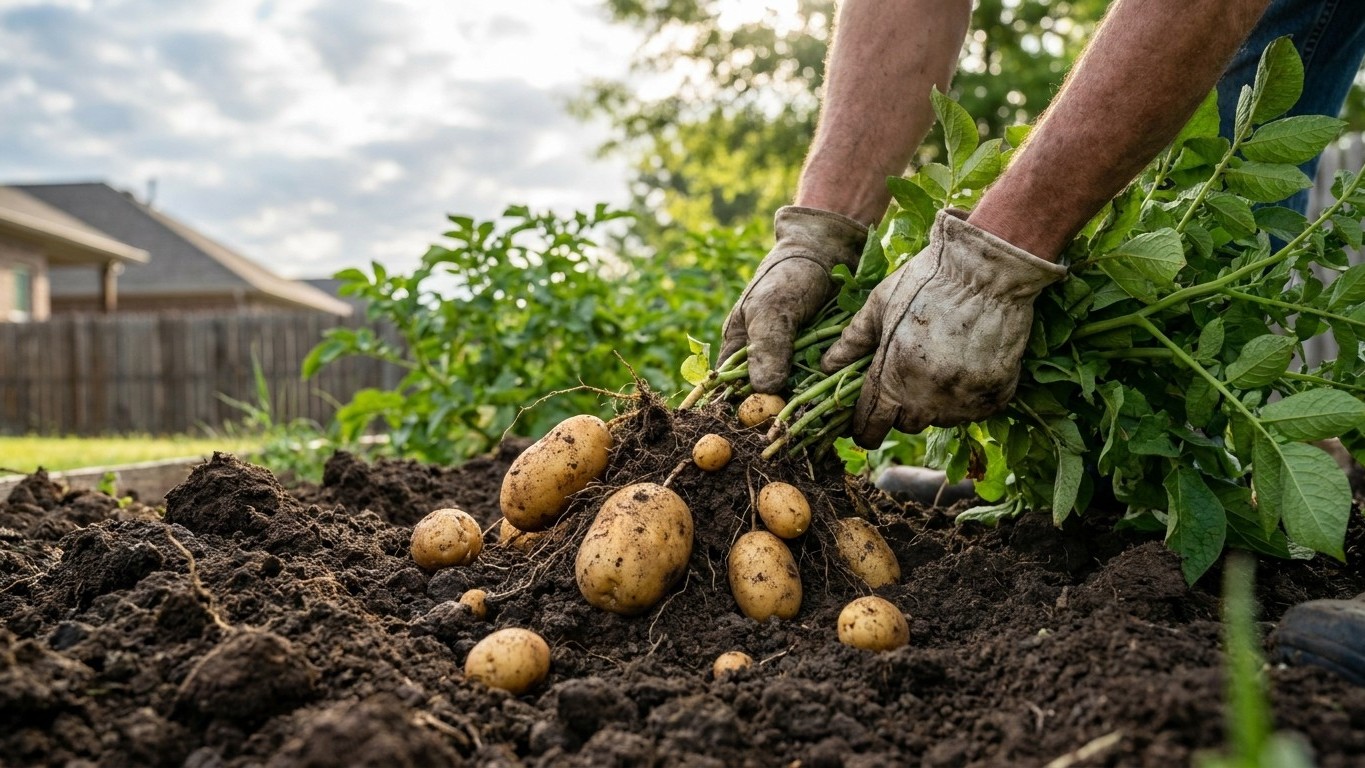

Arkansas summers cross 90°F on 69.2 days a year at the Little Rock reference station, well past the point where potato tubers stop sizing. The state’s last spring frost falls between March 12 and March 28. Put those two numbers together and the answer is straightforward: plant early, dig before the heat locks in, and treat this as a spring crop rather than a season-long one.
The short answer

Sixty-nine point two days a year at 90°F or above, at the Little Rock reference station, according to NOAA NCEI Climate Normals covering 1991-2020. That figure matters because Utah State University Extension identifies 90°F soil as the ceiling above which tuber set and fill are inhibited. Arkansas doesn’t cross that line once or twice a summer. It crosses it, on average, more than 69 times a year, usually clustered from June through August. That’s the entire premise a gardener here has to plan around.
The last spring frost window at the Little Rock reference station runs from March 12 to March 28, per the same NOAA NCEI dataset (station USW00013963). That gives a planting target early enough that the crop can bulk up in the cooler weeks of April and May, before the heat load climbs past the point where tubers stop sizing. For a closer look at When to Plant Potatoes in Arkansas, a spring-planted crop, dug in June before the worst of the summer heat sets in, works with Arkansas’s climate. A crop planted late, or left in the ground hoping for a second flush of growth in July or August, runs straight into the ceiling Utah State describes.
Variety choice follows from that timing, not the other way around. Utah State University Extension and University of Maine Cooperative Extension both classify potatoes by season length, early, mid-season, or late, and by end use, some suited to baking, some better for boiling and salads, rather than by an exact number of days to maturity. In Arkansas, an early-season variety gives the crop the best chance of sizing before soil temperatures climb into the danger zone. For a rundown of Potato Varieties That Suit Arkansas, a late-season type, the kind bred for long storage, is a harder fit here unless it goes in the ground at the very front edge of the planting window and comes out before the June heat builds.
What this means for the calendar
None of this requires guessing. The frost data and the heat-day count are both measured, both sourced, and both point the same direction: get the crop in the ground as early as the soil allows, and get it out before the 90°F days start stacking up. Everything else, hilling, watering, seed selection, supports that one decision, and the same logic carries through to Harvesting and Storing Potatoes in Arkansas once the crop is ready to come out of the ground.
When to plant here
The planting date isn’t picked from a calendar. It’s counted backward from two fixed points: the last spring frost window and the soil temperature threshold Utah State University Extension and University of Maine Cooperative Extension both use, 50°F. Here’s how the arithmetic works for Arkansas, and how to redo it for a different county.
- Start with the last spring frost window for the reference station: March 12 to March 28, per NOAA NCEI 1991-2020 Climate Normals.
- Potatoes go into the ground once soil temperature reaches 50°F, not once the air feels warm, per Utah State University Extension.
- That 50°F soil point arrives 14 to 21 days before the last frost date, according to the same source.
- Subtract 21 days from the early end of the frost window (March 12) and 14 days from the late end (March 28): that gives a planting range running from roughly late February to mid-March for the Little Rock reference area.
- Check actual soil temperature before planting rather than relying on the date alone. A cold, wet spring can push the 50°F mark later than the arithmetic suggests.
That range isn’t a guess dressed up as a formula. It’s the same subtraction any gardener can run for their own county once they know their local last-frost window, which is why the next section sends readers to a county-level extension office rather than asking them to apply Little Rock’s dates statewide.
What the heat does to the crop
The mechanism is simple and it doesn’t bend to good watering or careful mulching. Utah State University Extension states that tuber set and fill are inhibited by high temperatures, specifically soils above 90°F. Below that threshold, the plant is putting energy into growing tubers underground. Above it, that process slows or stops, regardless of how much water the plant is getting above ground. A well-irrigated potato patch sitting in 90°F-plus soil is not a healthy crop quietly waiting out the heat. It’s a crop that has already stopped sizing.
In Arkansas, that ceiling gets crossed often. The Little Rock reference station averages 69.2 days a year at 90°F or above, and soil temperature tends to track close behind air temperature once summer settles in. That’s not a one-week heat spike a gardener can water through. It’s a sustained stretch, typically running from early summer into late summer, during which soil at typical planting depth stays too hot for the tuber-forming process to keep working.
What that means in practice: Arkansas is a spring-crop state, not a full-season one. Potatoes planted at the front edge of the late-February-to-mid-March window get their bulking-up period in April and May, when soil temperatures sit well under 90°F, and come out of the ground before the heat load stacks up in June. A crop planted later, or one a gardener tries to stretch into July hoping for extra size, is fighting the same ceiling that stops the process outright. No amount of irrigation moves that number. The fix is timing, not water.
What goes wrong here
- Uncertified seed potatoes. Seed that isn’t certified disease-free can carry viruses invisibly, and there’s no cure once a plant is infected. Buying certified seed potatoes each season, rather than saving grocery-store potatoes or last year’s small tubers, is the one step that prevents a virus problem from ever starting.
- Planting into cold, wet soil before it reaches 50°F. Seed pieces sitting in cold, waterlogged soil rot before they sprout instead of growing. Wait for the soil itself, not the calendar or the air temperature, to hit 50°F.
- Skipping the hilling and ending up with green tubers. Tubers that push up near the surface and get exposed to sunlight turn green and develop solanine, which makes them unsafe to eat. Mounding soil over the row as the plants grow keeps developing tubers covered and out of the light.
- Digging too early, before the plant has finished bulking the tubers. Pulling potatoes at the first sign of summer heat, out of worry rather than observation, cuts the crop short before it’s sized up. Watch the foliage: once it yellows and begins dying back on its own, the tubers underneath have stopped growing and it’s time to dig, not before.
Checking this against your own county
A statewide window built on the Little Rock reference station is a starting point, not an instruction sheet for every county. Elevation changes soil warming speed, and Arkansas runs from Delta lowlands in the east to Ozark and Ouachita elevation in the north and west, a spread that can shift a planting window by two or three weeks in either direction. A county in the warmer south of the state may see its 50°F soil mark, and its last frost, well ahead of Little Rock’s dates. A higher-elevation county in the north can trail behind by the same margin.
The fix isn’t to guess at an adjustment. It’s to check soil temperature locally and confirm the local frost window with the University of Arkansas Cooperative Extension Service, reachable at uaex.uada.edu, before finalizing a planting date. County agents there track local frost data and soil conditions that a single reference station can’t capture.
Common questions
Can Arkansas gardeners grow a fall potato crop instead of a spring one?
The sourced material here covers spring planting timed to the 50°F soil mark and the last frost window. It doesn’t publish a fall-planting date for Arkansas, so that’s not a figure to invent. What is clear from the heat-ceiling mechanism is that any planting has to land in a stretch where soil stays under 90°F long enough for tubers to size, whether that stretch falls in spring or later in the year.
Does more frequent watering offset the 90°F soil ceiling?
No. Utah State University Extension attributes the slowdown in tuber set and fill directly to soil temperature above 90°F, not to soil moisture. A well-watered plant sitting in soil above that threshold is still past the point where sizing continues normally.
How do I know which variety season class fits my planting window?
Match the season class to how much cool weather is available before the heat load builds. In Arkansas’s late-February-to-mid-March planting range, an early-season variety has the best chance of finishing its bulking-up period before soil temperatures climb toward 90°F for the summer.
What’s the difference between hilling for yield and hilling to prevent green tubers?
They’re the same action with two benefits. Mounding soil over the row keeps developing tubers covered, which both gives them more room to size and blocks the sunlight exposure that turns exposed tubers green and produces solanine, making them unsafe to eat.