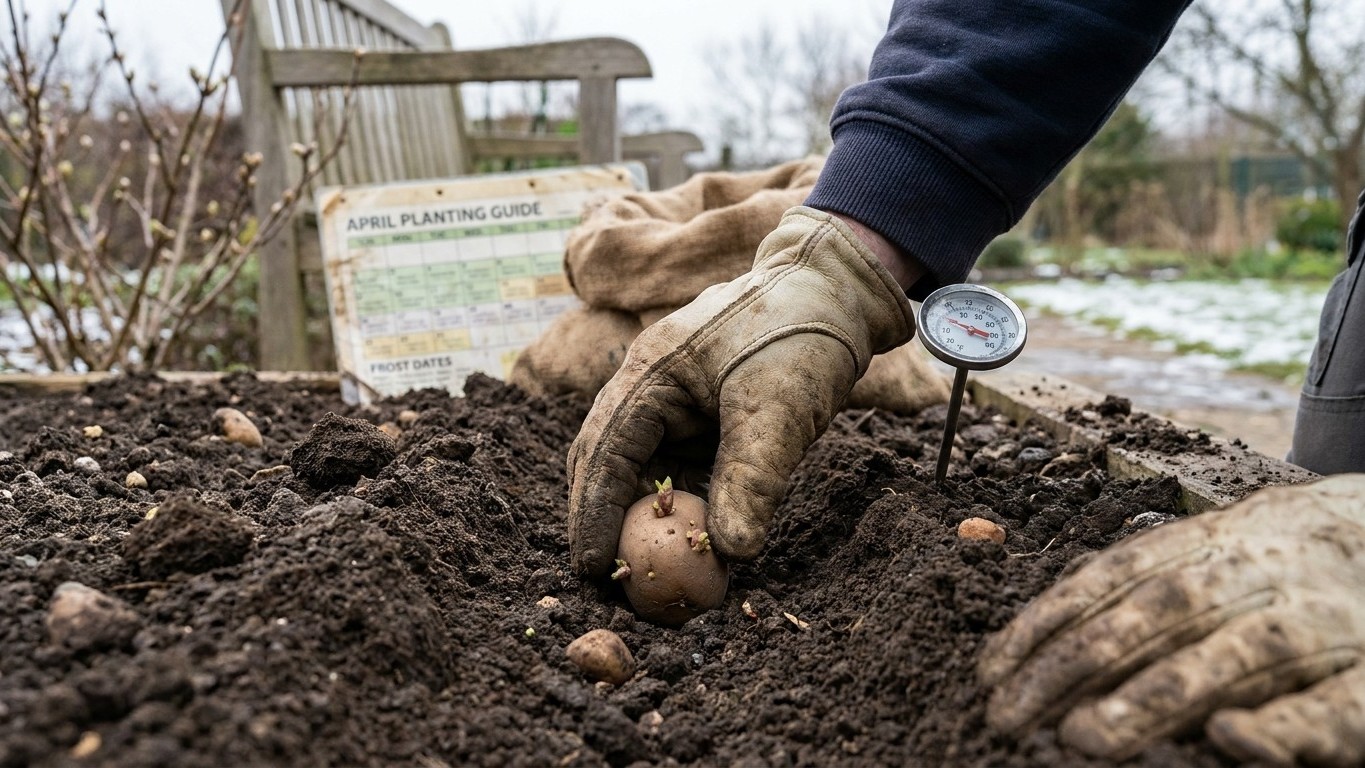

Plant Potatoes in Little Rock, Arkansas, 14 to 21 days before the last spring frost, which falls between March 12 and March 28 according to NOAA’s 1991-2020 Climate Normals for station USW00013963. Counted back, that puts seed potatoes in the ground from roughly mid-February through mid-March, whenever soil temperature reaches 50°F. The calendar is a starting point. Soil temperature is what actually triggers the shovel.
The short answer
NOAA’s 1991-2020 Climate Normals for station USW00013963, the reference point for the Little Rock area, place the last 32°F freeze somewhere between March 12 and March 28. That’s a 16-day spread, which Matters More Than it looks: a gardener working off a single “average” date can end up planting two weeks earlier or later than a neighbor doing the same math from a different year’s memory. The normals give a band, not a day.
Utah State University Extension and the University of Maine Cooperative Extension (Bulletin #2077) both describe the same planting rule for potatoes: get seed pieces into the ground as soon as soil reaches 50°F, which lands 14 to 21 days ahead of that last frost date. Applied to the Little Rock window, that means counting back from March 12 gives a planting date around February 19. Counting back from March 28 gives a planting date around March 14. Most years fall somewhere between those two.
Why plant before the frost has cleared at all? Because potatoes aren’t planted as a growing plant. The seed piece sits several inches under the soil surface, insulated from the light frosts that would kill a pepper seedling or a tomato transplant outright. By the time the first shoots break the surface, the worst of the frost risk has usually passed, or the plant can tolerate a light nip and keep growing. That’s the built-in buffer that lets potatoes go in the ground while air frost is still a real possibility.
One caution worth separating out clearly: the National Weather Service office covering Little Rock publishes a different threshold, a 36°F light-frost date, and gives it as April 3 in spring. That number belongs to tender plants like tomatoes and squash, not to potatoes. If you’re using this page to plan a mixed garden, don’t borrow the potato timing for anything that can’t handle soil below 50°F or a stray frost on exposed leaves. The two thresholds answer two different questions, and mixing them up is the single easiest way to either freeze a tomato transplant or leave your potato ground sitting idle for an extra three weeks it didn’t need.
What actually decides it
Soil temperature, not air temperature
The 50°F soil threshold is doing the real work in this whole calculation. Air temperature swings by 20 degrees or more in a single day; soil temperature moves slowly, which is exactly why it’s the more reliable trigger. A stretch of warm afternoons in early March can push air readings into the 70s while the ground four inches down is still sitting at 45°F. Plant on the air reading and the seed piece rots before it sprouts. That’s the mechanism a frost date alone can’t tell you: two properties on the same street, one with heavy clay and one with sandy loam, can hit 50°F soil a week or more apart even under identical air temperatures, because clay holds cold longer than sandy ground warms.
The 90°F ceiling that ends tuber sizing
The other end of the season has its own hard limit, and it’s the one home gardeners underestimate most. Utah State University Extension and the University of Maine Cooperative Extension both note that once soil temperatures climb above 90°F, tuber set and tuber fill are inhibited. That’s not a slowdown that more water fixes. It’s a biological stop sign: the plant keeps growing top growth, but the tubers underground quit sizing up regardless of irrigation. This is the mechanism that should decide how a gardener in a hot part of Arkansas plans the whole season, more than any single frost date does. Where summer soil temperatures reliably climb past that ceiling, the answer isn’t to baby a crop through July and August. It’s to plant as early as the 50°F floor allows and treat the harvest as a spring crop that finishes before the ceiling arrives, rather than a summer-long project.
Put the two mechanisms together and the planting window isn’t really about the frost date at all. It’s the gap between the day soil clears 50°F and the day it’s likely to cross 90°F. In a year with a late, cool spring, that gap opens later and closes earlier, compressing the whole crop. In a year with a fast warm-up, the window opens wide. That’s the reasoning a gardener needs even for a location or a year this page never covers directly.
How to do it
- Source certified seed potatoes rather than table potatoes from a grocery store or bin from last year’s harvest. Certified seed is checked for virus; uncertified seed carries it forward silently and spreads it through the row, and there’s no way to see the infection just by looking at the tuber.
- Check soil temperature directly with a soil thermometer pushed a few inches into the planting bed, rather than relying on air temperature or the calendar alone, since the two can diverge by weeks depending on soil type and drainage.
- Once soil reads at or near 50°F, count forward: this is your planting window, and per Utah State University Extension and the University of Maine Cooperative Extension it typically lands 14 to 21 days before the local last frost date, which for the Little Rock area falls between March 12 and March 28.
- Cut seed potatoes into pieces, each with at least one healthy eye, and allow the cut surfaces to callus over for a day or two before planting, which reduces rot risk in cool spring soil.
- Plant seed pieces into the prepared bed at a consistent depth and spacing, cut side down, eye side up.
- Hill soil up around the emerging shoots as the plants grow, which protects developing tubers from sun exposure and from any late, light frost that reaches the surface.
- Track the season’s soil temperature trend through summer, since crossing the 90°F mark in the root zone signals that tuber sizing has stopped regardless of watering or fertilizing.
- Plan harvest timing around the season class you planted, whether early, mid-season, or late, and pull the crop before extended heat locks in rather than waiting for a fixed date.
What goes wrong
- Planting by the calendar instead of the soil. A gardener who plants strictly on a fixed date, ignoring whether soil has actually reached 50°F, risks seed pieces sitting in cold, wet ground long enough to rot before sprouting. The remedy is simple: check the soil directly with a thermometer before digging, every season, regardless of what worked the year before.
- Using uncertified seed potatoes. Grocery-store potatoes or saved tubers from a prior harvest can carry viruses invisibly, and those viruses don’t show up until the plant is already struggling mid-season. Buying certified seed potatoes from the start avoids introducing a problem that has no in-season fix.
- Confusing the 36°F light-frost date with the potato planting window. The National Weather Service’s Little Rock office publishes that light-frost date for tender plants; applying it to potato timing either delays planting for weeks with no benefit or creates confusion about which threshold actually applies to a below-ground seed piece. Keep the two numbers separated by crop type, not by habit.
- Ignoring the 90°F soil ceiling during summer. Gardeners who keep watering through a heat spell, expecting tubers to keep sizing, are often working against a mechanism water can’t override. Once soil regularly tops 90°F, tuber fill has already stalled; the fix is timing the whole crop earlier next season rather than trying to push a summer crop through the ceiling.
- Skipping the hilling step. Exposed tubers near the soil surface catch sunlight and light frost alike, both of which damage the crop. Hilling soil up around the stems as they grow keeps developing tubers covered and shielded through the rest of the season.
Common questions
Can I plant potatoes before the last frost date in Arkansas?
Yes, and that’s the point of counting back rather than waiting. Utah State University Extension and the University of Maine Cooperative Extension both describe planting 14 to 21 days ahead of the last frost, once soil hits 50°F, because the seed piece sits underground and isn’t exposed the way a transplant’s leaves are.
What if my soil hasn’t reached 50°F by the recommended date?
Wait for the soil, not the date. The 50°F threshold from Utah State University Extension and the University of Maine Cooperative Extension is the trigger, and planting into colder ground risks rot before sprouting regardless of what the frost-date window suggests.
Does the Little Rock frost window apply to the whole state?
No. The March 12 to March 28 range comes from NOAA NCEI data for station USW00013963, which represents the Little Rock area specifically. Other parts of Arkansas, particularly higher-elevation or northern regions, will run on a different local frost timeline not covered by this figure.
Why do tubers stop growing in midsummer heat?
Once soil temperature climbs above 90°F, tuber set and fill are inhibited, according to Utah State University Extension and the University of Maine Cooperative Extension. That’s a heat-driven biological limit on the tubers themselves, not a watering problem, so irrigation during a hot stretch won’t restart sizing once the ceiling is crossed.