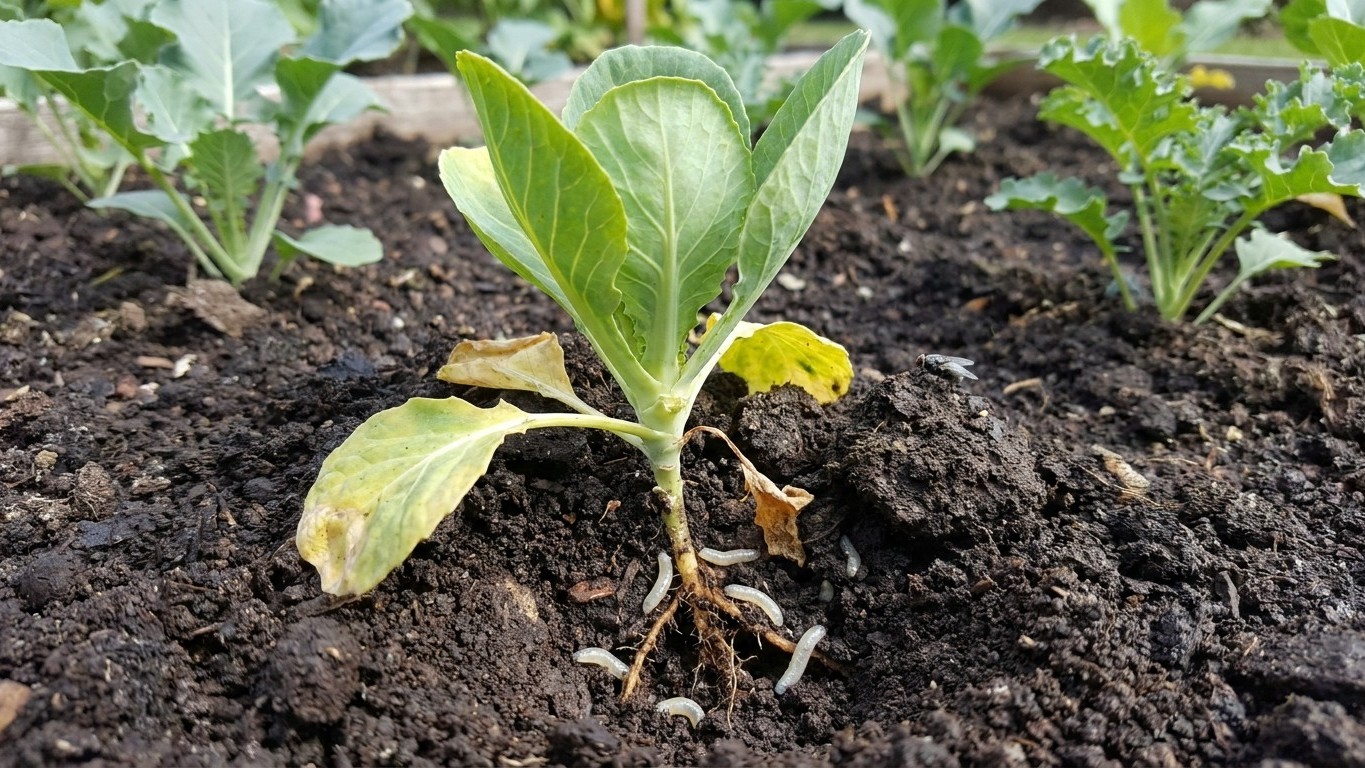

Cabbage maggot damage shows up as a wilting or stunted plant with no insect anywhere on it, because the culprit, Delia radicum, does all its feeding underground on the roots of cabbage, broccoli, kale, turnip and radish. Adults are unremarkable gray flies that cause no harm themselves. The larvae are the problem, and they work out of sight for two to three weeks before pupating in the soil. Identification, timing and control each depend on details that shift by region, which is what the rest of this cluster covers.
What it is and what it attacks

Delia radicum belongs to the same fly family as onion maggot and seedcorn maggot, and it shares their basic strategy: lay eggs at the base of a host plant and let the larvae do the damage where nothing above ground can see it. Host range covers nearly the whole brassica family. Cabbage, broccoli, cauliflower, Brussels sprouts, kale, turnip and radish are all vulnerable, and radish or turnip roots are often hit hardest since the larvae can tunnel straight through the part meant for the table. The fly is present across brassica-growing regions of North America; there is no region where it can be assumed absent, only years and locations where pressure happens to run lighter.
What makes it hard to catch early is exactly where it works. Eggs go into the soil at the stem base, not onto leaves, and the larvae never surface to feed. A grower typically sees the plant’s reaction rather than the insect itself: yellowing lower leaves, a wilt that doesn’t recover after watering, seedlings that topple at the soil line, or a plant that stunts and pulls out of the ground with almost no root system left. By the time those symptoms are obvious, the larvae have often already finished feeding and moved on to pupate nearby.
That gap between symptom and cause raises three practical questions answered in more depth elsewhere on this site. What does the damage actually look like, and how do you rule out a nutrient problem or a different root pest? The cabbage maggot damage page walks through the visual signs stage by stage. When does the fly actually show up, and why does the same calendar date mean nothing from one state to the next? The cabbage maggot life cycle page covers the generations, the overwintering pupal stage, and how soil temperature drives emergence. Once you know you have it, what actually reduces the damage instead of guessing? The cabbage maggot control page covers timing, physical barriers and the natural enemies that keep populations down in a healthy garden.
Recognizing it
Cabbage maggot damage starts underground, so the first visible sign is usually a plant that isn’t behaving right rather than a mark anyone can point to. Seedlings and young transplants are most vulnerable: a plant that wilts in the heat of the day and doesn’t recover by evening, whose lower leaves take on a gray or purple tint, is showing the classic pattern. Pull a struggling plant and check the roots before blaming water or fertility. Root maggot damage looks like brown, water-soaked tunnels through the main root, with smaller feeder roots chewed away, and sometimes the larvae themselves are still visible: small, white, legless maggots roughly a quarter-inch long.
On mature plants the symptoms are subtler. Cabbage and broccoli can wobble on their stems, heads can fail to size up properly, and a plant that looked fine a week earlier can topple over simply because there’s no root left to hold it upright. Radish and turnip growers often only find the damage at harvest, when tunnels run straight through the crop.
Several other problems mimic this pattern closely enough to cause a wrong diagnosis. Clubroot disease also produces wilting and a damaged-looking root system, but it causes swollen, club-shaped galls rather than tunnels, and no larvae are present. Wireworms and flea beetle larvae feed on roots too, but their tunneling pattern and body shape differ from the legless, tapered cabbage maggot. Nutrient deficiency and transplant shock cause wilting without any root damage at all, which is the fastest way to rule them out: a healthy root system means the problem is above ground, not below it. Because these overlaps trip up a lot of first-time growers, the cabbage maggot damage page compares each look-alike side by side with what to check on the root itself, so a five-minute inspection is usually enough to sort them out.
When it appears
Timing is where this pest causes the most confusion, because the fly doesn’t follow a calendar, it follows soil temperature. Adults emerge from overwintering pupae once soil warms into a specific range in spring, then lay eggs at the base of host plants within days. That first spring generation is usually the most damaging one, since it targets the tender seedlings and transplants gardeners are just putting in the ground.
Eggs are laid in small clusters right at the soil surface, tucked against the stem, and hatch within days into larvae that burrow straight down to the roots. The larval feeding period runs several weeks before the maggot pupates in the surrounding soil, so a single generation from egg to adult can take roughly a month under good conditions, faster in warm soil and slower in a cool spring.
Depending on the region, there can be two to four generations across a season, with a second flight in early summer and, in cooler or longer-season areas, another in fall. The fall generation matters as much as the spring one for anyone growing fall brassicas or storage radishes, since larvae feeding right before harvest ruin a crop just as it’s ready to pull.
Because emergence depends on accumulated soil warmth rather than a fixed date, the same fly can show up in one state weeks before it shows up in another, and can even shift by two or three weeks from one year to the next in the same county. Extension services track this with degree-day models and soil temperature monitoring built for their own region, which is the only reliable way to know when the local risk window opens. A date that worked last year, or that worked for a grower three states away, isn’t a substitute for that local tracking. The cabbage maggot life cycle page breaks down each generation, how long pupae can sit dormant in the soil, and what field signs indicate a new flight has started, region by region.
What works
Because the damage happens underground and out of reach, the most effective management leans on prevention rather than reacting once wilting appears. Once larvae are established inside a root, little reverses the damage on that particular plant; the goal is keeping eggs from ever being laid at the stem base in the first place.
Timing transplanting or direct seeding to avoid the peak of the first spring flight, based on local extension guidance rather than a general calendar date, removes a large share of the risk before it starts. Physical barriers work well for home gardens: floating row covers or mesh collars placed around the stem at the soil line, installed at planting and sealed at the edges, block egg-laying females from ever reaching the stem. Because the fly needs to land right at the base of the plant, even a simple cardboard collar pushed into the soil around each transplant can meaningfully cut egg-laying.
Natural enemies do real work against this pest where a garden or field supports them. The rove beetle Aleochara bilineata is the standout: its larvae parasitize cabbage maggot pupae in the soil, and adult rove beetles also prey directly on eggs and young larvae, making it one of the more effective biological checks on populations from one generation to the next. Ground beetles add to that pressure by feeding on eggs and larvae at the soil surface. Both groups are wiped out by broad-spectrum insecticide use but tolerate careful mechanical cultivation, which is one more reason timing and barriers are worth trying first: preserving these predators keeps pressure lower across the whole season, not just on the current crop.
The cabbage maggot control page goes deeper into row cover specifics, crop rotation distances, and how to time any treatment against the local flight rather than a generic date. Because emergence dates, generation counts and permitted products are all set at the state level, check this site’s cabbage maggot page for your state before deciding when to act; it carries the extension service link for your region.
Common questions
Is cabbage maggot the same insect as onion maggot or seedcorn maggot?
No. All three are root-feeding flies in the same family, but they’re different species with different host ranges. Cabbage maggot targets brassicas and radish specifically, while onion maggot and seedcorn maggot attack other crops, even though the damage pattern and the underground feeding habit look similar.
Can cabbage maggot survive winter in the soil?
Yes. The pest overwinters as a pupa in the soil, which is why it can reappear in the same bed year after year without any new introduction, and why crop rotation and fall cleanup of infested roots both help reduce the population available to emerge the following spring.
Does crop rotation actually reduce cabbage maggot pressure?
It helps, because moving brassicas away from where they grew the previous year puts distance between newly emerging adults and a ready host, but it isn’t a complete fix on its own since adult flies can travel to find new plantings. It works best paired with timing and physical barriers rather than alone.
Are radishes and turnips really more vulnerable than cabbage?
They’re not necessarily attacked more often, but the damage is more obvious and more costly, since the larvae tunnel directly through the swollen root that’s the entire harvestable crop. Cabbage and broccoli can sometimes outgrow moderate root damage and still produce a usable head, while a tunneled radish is simply unmarketable.