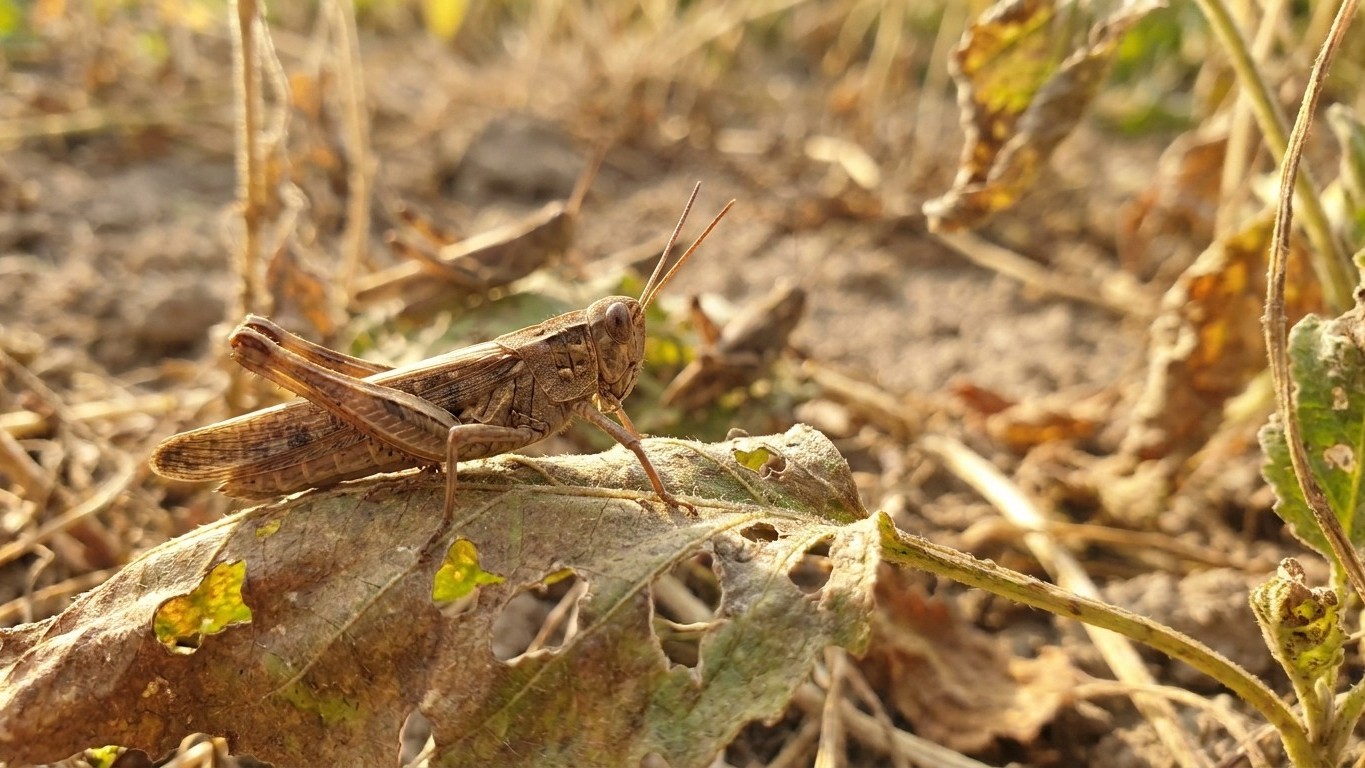

Grasshoppers show up in nearly every state, and most years a healthy garden barely notices them. The trouble starts when weather turns dry and hot for a stretch, because that’s when populations explode and a handful of insects becomes a chewing swarm. Below, each section points to a deeper page: identification, life cycle, and control, plus your own territory’s extension guidance.
What it is and what it attacks

Grasshoppers belong to the order Orthoptera, family Acrididae, and in North America the most damaging pest species fall largely within the genus Melanoplus. That’s the one scientific name worth remembering here, because it covers the group behind most large-scale crop and garden losses on this continent. Everywhere else in this article, “grasshopper” is enough.
Host range is the first thing that surprises people. In a normal year, grasshoppers stick mostly to grasses, weedy field edges, and roadside vegetation. In a dry year, that changes fast. With their preferred grasses stressed or gone, grasshoppers move into whatever stays green: alfalfa, small grains, soybeans, vegetable gardens, ornamental shrubs, even young tree seedlings. Reports of grasshoppers stripping bark off woody stems almost always trace back to a drought stretch that killed off the grass they’d rather eat.
Weather drives outbreaks, not garden conditions
This is the trait that separates grasshoppers from most other pests homeowners deal with. A tidy, well-watered yard doesn’t protect you the way it does against, say, aphids or fungal disease. Grasshopper numbers build up regionally, over one or two consecutive dry, warm seasons, based on how many eggs survive winter and how quickly nymphs develop in spring. A single property can do everything right and still get hit hard if the surrounding countryside had a grasshopper-friendly year.
That regional pattern is why this page works as a hub rather than a single how-to. Three questions follow from it, and each has its own dedicated page on this site: what the damage actually looks like compared to other chewing insects, when grasshoppers hatch and mature in your part of the country, and what combination of timing, barriers, and natural enemies actually reduces numbers. The species is the same nationwide in broad strokes. The calendar, the thresholds, and even the mix of dominant species are not, which is why the life cycle and control questions get answered by state extension services rather than by a single blanket recommendation.
Recognizing it
Grasshopper feeding leaves a distinctive signature once you know what to look for. Leaves show ragged notches along the edges rather than clean holes, and heavy infestations can skeletonize a plant down to the veins in a matter of days. On grain crops, grasshoppers clip seed heads and chew through stems near the base. Vegetable gardeners often notice damage on the youngest, most tender growth first, and seedlings can be cut off entirely overnight during a bad outbreak.
The confusion usually comes from three other groups. Crickets chew similar notches but tend to work at night and stay closer to soil level. Katydids favor tree and shrub foliage and are far less likely to move in numbers across open ground. True caterpillars, meanwhile, leave frass (small dark droppings) on and around damaged leaves, something grasshoppers also produce but in a different, drier pellet form. Locusts, which are technically certain grasshopper species behaving in dense migratory swarms, cause the most dramatic damage but are the exception rather than the rule in most home landscapes.
Getting the identification right matters because control timing differs by insect. Spraying for a caterpillar problem does nothing for grasshoppers hatching from soil, and vice versa. The grasshopper damage page on this site walks through side-by-side signs, including photos of feeding patterns, so a five-minute inspection can settle which pest is actually responsible before any money gets spent on control.
When it appears
Grasshoppers spend the winter as eggs, laid in pods pushed a short distance into soil the previous fall, usually in undisturbed ground like field margins, ditches, and untilled garden edges. Nymphs hatch once soil warms enough in spring, then go through several molts over roughly five to six weeks before reaching adult size and developing full wings. Most territories see one generation per year, with adults laying the next winter’s eggs in late summer and early fall before the first hard frost ends the cycle.
Why the calendar shifts by state
The exact hatch date, and the point at which nymphs become vulnerable to control, depends on soil temperature accumulation, which varies enormously between, say, a warm southern spring and a slow-to-thaw northern one. Extension services track these degree-day thresholds locally because a hatch window that’s accurate for one region can be off by weeks somewhere else. That’s also why outbreak-year predictions differ by state: they’re built from local fall egg-laying surveys, not a national count.
This timing question is exactly what the grasshopper life cycle page covers in detail, including how egg pods survive winter, what triggers hatching, and why early nymph stages matter so much more for control than adults do. Missing that early window is the single most common reason a control effort fails, because by the time grasshoppers are large, winged, and mobile, most tactics lose most of their effectiveness.
What works
Timing beats everything else with grasshoppers. Young nymphs are wingless, stay close to where they hatched, and are far easier to affect than the fully grown, highly mobile adults that follow a few weeks later. Once wings develop, grasshoppers can travel long distances in a single day, which means a neighboring untreated field or roadside can resupply a property no matter how thoroughly it was treated earlier.
Physical barriers help on a garden scale. Floating row covers protect seedlings during the vulnerable early weeks, and tight-fitting netting around raised beds keeps nymphs from walking in from adjacent grass. Tillage of egg-laying sites in fall, where practical, destroys pods before winter and reduces the following spring’s hatch on that specific patch of ground, though it does nothing for eggs laid on a neighbor’s untilled field edge.
Natural enemies worth protecting
Biological control matters more with grasshoppers than with many pests, because several natural enemies genuinely suppress populations without any intervention. Blister beetle larvae feed specifically on grasshopper egg pods underground, which is one reason blanket insecticide use against adult blister beetles can backfire by removing this egg predator. Ground beetles, robber flies, and a range of birds, including grackles and meadowlarks, take a steady toll on nymphs and adults through the season. A naturally occurring protozoan pathogen, Nosema locustae, is also used in bait formulations aimed at young nymphs and spreads slowly through a population over time rather than delivering an immediate knockdown.
Preserving these allies means leaving some field margins and grassy strips undisturbed for beetle habitat, and avoiding unnecessary broad-spectrum treatments once nymph numbers are already declining on their own. The full sequence, timing windows, bait versus barrier decisions, and how to judge whether a natural enemy population is already doing the job, is laid out on the grasshopper control page. Because action thresholds and hatch dates are set locally, pair that page with your own state’s land-grant university extension service, which publishes the current-season numbers that actually apply to your county.
Common questions
Are grasshoppers and locusts the same insect?
Locusts are grasshopper species capable of switching into a dense, migratory swarm phase under the right conditions. Outside of a swarm, they look and behave much like other grasshoppers, which is why the term “locust” gets used loosely in everyday conversation.
Can grasshoppers damage trees and shrubs, not just gardens?
Yes, particularly during drought years when preferred grasses die back. Heavy populations will feed on leaves, tender bark, and new growth of woody plants, especially young seedlings with thin bark.
Do grasshoppers survive winter as adults?
No. Adults die off after laying eggs in late summer or fall. Winter survival happens entirely at the egg stage, in pods placed just below the soil surface, which is why fall soil disturbance can reduce the following year’s hatch.
Is it possible to predict a grasshopper outbreak before it happens?
State extension services often run fall surveys counting egg-laying adults per square yard, giving a rough forecast for the following spring. These figures vary by state and by season, so checking your own territory’s current extension report is more reliable than any general rule of thumb.