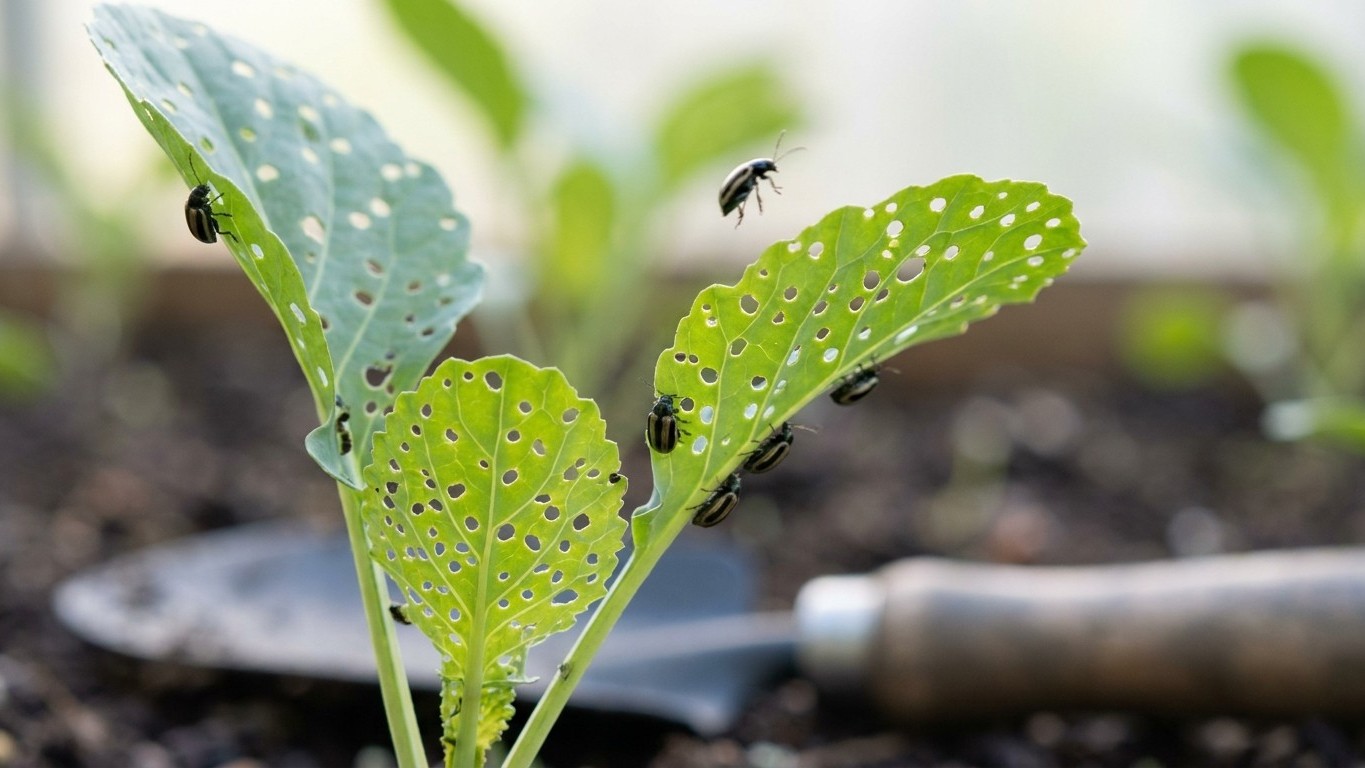

Flea beetles are small, jumping leaf beetles that chew tiny round holes in the foliage of brassicas, eggplant and potatoes, and the fastest way to confirm them is that shotgun-hole pattern on young leaves paired with an insect that springs away the instant you touch the plant. Adults overwinter nearby and attack seedlings hardest, which is why transplant timing matters more than any spray.
What it is and what it attacks

The name covers several related species in the leaf beetle family (Chrysomelidae, subfamily Alticinae), not one single insect. In vegetable gardens across the country, the ones that matter most are the crucifer flea beetle (Phyllotreta cruciferae) and its relatives on cabbage-family crops, plus the potato flea beetle and several Epitrix species that target potatoes and eggplant. All of them share the trait that gives the group its name: enlarged hind legs built for jumping, which make a disturbed adult vanish in a blink rather than crawl away like most beetles.
Host range is fairly predictable once you know the family. Brassicas (cabbage, broccoli, kale, arugula, radish, turnip) draw the crucifer and striped flea beetles almost every season. Eggplant and potato pull in the Epitrix group, and eggplant seedlings in particular can be riddled with holes within days of going into the ground. Some species will also nibble tomatoes and peppers, though the damage there is usually cosmetic rather than crop-threatening.
Why seedlings take the worst hit
A mature plant with a full canopy can shrug off a scattering of pinholes. A cotyledon-stage seedling cannot. Adult flea beetles emerging in spring go looking for the tenderest tissue available, and a newly transplanted brassica or eggplant, still shocked from the move and low on leaf area, is exactly that. Enough feeding on a single true leaf can stunt or kill the plant outright, which is the reason growers watch the two-to-three-week window right after planting more closely than any other stage of the season.
This page is the starting point for the whole flea beetle picture. If you’ve already found holes and want to rule out other chewing pests, the damage identification page walks through the shotgun pattern in detail. If you’re trying to work out when adults will show up on your calendar, the life cycle page breaks down the stages and why emergence timing shifts by region. And if you’re past identification and ready to act, the control page covers row covers, trap crops and the natural enemies worth protecting. Each of those pages goes deeper than what follows here.
Recognizing it
The signature damage is a scatter of small, round to irregular holes across a leaf, often described as looking like it was hit with fine buckshot. On brassica seedlings the holes cluster on the first true leaves; on eggplant and potato foliage they tend to spread across the whole leaf surface, sometimes leaving only the veins intact on a heavily hit plant. The beetles themselves are tiny, usually under an eighth of an inch, and their defining behavior is the jump. Brush a leaf and you’ll see several beetles spring off at once, which is a faster confirmation than trying to catch and inspect one.
A few other pests leave chewed foliage that gets mistaken for flea beetle damage. Slugs leave ragged holes with slime trails and feed mostly at night, so daytime holes without slime point away from them. Caterpillars leave larger, jagged bites and often leave frass (droppings) behind, while flea beetle holes stay small and clean-edged. Adult cucumber beetles chew similar-sized holes on a different plant family and don’t jump the same way. When the holes are pinhole-small, the plant is a brassica, eggplant or potato, and the insect leaps rather than crawls, flea beetles are almost always the answer.
Because the holes can look similar across several unrelated pests, and because the right response depends on getting the identification right the first time, the damage page on this site walks through side-by-side photos and the specific tells that separate flea beetle feeding from lookalike damage on each host crop.
When it appears
Adult flea beetles overwinter in plant debris, hedgerows and soil at the edges of fields and gardens, then emerge in spring as soil warms. From there they feed, mate and lay eggs at the base of host plants; larvae of most species develop in the soil feeding on roots, largely out of sight, before the next generation of adults emerges to feed on foliage again later in the season. Depending on the species and the region, there can be one generation a year or several, and that second or third generation is often what growers notice hitting fall brassica plantings.
Emergence timing is the piece that varies the most, and it varies for a simple reason: it tracks soil temperature and degree-day accumulation, both of which differ by hundreds of miles and by season. A date that triggers emergence in one state can be two or three weeks early or late in another, and even within a state, a cool spring shifts the whole schedule. That’s exactly why no single national date, degree-day threshold or calendar window can apply everywhere, and why the life cycle page on this site breaks the stages down in more depth without pretending to hand out one nationwide timetable.
What that means for a reader planting a garden or a field is straightforward in practice, even if the exact date isn’t: the highest-risk window is always the first two to three weeks after seedlings emerge or go into the ground, whenever that happens to fall locally. Watching the plants closely during that stretch, rather than watching a calendar, catches the damage before it becomes serious.
What works
Timing beats almost everything else with this pest. Delaying transplant or seeding by even a week or two, so that tender seedlings aren’t in the ground during peak adult emergence, avoids more damage than most interventions applied after the fact. Where that isn’t practical, physical barriers do the next-best job: floating row covers placed immediately after planting and sealed at the edges keep adults off the plants during the vulnerable early stage, and they can simply be removed once plants toughen up or once flowering crops need pollinator access.
Sticky traps and trap crops (planting a sacrificial brassica like mustard slightly ahead of the main crop) can pull adults away from the plants you actually want to protect. Reducing overwintering habitat at field or garden edges, by clearing plant debris in fall, also cuts down the local population that shows up the following spring.
Protecting the natural enemies already on the job
Biological control is more useful here than it gets credit for. Ground beetles are active predators of flea beetle eggs and larvae in the soil, and a parasitic wasp, Microctonus vittatae, attacks adult crucifer flea beetles directly, reducing their reproduction. Beneficial soil-dwelling nematodes in the Steinernema genus can also suppress the root-feeding larval stage. None of that protection survives broad-spectrum insecticide use, which kills the predators and parasitoids along with the target pest and often lets flea beetle populations rebound worse the following year. Leaving some ground cover, mulch or undisturbed soil at field margins gives ground beetles a place to overwinter and keeps that natural pressure in place season after season.
The control page on this site goes further into how to sequence these tactics, and because effective timing and legal product options genuinely differ by state, the territory page for your specific state pulls in your region’s extension service guidance, the same source the control page points to rather than any single national recommendation.
Common questions
Do flea beetles bite people or pets?
No. Flea beetles feed exclusively on plant tissue and pose no threat to humans or animals; the “flea” in the name refers only to their jumping ability, not any biting behavior toward mammals.
Can flea beetles kill an established, mature plant?
Rarely. Mature plants with full leaf canopies generally tolerate flea beetle feeding without lasting harm. The real risk is to seedlings and young transplants, where heavy feeding on limited leaf area can stunt growth or kill the plant outright.
Will flea beetles go away on their own if I wait a few weeks?
Adult feeding pressure typically drops once plants pass the seedling stage and grow past the vulnerable window, but the insects themselves don’t disappear from the area. They complete their life cycle in the soil nearby and can produce another generation of adults later in the season, especially affecting fall plantings.
Are all the tiny holes in my garden from flea beetles?
Not necessarily. Several pests leave small chewed holes, and the surest way to confirm flea beetles specifically is watching for the jumping behavior when you disturb the plant, combined with the host crop (brassicas, eggplant, potato) and the clean-edged, pinhole-sized damage pattern described on the identification page.