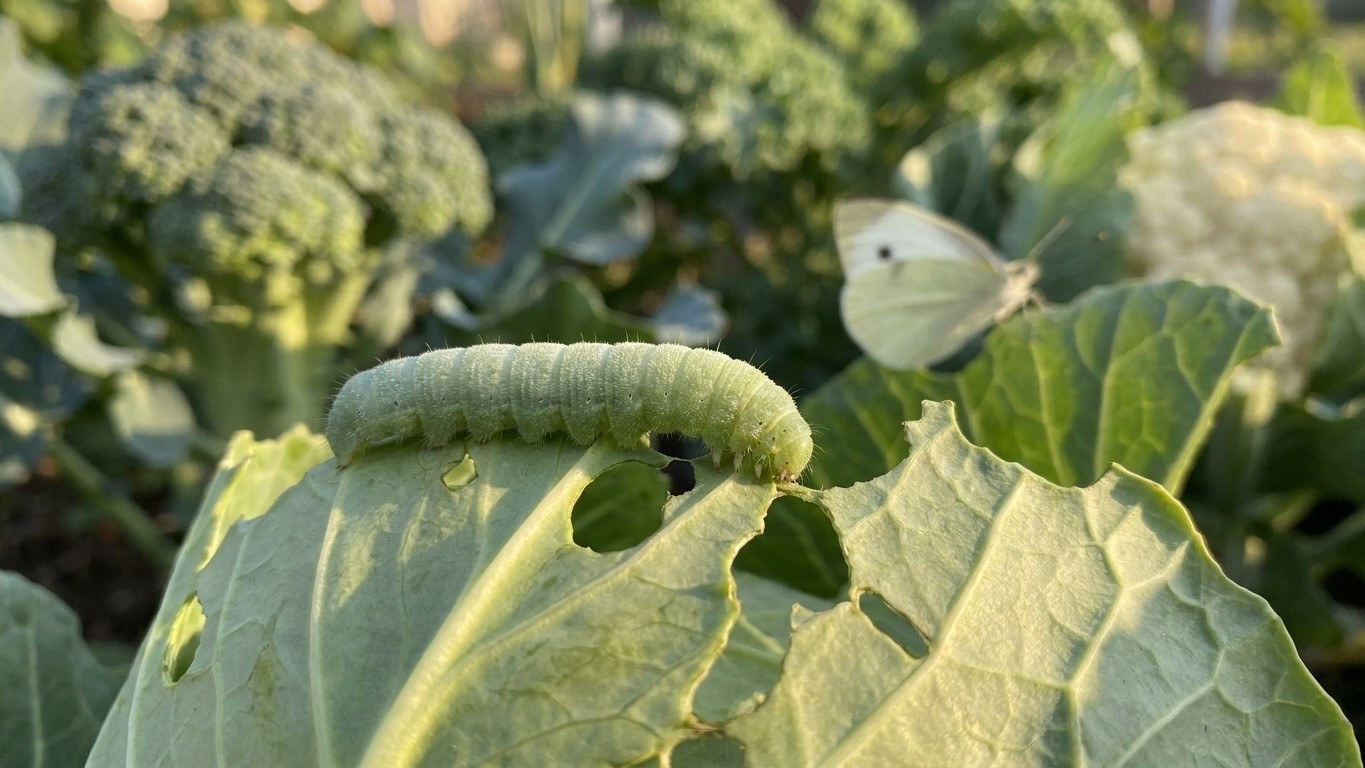

The imported cabbageworm is the velvety, pale-green caterpillar chewing ragged, irregular holes in cabbage, kale, broccoli and other brassica leaves across nearly every US garden. It’s the larval stage of a small white butterfly gardeners often mistake for a harmless visitor. Left unchecked, a handful of caterpillars can skeletonize young transplants within days, though mature plants usually shrug off moderate feeding.
What it is and what it attacks

The species behind the damage is Pieris rapae, known to entomologists and extension agents alike simply as the imported cabbageworm. That common name is a bit of a misnomer today: the insect arrived from Europe in the 1860s and has since spread to every state in the continental US, so calling it “imported” is more a nod to history than a hint that it’s rare or localized. It isn’t. Wherever brassicas grow, this caterpillar shows up.
Its host list reads like a produce aisle: cabbage, kale, broccoli, cauliflower, Brussels sprouts, collards, bok choy, mustard greens, and even ornamental kale grown for looks rather than eating. Radish and turnip tops can host light feeding too. The caterpillar doesn’t discriminate much between commercial fields and backyard raised beds, which is why so many home gardeners end up staring at lace-like leaves wondering what happened overnight.
The butterfly people admire is the problem stage
Here’s the detail that surprises a lot of people: the adult imported cabbageworm is the small white butterfly with one or two black spots on each forewing that flutters lazily through vegetable gardens all summer. Many gardeners actually enjoy watching it, assuming it’s a pollinator doing good work. It is visiting flowers, but its real job, from the plant’s perspective, is laying eggs. Each female can deposit eggs steadily over her lifespan, and every one of those eggs becomes another leaf-chewing larva. The butterfly itself does no damage; the caterpillar it produces does all of it.
This hub page pulls together the three questions gardeners typically ask once they’ve noticed a problem. First, what does the damage actually look like, and how do you tell it apart from similar pests? Second, when in the season does this insect show up, and why does that timing shift depending on where you live? Third, what actually reduces the population without wrecking the garden’s balance of helpful insects? Each of those questions gets a full answer on its own page, linked below, because the details (especially timing) genuinely differ by region and deserve more room than a summary can give.
Recognizing it
Damage from imported cabbageworm shows up as irregular holes chewed through leaves, often starting at the edges and working inward, plus small, dark green pellets of frass scattered on foliage and in the crevices near the head of cabbage or broccoli. Young transplants can be reduced to skeletonized ribs of leaf tissue in a matter of days when several caterpillars feed together, while mature plants tend to tolerate scattered holes without much yield loss.
The tricky part is that this caterpillar isn’t the only one making holes in brassica leaves. Cabbage looper caterpillars leave similar chewing but move with a distinctive looping crawl and lack the fine, velvety hairs covering the cabbageworm’s body. Diamondback moth larvae are smaller, thinner, and tend to feed more on the underside of leaves, sometimes skeletonizing them from below while leaving the upper surface intact. Telling these three apart matters because their feeding windows and vulnerability to certain natural enemies aren’t identical, even though the plants they attack overlap almost completely.
Color and texture offer the fastest field check: the imported cabbageworm larva is a uniform velvety green with a faint yellow stripe running down its back, moves slowly, and curls into a loose C-shape when disturbed. For a side-by-side breakdown of frass patterns, feeding location on the plant, and photos comparing all three look-alikes, the site’s dedicated imported cabbageworm damage page walks through the identification details this summary can’t fully cover.
When it appears
Imported cabbageworm doesn’t run on a single national calendar. It overwinters as a pupa, and how many generations it produces each year, and when the first adults emerge, tracks closely with regional temperatures. In warmer coastal and southern zones, several overlapping generations can occur across a long growing season, while colder northern regions typically see fewer, more distinct generation cycles squeezed into a shorter window. That’s why two gardeners in different states, both growing the same variety of broccoli, can report completely different timelines for when the caterpillars first appear.
The life cycle itself runs through four stages: egg, larva (the damaging caterpillar phase), pupa, and adult butterfly. Eggs are laid singly on the undersides of leaves and hatch within roughly a week under favorable conditions, after which the larva feeds for several weeks before pupating, often attached to the underside of a leaf or nearby structure. The adult butterfly then emerges to mate and start the cycle again. Because each of these stages responds differently to temperature, extension services track degree-day accumulations rather than fixed calendar dates to predict when the next wave of egg-laying, and therefore the next wave of caterpillars, will hit.
That regional variability is exactly why a single “spray by this date” rule doesn’t hold up nationally. The full breakdown of egg, larval, pupal and adult timing, along with how many generations to expect in different climate zones, lives on the site’s imported cabbageworm life cycle page, which is worth reading before deciding when to start watching plants closely.
What works
Timing beats almost everything else when it comes to managing imported cabbageworm. Catching eggs and young larvae early, before they’ve done much feeding, means less damage overall and fewer decisions to make later. Checking the undersides of leaves weekly once butterflies are seen flying through the garden lets a gardener remove eggs and small caterpillars by hand before populations build.
Physical barriers are the most reliable non-chemical tool available. Lightweight floating row covers, installed at planting and sealed at the edges, keep the adult butterflies from ever reaching the leaves to lay eggs in the first place. Since the butterflies do the damage indirectly (by producing the caterpillars), blocking egg-laying access solves the problem at its source rather than reacting to it after the fact.
Natural enemies deserve real credit here, more than most gardeners realize. Parasitic wasps, particularly Cotesia glomerata, lay their own eggs inside cabbageworm larvae and are one of the most effective biological checks on populations in gardens that don’t disrupt them with broad-spectrum sprays. General predators, including lacewings and various predatory beetles, also feed on eggs and small larvae. Preserving these allies mostly means avoiding indiscriminate insecticide use and planting small-flowered plants nearby (dill, alyssum, and similar species) that give adult parasitic wasps a nectar source to sustain themselves between hunting bouts.
Because permitted products, action thresholds, and effective timing windows differ by state and by season, the full control breakdown, including where a targeted biological insecticide fits into a garden or field program, lives on the site’s imported cabbageworm control page. From there, the site’s own territory pages link out to each state’s extension service, which is the authority worth checking for current, region-specific guidance rather than relying on a single national rule.
Common questions
Is the imported cabbageworm the same insect as the cabbage looper?
No. They’re different species that happen to attack the same plants. The cabbageworm is uniformly velvety green and crawls in a straight line, while the looper is smoother-bodied and arches its back into a distinctive loop as it moves.
Do imported cabbageworms harm plants other than brassicas?
Feeding is concentrated almost entirely on cabbage-family crops and related ornamentals like flowering kale. Occasional light feeding has been noted on radish and turnip foliage, but damage to unrelated garden plants is rare.
Why do I see the white butterflies but not much damage?
Adult butterflies are highly visible because they fly during the day, but they don’t feed on leaves themselves. Damage only appears once their eggs hatch into larvae, which can take roughly a week, so a gap between spotting butterflies and spotting chewed leaves is normal.
Can row covers alone keep gardens caterpillar-free?
Row covers work very well as long as they’re sealed at the soil line before butterflies start flying and are left undisturbed through the season. Any gap or tear gives adults an opening to reach leaves and lay eggs underneath, so periodic checking of the cover’s edges matters as much as installing it in the first place.