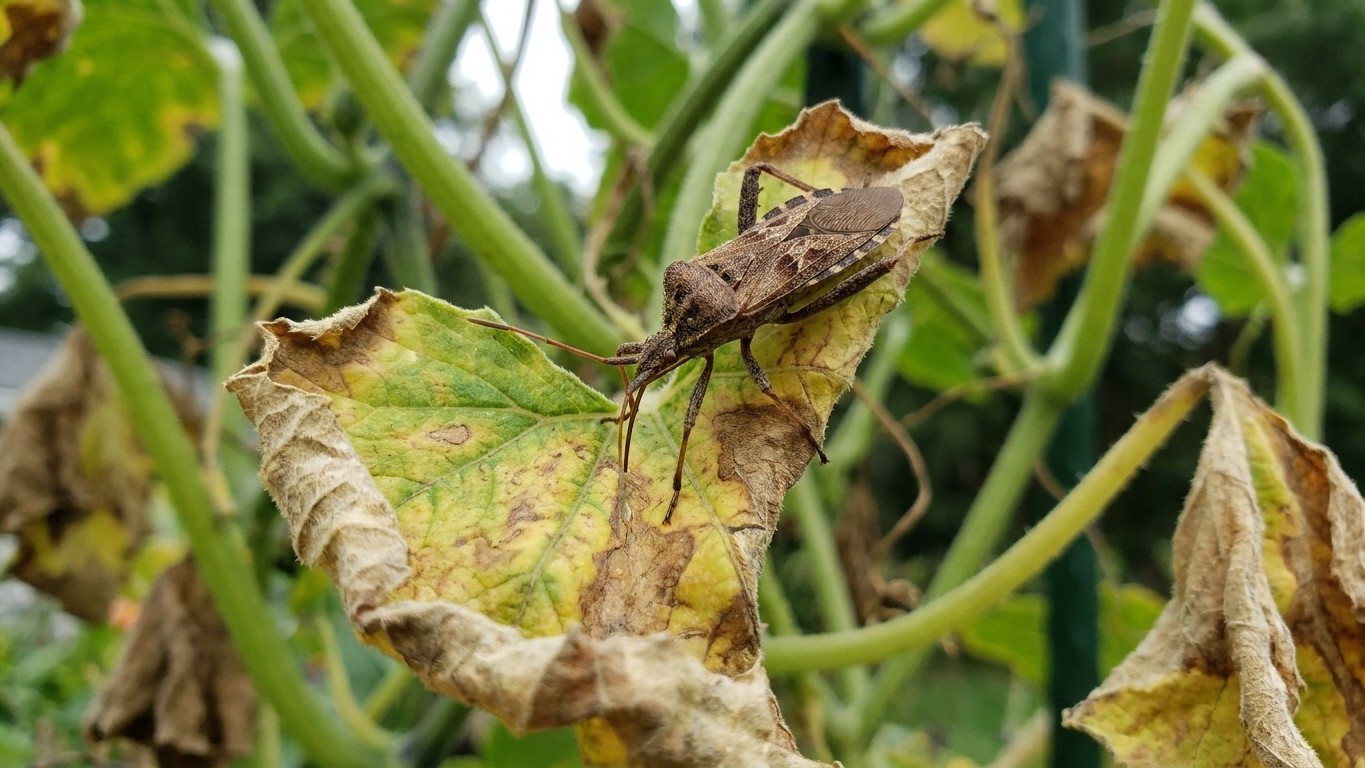

Squash bug (Anasa tristis) targets squash, pumpkin, and other cucurbits, feeding with a needle-like mouthpart that injects saliva and drains sap from leaves and stems. The damage shows up as wilting that spreads from the crown outward, and it’s frequently mistaken for the true stink bug, a different insect that needs a different response. Getting the identification right is the first step to stopping it.
What it is and what it attacks

Squash bug feeds almost exclusively within the cucurbit family: squash, pumpkin, and to a lesser degree cucumber and melon. Not every variety suffers the same way. Yellow crookneck and zucchini tend to collapse fast under a heavy infestation, while butternut and other hard-shelled winter squash usually tolerate more feeding before symptoms appear. That difference matters when you’re deciding which plants in a mixed cucurbit bed need the closest watching.
The mouthpart is the real story here. Squash bug doesn’t chew. It pierces plant tissue with a stylet and injects saliva that breaks down cells before sucking the liquefied contents back out. That saliva also carries a bacterium linked to a vine-collapse disease in some cucurbit crops, which is why a light infestation can sometimes cause damage that looks disproportionate to the number of insects you can find.
Confusion with the brown marmorated stink bug and other stink bug species is constant, and it’s not a trivial mix-up. Stink bugs feed on a much wider range of crops and their populations, natural enemies, and monitoring windows differ from squash bug’s. Treating one like the other wastes effort and misses the actual timing that matters for the insect in your garden.
This page works as a starting point for three questions gardeners usually ask once they’ve found something suspicious on a squash leaf. What exactly am I looking at, and how do I tell it apart from a stink bug or squash bug eggs versus another insect’s eggs? That’s covered on the squash bug damage page, which walks through the visible signs stage by stage. When will I see it, and why does that date move around from state to state? The squash bug life cycle page breaks down the stages and the seasonal pattern behind them. And once it’s confirmed, what actually reduces the population without wrecking the rest of the garden? That’s the focus of the squash bug control page. The rest of this page connects those pieces so you know which one to read next.
Recognizing it
Adult squash bugs are flat-backed, brownish-gray, roughly the length of a fingernail, and they run for cover the moment a leaf is disturbed rather than flying off immediately like a stink bug tends to. Nymphs look nothing like the adults at first: newly hatched ones are gray with black legs, almost spider-like, clustering tightly on the underside of leaves near the feeding site. Eggs are a giveaway on their own, laid in neat, uniform rows or clusters in the V formed by leaf veins, bronze to reddish-brown and easy to spot against green foliage if you check the underside of leaves regularly.
The feeding damage itself follows a pattern that’s worth learning independent of finding the insect. Leaves develop yellow speckling first, then brown, then they go crisp and collapse, often starting with a single leaf or runner while the rest of the plant still looks fine. That localized wilting, sometimes called a symptom that mimics bacterial wilt, is one of the more reliable field clues, because it shows up before the population is large enough to be obvious at a glance.
Stink bugs, by contrast, tend to leave scarring and dimpling directly on the fruit rather than collapsing whole vines, and they favor a broader host range that includes tomatoes and peppers alongside cucurbits. Squash vine borer, another common look-alike culprit for sudden wilting, leaves a telltale hole and frass at the base of the stem rather than the insect itself being visible on the leaf underside. Telling these apart before choosing a response saves time, since none of the three respond to the same tactics or the same timing.
The full identification sequence, including what the egg clusters look like at each stage of development and how the damage progresses week by week, is laid out on the squash bug damage page with the visual markers side by side.
When it appears
Squash bug life cycle runs from overwintered adult to egg to nymph to new adult, and the whole sequence tends to run once or twice within a growing season depending on the region and how long the warm months last. Adults spend winter tucked under garden debris, mulch, or structures near the previous year’s cucurbit bed, then emerge once temperatures warm enough to move and feed. That emergence date is exactly the kind of detail that shifts by hundreds of miles and by weeks depending on where the garden sits, so no single calendar date works nationally.
Once mated, females lay eggs over an extended period rather than all at once, which is part of why a garden can show three different life stages, eggs, early nymphs, and adults, on the same day. Nymphs pass through several molts before reaching adult size, feeding the entire time, and it’s during this nymph stage that populations are most vulnerable to intervention because the insects are clustered, slower, and not yet capable of the rapid scattering adults manage.
Timing varies by territory because it’s driven by accumulated warmth, not the calendar. Extension services track this with degree-day models and local scouting reports, and those thresholds differ from one state’s program to the next and even shift somewhat from one growing season to another depending on spring weather. That’s the reason a specific emergence week or egg-hatch date isn’t given here: the accurate number lives with your regional extension service, and it changes.
The full breakdown of each stage, how long it lasts, and how to read the seasonal pattern in your own garden sits on the squash bug life cycle page, which is built around that regional variability rather than a single fixed timeline.
What works
Timing beats volume with this insect. Because nymphs are the most exposed and least mobile stage, control efforts aimed at that window tend to outperform anything applied after adults have dispersed and hardened. Checking the underside of leaves regularly during the season and removing egg clusters by hand before they hatch is one of the simplest, lowest-cost tactics available, and it works precisely because the eggs are laid in visible, predictable clusters rather than hidden.
Physical barriers matter early. Row covers placed over young plants at transplant or seeding block adults from laying eggs in the first place, though they need to come off once flowers open so pollinators can reach the blooms. Boards or shingles laid near the base of plants overnight can also concentrate adults in one place by morning, since squash bugs seek shelter in cracks and debris, making them easier to collect and remove.
Natural enemies do real work against this species, and preserving them pays off more than most sprays. The tachinid fly (Trichopoda pennipes) parasitizes squash bug adults directly, laying an egg on the bug’s body that develops into a larva feeding internally, and populations of this fly build up naturally where broad-spectrum treatments haven’t wiped them out. Ground beetles and certain predatory true bugs also take nymphs and eggs when given the chance. Keeping a diverse planting, avoiding unnecessary broad treatments, and leaving some undisturbed ground cover nearby all support these natural predators rather than working against them.
The specific thresholds for when intervention is worth the effort, along with the sequence extension programs recommend for the nymph window in each region, are covered in detail on the squash bug control page. Because emergence dates and treatment windows are state-specific, pairing that page with the guidance for your own territory on this site gives the most accurate picture for your garden.
Common questions
Is a squash bug the same as a stink bug?
No. They belong to different families, and while both are shield-shaped and both feed by piercing plant tissue, squash bug feeds almost exclusively on cucurbits and causes localized wilting, while stink bugs feed on a wider range of crops and typically scar fruit rather than collapsing vines.
Can squash bug damage kill an established plant?
Yes, particularly in susceptible varieties like zucchini and yellow crookneck, where heavy feeding combined with the bacterium sometimes transmitted through squash bug saliva can cause a vine to wilt and die within days once symptoms start.
Do squash bugs come back every year in the same garden?
They can, since adults overwinter locally under debris and mulch near the previous season’s cucurbit planting. Clearing old vines and debris at the end of the season reduces the number of adults with a place to spend winter nearby.
What’s the single most effective step for a home garden?
Checking leaf undersides regularly during the season and removing egg clusters before they hatch, combined with row covers during early growth, addresses the insect at its most vulnerable stages before a larger population has a chance to establish.