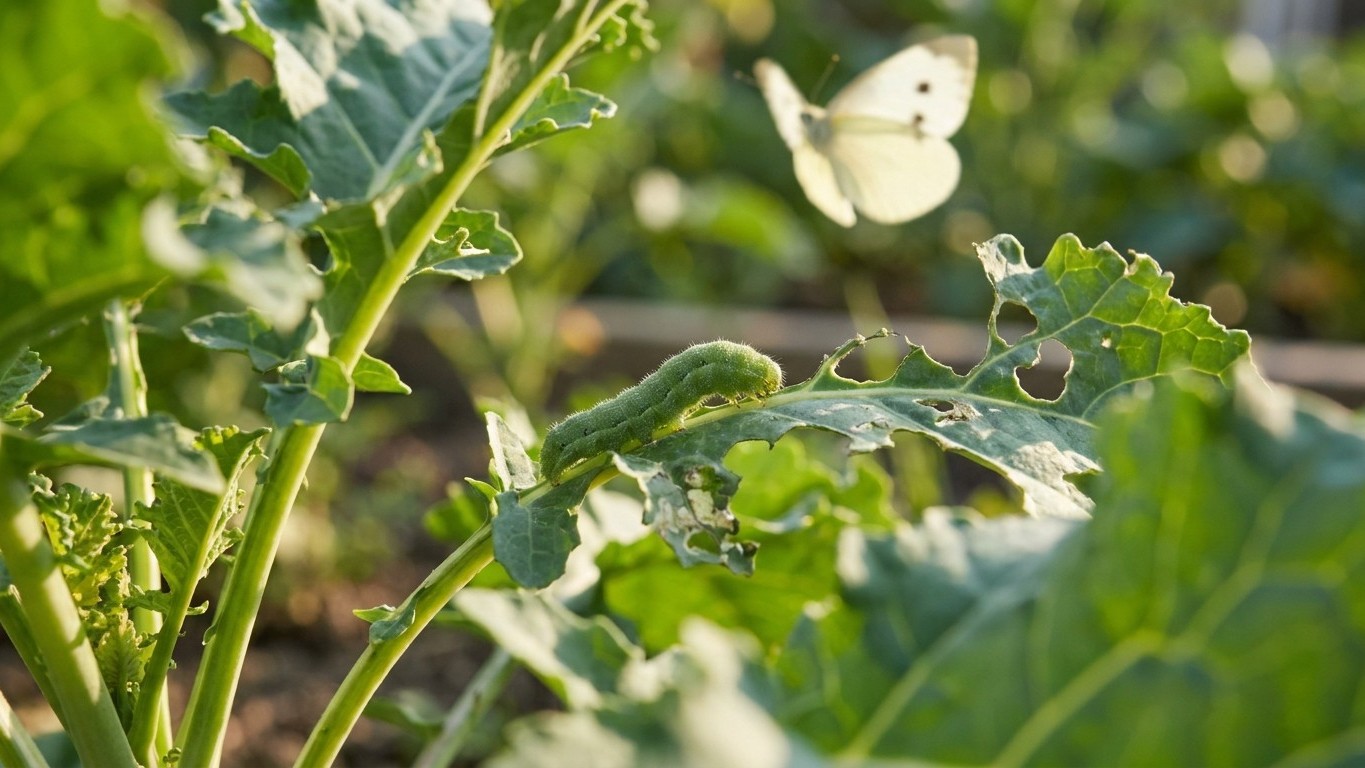

Imported cabbageworm control works when you match the method to the larval stage doing the damage, not the adult butterfly you happen to see fluttering over the bed. The caterpillar of Pieris rapae is what chews holes in cabbage, broccoli, and kale, and the fixes that actually reduce that damage combine timing, physical barriers, and protecting the wasps and beetles already hunting it. A pesticide is sometimes warranted, but only under specific conditions, and only against the right stage.
Timing beats product
Here’s the part most advice skips entirely: an intervention aimed at the wrong life stage does nothing, no matter how good the product or how careful the application. The white butterfly people notice drifting over the garden isn’t the problem. That’s the adult, and it doesn’t feed on your plants at all. It’s simply looking for a place to lay eggs.
The damage comes later, from the velvety green larvae that hatch from those eggs and start feeding within days. Spraying or trapping when adults are flying wastes effort and, if a broad-spectrum product gets used, kills beneficial insects for no benefit. The window that matters is when eggs have hatched but larvae are still small, since young caterpillars are far more vulnerable to both biological controls and any product treatment than older, larger ones that have already done most of their feeding.
This is why identification by stage matters more than identification by species alone. A garden can have adult butterflies present for weeks while larval activity spikes only during a narrower stretch tied to local temperature and generation timing. Southern states can see three or four generations in a season; northern states typically see fewer, compressed into a shorter window. Those emergence and generation dates shift by region and by year, which is exactly why a single national calendar doesn’t work here.
Before choosing any control method, it’s worth understanding the full sequence from egg to pupa to adult, since that sequence determines when each tactic below actually has a chance to work. The imported cabbageworm life cycle page lays out each stage and roughly how long it lasts, which turns “I saw a caterpillar” into “I know what to do this week.” Skipping that step is the single most common reason gardeners feel like they’ve tried everything and nothing worked. It usually wasn’t that the method failed. It was aimed at a stage that had already moved on, or hadn’t arrived yet.
What works without a product
Several tactics reduce imported cabbageworm damage without any spray, and they’re worth trying first, though none of them are effortless.
Barriers, trap crops, and hand removal
- Row covers: lightweight floating covers block adult butterflies from reaching plants to lay eggs at all. They must go on at transplanting or seeding, before adults are active, and stay sealed at the soil line. Since cabbage-family crops don’t need pollinator access, covers can stay on for the whole season, which makes this one of the more effective and least laborious options once it’s installed correctly.
- Hand removal: checking leaf undersides for the yellowish, ribbed eggs and picking off larvae works well in small plantings but demands a real commitment. It has to happen every two to three days during peak egg-laying, since a missed week lets larvae grow past the size where hand-picking keeps up with feeding damage.
- Trap crops: nasturtiums or collards planted as a decoy near the main crop can pull egg-laying activity away from the plants you actually want to harvest. This only works if the trap crop is monitored and larvae on it are removed or destroyed, otherwise it becomes a breeding ground that feeds the next generation right back into the garden.
Planting timing and cleanup
Shifting planting dates to avoid peak adult flight periods reduces the number of eggs laid on young, vulnerable transplants in the first place. Since flight timing varies by state and by season, this is another point where a local extension calendar does more good than a generic date. After harvest, clearing out crop debris and old cabbage-family plants removes overwintering pupae, which lowers the starting population for next year rather than just managing the current one. None of this is glamorous work, but it’s the difference between fighting the same infestation every summer and gradually shrinking it.
The allies you already have
Before reaching for anything in a bottle, it helps to recognize the insects already working against imported cabbageworm for free. The parasitic wasp Cotesia glomerata lays its eggs inside cabbageworm larvae, and the wasp larvae that hatch consume the caterpillar from within, eventually killing it. Small Trichogramma wasps attack the eggs directly, parasitizing them before larvae even emerge. Lady beetles, lacewings, and general predatory bugs feed on eggs and small larvae, and birds such as sparrows will pick caterpillars off open plantings, particularly where a diverse planting gives them cover to hunt from.
These natural enemies do measurable work. A garden with an established population of parasitic wasps can show noticeably fewer surviving larvae per plant than one where those wasps have been wiped out, even without any additional intervention. According to the University of Minnesota Extension, biological control from parasitoids and predators is a meaningful part of managing this pest in home gardens, not a minor supplement to spraying.
Here’s the part that gets ignored constantly: a broad-spectrum insecticide doesn’t distinguish between the caterpillar you’re targeting and the wasp that was about to kill it for you. Spray indiscriminately and you knock back the parasitoid population along with the pest, and because wasps take longer to rebuild their numbers than a fast-reproducing caterpillar does, the pest often rebounds faster than its natural enemies can recover. That’s how a manageable cabbageworm problem turns into a worse one next month, on the same plants, with fewer allies left to help.
Protecting these insects mostly means restraint: skip cover sprays applied “just in case,” let flowering herbs and small blooms grow near the vegetable bed to give adult wasps a nectar source, and treat only when and where actual larval damage crosses a level that justifies it. That last point is exactly where the next section picks up.
When a product is the answer
There’s an honest case for treatment, and it applies when physical barriers weren’t installed in time, hand removal can’t keep pace with a larger planting, and larval feeding is climbing toward damage that will cost the harvest. In that situation, a targeted product aimed specifically at young larvae, while they’re small and still feeding near the leaf surface, does far more good than the same product applied later against nearly-mature caterpillars that have already caused most of the damage and are about to pupate anyway.
What can’t be answered here is which product, at what rate, on what schedule. Permitted active ingredients for home and commercial vegetable growers differ by state, by crop, and they change from season to season as registrations are reviewed and updated. A product cleared for use on cabbage in one state may carry different restrictions, or none at all, in another, and label language is the legal requirement no matter what a general article says. Naming a specific brand or rate here would mean guessing at rules that your state’s regulators actually set.
The reliable path is your local Cooperative Extension office, which tracks current registrations, degree-day thresholds for larval emergence, and action levels specific to your growing region. This site keeps a page for that lookup by territory, since the right contact and the right guidance depends entirely on where the garden actually is. Start there before buying anything, and treat only the stage the label and your extension agent both point to, which in nearly every case means small, actively feeding larvae rather than eggs or near-mature caterpillars.
Common questions
Are the white butterflies I see the ones causing the damage?
No. Adult Pieris rapae butterflies don’t feed on cabbage-family plants at all. The damage comes from the green larvae that hatch from eggs the adults lay, so seeing butterflies tells you eggs are likely present, not that feeding damage is happening yet.
Do row covers need to come off for pollination?
No. Cabbage, broccoli, kale, and related crops don’t rely on pollinators for the part you harvest, so covers can stay sealed for the full growing season without affecting yield.
Will spraying kill the parasitic wasps that attack cabbageworm?
A broad-spectrum insecticide will kill Cotesia glomerata and Trichogramma wasps along with the target caterpillars, since these products don’t distinguish beneficial insects from pests. That’s a major reason populations can rebound worse after an untargeted spray.
How do I know if treatment is actually needed?
Check leaf undersides regularly for eggs and small larvae, and track whether feeding damage is increasing despite barriers and hand removal. If it is, your state’s Cooperative Extension office can confirm current action thresholds and registered options for your specific crop and region.