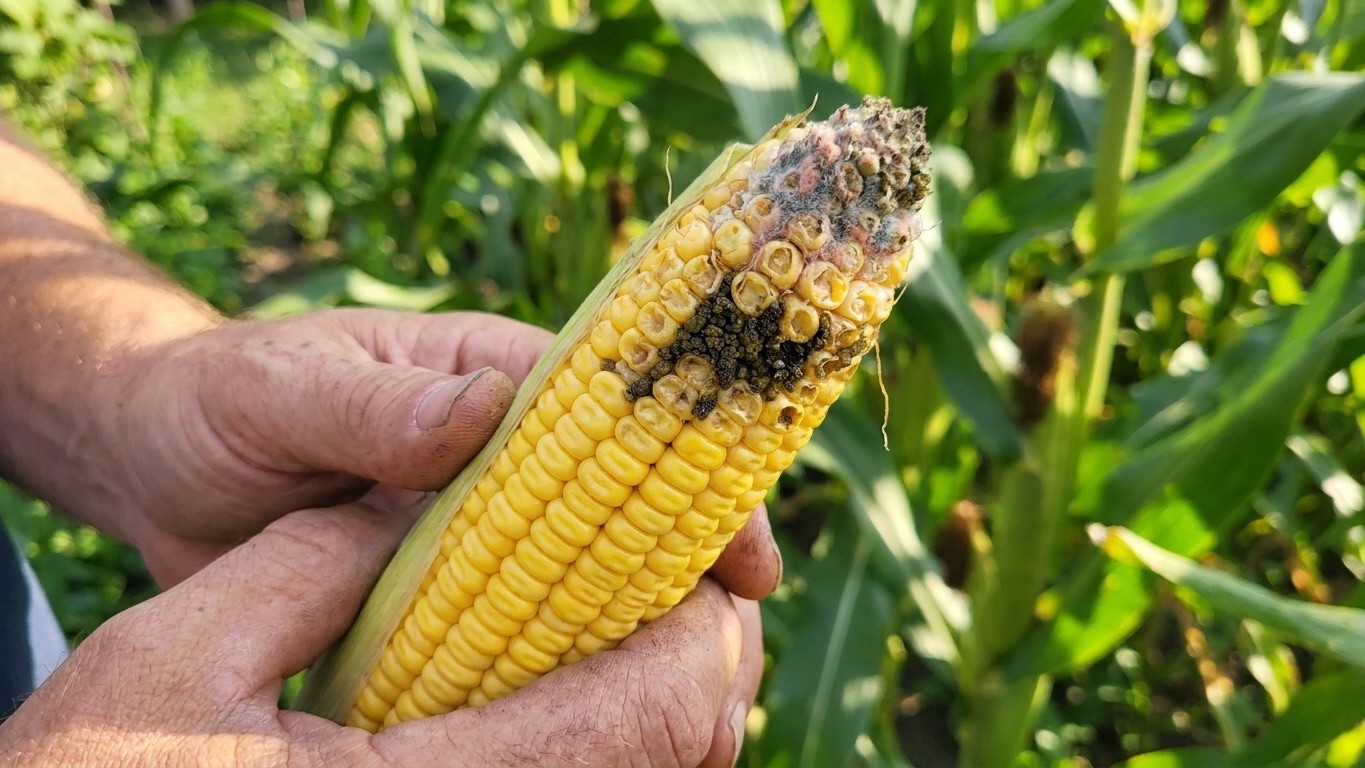

A perfect ear of sweet corn with a rotten, tunneled tip is the classic sign of corn earworm (Helicoverpa zea). The caterpillar feeds down through the silk channel into the kernels at the tip, leaving behind chewed kernels, dark frass, and often a trail of mold. On tomatoes, the same species bores directly into the fruit near the stem. Once you know where to look, the damage is unmistakable.
What the damage looks like

From a few feet away, an infested corn patch rarely looks wrong. The plants stand green and full, the husks stay tight, and nothing about the outside of the ear signals trouble. That’s the frustrating part of this pest: it does its damage where you can’t see it until you go looking. The first hint, if there is one, is a bit of silk that’s turned brown and matted earlier than the rest of the patch, or a small hole chewed at the very tip of the husk where the silk emerges.
Get closer and pull back the husk, and the picture changes fast. At the tip of the ear, kernels are chewed away in an irregular patch, sometimes just the surface, sometimes tunneled several inches deep. Mixed in with the damage is a coarse, wet-looking frass, the caterpillar equivalent of sawdust, packed loosely between the kernels. Where the feeding has been going on for a while, you’ll often see gray or pink mold moving in behind it, because the wounds left in the kernels are an open door for fungal decay.
On the ear itself
Look at the caterpillar itself if one is still present, and the variation is part of the identification. Corn earworm larvae range from pale green or yellow to brown or nearly black, all on the same plant, with pale stripes running the length of the body. They’re smooth-skinned with only scattered short hairs, not fuzzy. Most ears hold just one caterpillar, because the species is cannibalistic, an older, larger larva will eat a younger one it encounters in the same feeding tunnel. That single-worm pattern is itself a useful clue when you’re trying to tell this pest apart from others that damage corn in groups.
On tomatoes, the entry point looks different. Instead of working through silk, the caterpillar chews a clean, round hole into the fruit, usually near the stem end, and tunnels inward. The outside of the tomato may show only a small dark spot at first, but the inside is often hollowed out and full of frass, and secondary rot follows quickly once the fruit is opened up to the air.
What it is confused with
Because the visible symptom, chewed kernels or a hole in a tomato, overlaps with several other pests, misidentification is common. Treating the wrong insect wastes a season, and in some cases actually makes things worse by disrupting natural enemies that were already keeping the real problem in check.
| Could be confused with | How to tell them apart | Why it matters |
|---|---|---|
| Fall armyworm | Feeds mainly in the whorl and leaves ragged, windowpane-style holes in young leaves before the ear even forms; when it does reach the ear, damage often comes from the side, not straight down the silk channel | Different timing means treatment aimed at silk stage misses the window entirely |
| European corn borer | Bores into the stalk and ear shank, leaving visible entry holes and sawdust-like frass on the outside of the stalk, not concentrated at the ear tip | Stalk tunneling weakens the plant structurally in a way tip feeding does not, calling for a different response |
| Sap beetle | Small, hard-shelled beetle that arrives after other damage or disease has already opened the ear; found clustered in the wound, not tunneling fresh kernels | Sap beetles are usually a secondary visitor, not the original cause, so spraying for them ignores the real entry point |
| Kernel rot / mold alone | Gray or pink mold with no chewed kernels, no frass, and no tunnel | A grower who assumes insect damage may reach for an insecticide when the real issue is fungal and needs a completely different response |
The mold mix-up is the one that leads growers furthest astray. Seeing pink or gray fuzz at the ear tip, it’s easy to assume disease alone and skip the search for a caterpillar or leftover frass, when in fact the mold moved in because feeding damage opened the kernels to infection. Skip the insect search and next season brings the same combination back, because the underlying pest was never addressed.
The fall armyworm mix-up runs the other direction. Growers who spot whorl damage early in the season sometimes assume the same insect caused the ear-tip damage found later, and time a treatment for silk stage that isn’t the right target at all. Two different species, two different windows, one shared name in a lot of home gardener’s heads: “worms in the corn.”
Where to look to confirm
Confirming corn earworm means going straight to the silk, and timing the visit matters as much as the location. The best time to check is once silks have emerged and started to dry or brown at the tips, which is when moths are most attracted to lay eggs and larvae are actively feeding down the channel. Checking too early, while silks are still fresh and green, often turns up nothing even in an infested patch, simply because the caterpillar hasn’t tunneled far enough yet to be visible.
On the plant
Peel back the husk from the tip down, rather than tearing it open from the side, so you can follow the feeding tunnel in the direction the caterpillar traveled. Look first at the silk channel itself for chewed strands and frass, then move down to the exposed kernels at the very tip of the ear. A single caterpillar, of whatever color, tucked into a tunnel of hollowed kernels and loose frass is the clearest confirmation available. Check several ears across the patch, not just one, since infestation is rarely uniform even within a single row.
On tomatoes, check fruit that’s still green to just-turning, since that’s the stage moths tend to target for egg-laying. Run a finger over the stem end and shoulders of each fruit feeling for a small punched hole, then cut open any fruit with a suspicious mark. Interior tunneling and frass confirm the diagnosis even if the entry hole looked minor from outside.
Exact emergence timing, degree-day thresholds, and action levels for corn earworm are set locally and vary by state and by season, which is why no single number applies everywhere. Your state’s extension service tracks moth flights with pheromone traps and publishes the current guidance for your region, and that’s the source to check before deciding whether what you’re seeing warrants a response at all.
What to do once you are sure
Once the identification is confirmed, feeding within a single ear or fruit is close to done by the time it’s found. There’s no product that reaches a caterpillar already inside a sealed husk or a tomato, so the practical decision at this stage is about the rest of the season and the rest of the planting, not the individual ear in hand. That decision depends on understanding when moths fly, when eggs are laid, and how many generations are likely before harvest, which is exactly what the life-cycle page in this series lays out in detail.
Biological control is worth taking seriously here, more so than with many garden pests, because natural enemies already do real work against corn earworm. Several species of parasitic wasps in the genera Trichogramma and Cotesia attack eggs and larvae, and general predators like lacewings, minute pirate bugs, and ground beetles take a toll on eggs and small larvae before they tunnel in deep enough to be protected. Broad-spectrum treatments applied at the wrong time can wipe out these allies along with the target pest, which is part of why timing and targeting matter more than simply spraying on a calendar.
What actually works, and when to apply it if you decide a treatment is warranted, is covered on this series’ control page, which walks through the options in order from least to most disruptive. And because timing windows, degree-day models, and locally-approved products differ by state, the page for your own territory in this pest series names your state’s extension service directly, along with the local guidance current for this season. That’s the reference to check before making any treatment decision, since a threshold that applies in one region can be meaningless in another.
Common questions
Can I still eat corn with earworm damage?
Cutting away the damaged tip and any moldy kernels typically leaves the rest of the ear usable, since the caterpillar confines its feeding to the tip in most cases. Discard any ear where mold has spread deep into the cob rather than staying at the surface.
Does one caterpillar per ear mean the infestation is light?
Not necessarily. One caterpillar per ear is typical for this species regardless of how many ears in the patch are affected, because larvae are cannibalistic and eliminate competitors within the same ear. Count affected ears across the planting, not caterpillars per ear, to judge the scope.
Why do some ears get damaged and others right next to them don’t?
Moths tend to lay eggs on the freshest, most attractive silk available at the time they’re flying, so ears that silk out earlier or later than the peak flight window often escape with little or no damage. Staggered planting dates can spread this risk further.
Is corn earworm the same insect as tomato fruitworm?
Yes. Helicoverpa zea goes by “corn earworm” on corn and “tomato fruitworm” on tomatoes, but it’s the identical species behaving according to which host plant it’s found on.