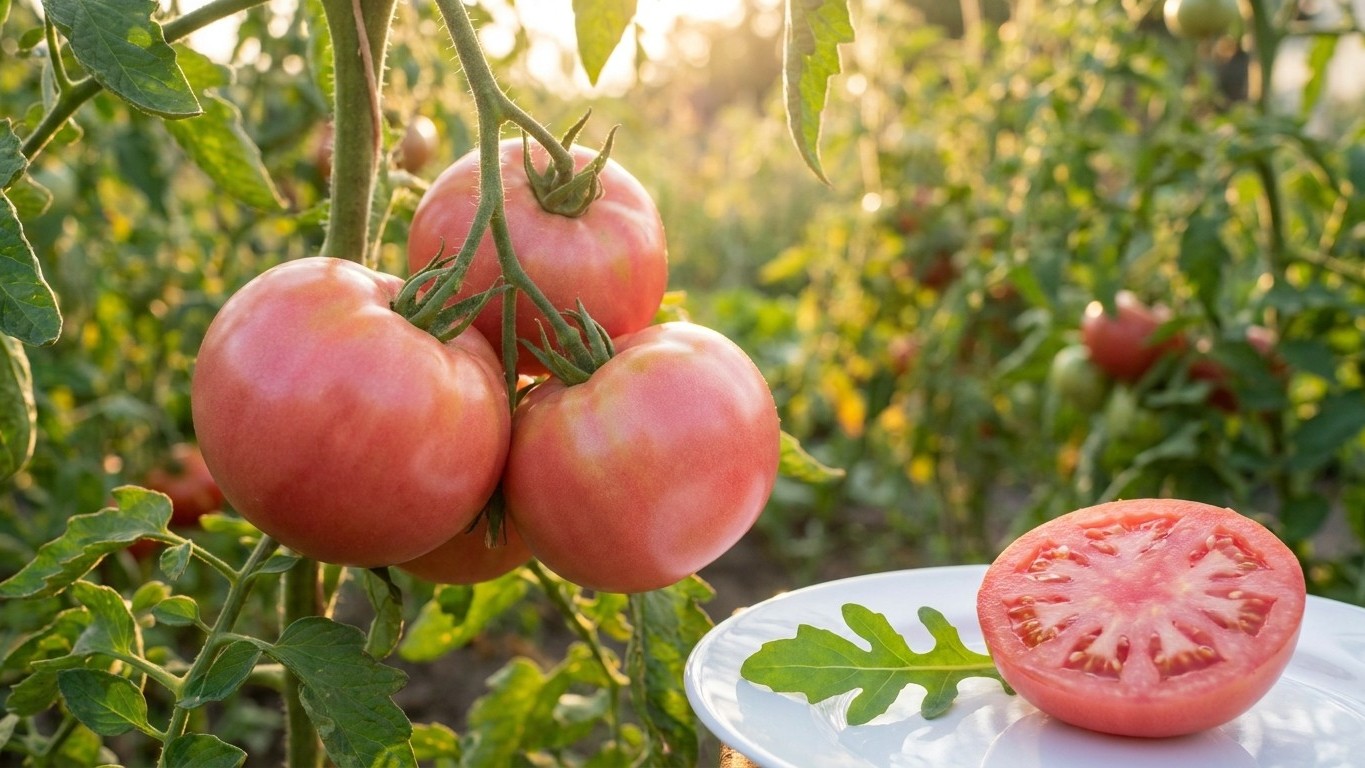

Strawberry Fields is a pink-fruited, indeterminate specialty tomato that needs about 75 days from transplant to its first ripe fruit. That number decides almost everything else: when you can safely set it out, whether your growing season gives it room to produce more than one flush, and why the pink tomatoes coming off this vine are best eaten fresh, sliced thick on a sandwich or tossed into a salad, rather than cooked down or canned.
What Strawberry Fields actually is
Three facts decide whether this tomato fits a given garden, and none of them is the color. First, the habit: Strawberry Fields is indeterminate, meaning the vine keeps growing and setting new fruit clusters until frost stops it, rather than ripening everything in one flush the way a determinate bush tomato does. That single fact drives the staking decision below. Second, the timing: it reaches maturity in 75 days counted from transplant, not from the day you sowed seed indoors. Growers who count from seeding routinely think they’re a month ahead of where they actually are, then wonder why the calendar doesn’t match the fruit.
Third, the fruit itself. This is a specialty type, pink-skinned rather than red, with a flavor described as balanced, sweet and acidic, and a texture that’s noticeably juicy. That juiciness is worth knowing before you plan what to do with a full basket of them: a wet, high-moisture tomato slices beautifully and eats well raw, but it isn’t the fruit you want if you’re aiming for a thick, cooked-down sauce or a tomato that holds its shape through a long simmer. Plan for fresh eating first, and treat any surplus as a bonus rather than the main goal.
Where it ripens in time, and where it is a gamble
The math a gardener needs is simple once it’s laid out, and it’s the same math whether the variety is Strawberry Fields or anything else: take your area’s frost-free window, subtract roughly two weeks for the soil to warm enough after the last frost to safely set transplants, then subtract the 75 days to maturity. What’s left over is your picking window, and because this variety is indeterminate, every extra week left in that window is another week of fruit rather than a wasted margin.
No station-by-station frost data is published on this page, so the right move for any reader is to pull up their own local average last and first frost dates through NOAA’s National Centers for Environmental Information and run the arithmetic themselves. That said, the shape of the outcome by region is predictable enough to describe in general terms.
Long-season regions
Along the Gulf Coast, the Southeast, and much of California’s Central Valley, frost-free seasons commonly stretch well past 200 days. Subtract the two-week soil-warming buffer and the 75-day maturity clock, and there’s still a broad harvest window left, often two to three months or more, which matters for an indeterminate vine that keeps producing as long as conditions allow.
Short-season regions
In the Upper Midwest, northern New England, and high-elevation pockets of the Mountain West, frost-free seasons can run closer to 100 to 120 days in some spots. Run the same subtraction there and the leftover picking window shrinks to a few weeks at best. That’s not necessarily a “no,” but it does mean starting transplants as early as safely possible, using season-extension tools like row cover, and accepting that a killing frost may end the harvest before the vine has produced its full potential. Gardeners in these zones should treat 75 days as a tight fit, not a comfortable one.
The two ways a season goes wrong
A long frost-free window on paper doesn’t guarantee a good crop, because two other limits don’t show up on a frost date table at all. The first is accumulated warmth. Tomato flowers won’t reliably set fruit when nighttime temperatures drop below 50°F, so a region can have a technically long frost-free season and still lose weeks of productive fruit-setting if spring nights stay cool or fall arrives with chilly evenings well before the actual frost date. Northern gardeners often hit this wall before frost ever touches the vine.
The second limit runs the opposite direction: heat. Once daytime temperatures push above roughly 86°F for sustained stretches, tomato pollen becomes sterile and blossoms drop without setting fruit. That’s why growers in the Deep South and the low desert Southwest typically run two separate crops, a spring planting that finishes before the worst heat and a second planting for fall, rather than expecting one continuous harvest through a scorching midsummer.
For a variety with a 75-day maturity and an indeterminate habit like Strawberry Fields, the cold-night limit tends to matter more in practice. Because the plant is built to keep fruiting for months rather than finishing in one flush, it needs a long, uninterrupted stretch of warm nights to realize that potential, and that’s exactly what short-season northern gardens can’t reliably provide. Southern growers dealing with a midsummer heat pause simply lose a few weeks in the middle and pick back up in fall; northern growers dealing with cool nights on both ends of the season may never get that second wind at all.
What it resists, and what it does not
Strawberry Fields carries two published disease resistances, and both are rated at the high end rather than the intermediate one: high resistance to nematodes and high resistance to late blight. That distinction matters. High resistance means the plant is bred to substantially suppress the disease under normal pressure. Intermediate resistance, which doesn’t apply here but shows up on plenty of other variety tags, only means the plant slows the disease’s progress rather than stopping it, and treating that milder rating as full protection is exactly how a garden loses a crop to something the label seemed to promise against.
What the catalogue does not list matters just as much. No resistance to early blight, fusarium wilt, verticillium wilt, or common bacterial diseases is published for this variety, which means none of those pressures are addressed by breeding here. Root-knot nematode and late blight pressure are handled well; everything else needs the standard defenses, meaning crop rotation, good airflow, mulching to keep soil-borne spores from splashing onto lower leaves, and watching the plant closely during humid stretches when early blight and other foliar diseases tend to move fastest.
Growing it without the usual mistakes
Because this is an indeterminate vine that keeps growing and fruiting until frost, it needs a tall cage or a sturdy stake set at planting time, not added later once the vine is sprawling. A short tomato cage sized for a determinate bush will be outgrown by midsummer, and a vine that’s fallen over is harder to harvest and more exposed to soil-borne disease. Give plants generous spacing, commonly in the range of two to three feet apart, so airflow can move between them; that spacing does real work against the foliar diseases the plant has no bred resistance to.
The mistake this timing invites is treating Strawberry Fields like a determinate variety that finishes in one flush. Determinate tomatoes are typically fed heavily early and then tapered off once fruit sets, because the plant isn’t going to keep growing much after that. An indeterminate 75-day variety needs steady, moderate feeding through the whole season, since it’s setting new flower clusters continuously rather than putting all its energy into one wave of fruit. Stopping fertilization too early, assuming the plant is “done” once the first tomatoes ripen, is the single most common way gardeners cut their own harvest short.
As the end of the season approaches, pinch the growing tip of each main stem about four to five weeks before the expected first fall frost. That stops the plant from setting new blossoms that have no realistic chance of maturing, and redirects its energy into ripening the fruit already on the vine, squeezing the most out of whatever picking window the local frost calendar allows.
Common questions
How many days does Strawberry Fields tomato need to ripen?
About 75 days, counted from the date of transplanting into the garden, not from when the seed was started indoors.
Is Strawberry Fields a determinate or indeterminate tomato?
Indeterminate. The vine keeps growing and producing new fruit until frost kills it, which is why it needs a tall cage or stake and continued feeding through the season rather than a one-time flush of care.
Does Strawberry Fields tomato resist disease?
It carries high resistance to nematodes and high resistance to late blight. No resistance is published for early blight, fusarium wilt, or verticillium wilt, so standard rotation and airflow practices are still needed against those.
What should I do with the pink tomatoes once they ripen?
Eat them fresh. The flavor is described as balanced, sweet and acidic, with a juicy texture that’s better suited to slicing for sandwiches and salads than to long cooking or canning, where a drier, meatier tomato typically performs better.