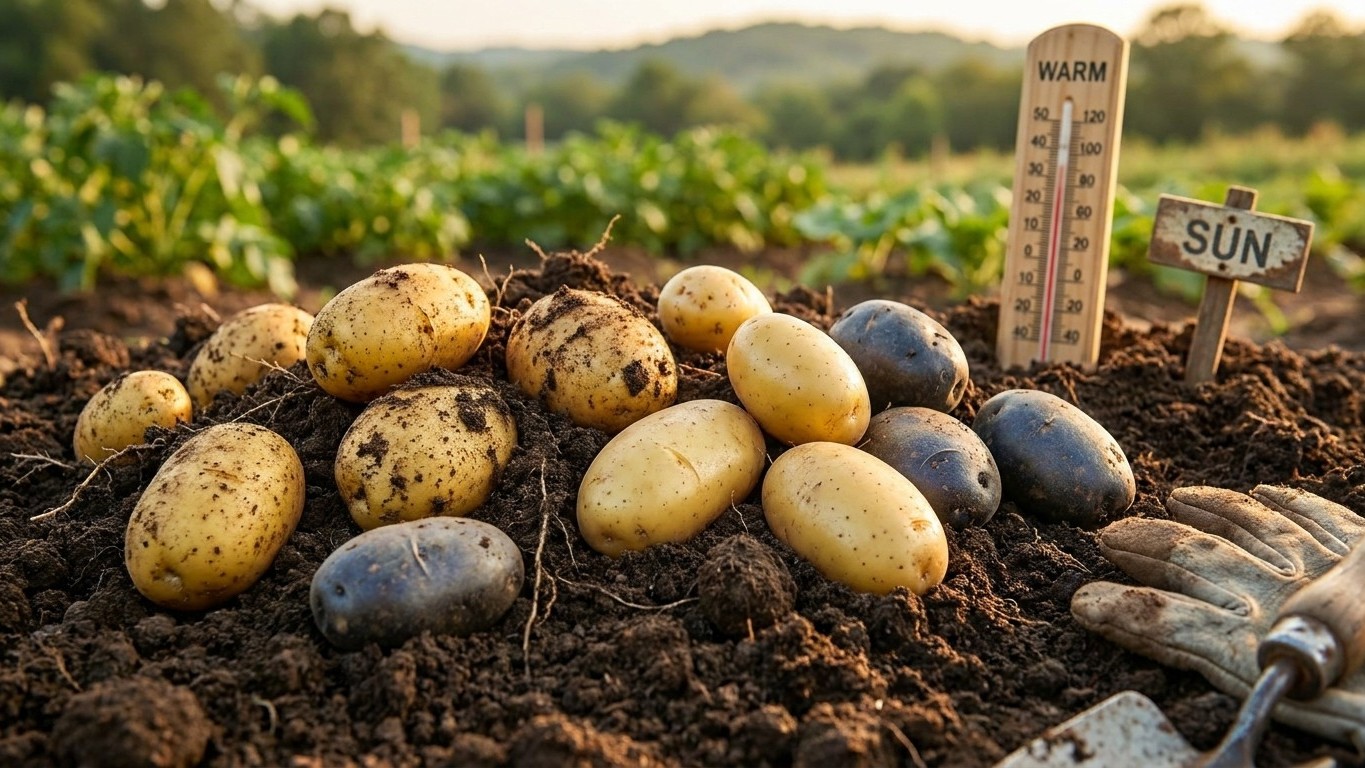

Georgia gardeners get the best results from early and mid-season potatoes, because the state’s soil warms past the 90°F threshold that stops tuber sizing long before a late-season crop would finish filling out. That single fact, drawn from Utah State University Extension’s potato fact sheet, shapes almost every variety decision a Georgia grower makes, from the Blue Ridge foothills to the coastal plain.
The short answer
Plant early and mid-season potatoes in Georgia, and treat a full late-season crop as a gamble unless you’re gardening at elevation in the far north of the state. The reasoning comes straight from Utah State University Extension’s Potatoes in the Garden fact sheet: tuber set and fill shut down once soil temperatures climb above 90°F. Georgia’s growing season heats up fast once spring passes, and a late-season variety that needs the longest possible window to bulk up its tubers is exactly the crop most likely to hit that ceiling before it’s done.
Early and mid-season varieties sidestep the problem by finishing their tuber-fill window while the soil is still cool. Neither Utah State nor the University of Maine Cooperative Extension publishes a specific days-to-maturity count for named varieties, so the honest way to describe a potato’s timing is by its season class, not a number of days. What both sources do publish is what a variety is grown for: some are suited to boiling and salads, others to baking, and some work for both. That’s the frame Georgia growers should use when they pick seed.
The planting window itself is set by frost, not by the calendar page. Using NOAA NCEI’s 1991-2020 Climate Normals for station USW00013874 (the Atlanta reference), the last spring frost falls somewhere between March 11 and March 29. Potatoes go in the ground 14 to 21 days before that date, once soil temperature reaches 50°F, according to the University of Maine Cooperative Extension’s Bulletin #2077. That means an Atlanta-area gardener working from the early edge of the frost window could be planting seed potatoes in late February, well before most other spring vegetables go in.
None of this means late-season varieties are banned from Georgia soil. A grower at higher elevation in the north Georgia mountains, where cooler soil persists longer into early summer, has more room to run a longer-season crop than someone gardening on the coastal plain. But for most of the state, the safer bet is an early or mid-season variety planted for a spring harvest, dug before the heat sets in rather than nursed through a Georgia summer.
Here’s how that maps onto variety choice and use, without assigning any invented maturity number:
| Season class | What it’s grown for | Fit for Georgia |
|---|---|---|
| Early | Boiling, salads | Best statewide fit; finishes before heat peaks |
| Mid-season | Boiling, baking, all-purpose | Good fit if planted at the early edge of the window |
| Late | Baking, storage | Best reserved for north Georgia elevation, not lowland or coastal plain |
What actually decides it
The variety question in Georgia isn’t really about taste or skin color. It’s about whether a potato’s tuber-fill window closes before the soil turns hostile. Three separate mechanisms interact to produce that outcome, and a gardener who understands them can make a call on a variety this page never even names.
Soil temperature and tuber set
Tubers form and bulk up underground, which means soil temperature, not air temperature, is what controls the crop. Utah State University Extension is specific on this point: once soil climbs above 90°F, tuber set and fill are inhibited, and watering more doesn’t reverse it. A longer-season variety needs its tuber-fill period to stretch further into the calendar, which in Georgia means stretching further into the part of the year when soil is most likely to cross that ceiling. An early variety, by contrast, does most of its bulking while the ground is still cool from spring.
The planting window is set backward from frost, not forward from a date on a calendar
The University of Maine Cooperative Extension’s guidance is to plant potatoes 14 to 21 days before the last frost date, once soil has reached 50°F. That’s a backward calculation: find the last frost date for your location, count back two to three weeks, then confirm soil temperature independently before committing seed to the ground. Skipping the soil-temperature check and planting purely by the calendar date risks putting seed into cold, wet soil that hasn’t warmed enough to support sprouting.
Georgia is not one climate
The NOAA NCEI frost data cited here comes from an Atlanta-area station, and Atlanta’s airport site runs warmer than much of the surrounding region because of urban heat retention. North Georgia and the mountains see their last frost weeks later in spring and their first fall frost weeks earlier, which shortens the whole growing season on both ends. The coastal plain runs the opposite direction, staying milder longer. A gardener in the mountains working from an Atlanta frost date risks planting too early; a gardener near the coast working from the same date risks planting too late relative to how fast the heat arrives. This is exactly why season class, elevation, and regional heat arrival have to be weighed together rather than treated as a single statewide rule.
How to do it
- Identify your local last spring frost window. For the Atlanta reference area, NOAA NCEI’s 1991-2020 Climate Normals put it between March 11 and March 29; adjust earlier for the coastal plain and later for north Georgia and mountain elevations.
- Check soil temperature directly with a soil thermometer rather than guessing from air temperature. University of Maine Cooperative Extension’s benchmark is 50°F before seed potatoes go in the ground.
- Count back 14 to 21 days from your local last frost date to set the target planting window, per the same University of Maine guidance.
- Buy certified seed potatoes rather than saving tubers from a grocery store or a prior home crop.
- Match the season class to your region: choose early or mid-season varieties for most of Georgia, and reserve late-season selections for cooler, higher-elevation sites in the north of the state.
- Choose the variety by intended use, boiling, baking, or an all-purpose type, since that’s the distinction Utah State and University of Maine publish, rather than relying on texture labels neither source uses.
- Plant seed pieces once soil has reached the 50°F mark and the frost-window calculation lines up.
- Track soil temperature through the growing season, and plan the harvest of any mid- or late-season crop before soil temperatures climb toward the 90°F ceiling that halts tuber fill.
What goes wrong
- Planting uncertified seed potatoes. Grocery-store tubers or saved seed from a prior crop can carry viruses that stunt yield and spread through the soil. The fix is buying certified seed potatoes, which is the standard both extension sources point growers toward.
- Choosing a late-season variety for a lowland or coastal Georgia garden. The tuber-fill window runs straight into the soil-temperature ceiling described by Utah State University Extension, and the crop simply stops sizing. The remedy is dropping down to an early or mid-season class, or reserving late-season potatoes for higher, cooler ground in north Georgia.
- Planting by the calendar date alone. A last-frost date tells you when the air is safe, not when the soil is ready. Skipping the soil-temperature check from University of Maine Cooperative Extension risks seed rotting in cold, wet ground before it can sprout. Confirm 50°F with a thermometer before planting, regardless of what the date on the wall says.
- Using the Atlanta frost date for the whole state. The NOAA NCEI figures cited here come from a single Atlanta-area station, and Georgia’s climate varies sharply across elevation and distance from the coast. North Georgia and mountain gardeners should expect frost weeks earlier in fall than the Atlanta reference suggests, while coastal plain gardeners can typically push both ends of the season further. Treat the Atlanta window as a reference point to adjust from, not a fixed rule for every county.
- Trying to nurse a summer crop through Georgia’s heat. Once soil crosses 90°F, more irrigation doesn’t restart tuber fill; the mechanism is heat, not drought. The workable fix is to plan for a spring-dug crop from an early or mid-season variety instead of extending the growing season into summer heat.
Common questions
Can late-season potatoes be grown anywhere in Georgia?
They fit best at higher, cooler elevations in north Georgia, where soil is slower to reach the 90°F ceiling described by Utah State University Extension. In lowland and coastal areas, an early or mid-season variety is the more reliable choice.
How early can seed potatoes go in the ground in the Atlanta area?
Once soil reaches 50°F and the date falls 14 to 21 days before the local last frost, which NOAA NCEI’s 1991-2020 Climate Normals place between March 11 and March 29 for the Atlanta-area station. That can mean planting as early as late February in some years.
Is there a published maturity date in days for Georgia-suited potato varieties?
No. Neither Utah State University Extension nor the University of Maine Cooperative Extension publishes a days-to-maturity figure for named varieties. Both instead classify potatoes by season, early, mid-season, or late, which is the basis this article uses.
Does it matter if seed potatoes are certified?
Yes. Uncertified seed, including tubers saved from a home crop or bought at a grocery store, can carry viruses that reduce yield and spread through the garden. Certified seed potatoes are the standard recommendation from the extension sources cited here.