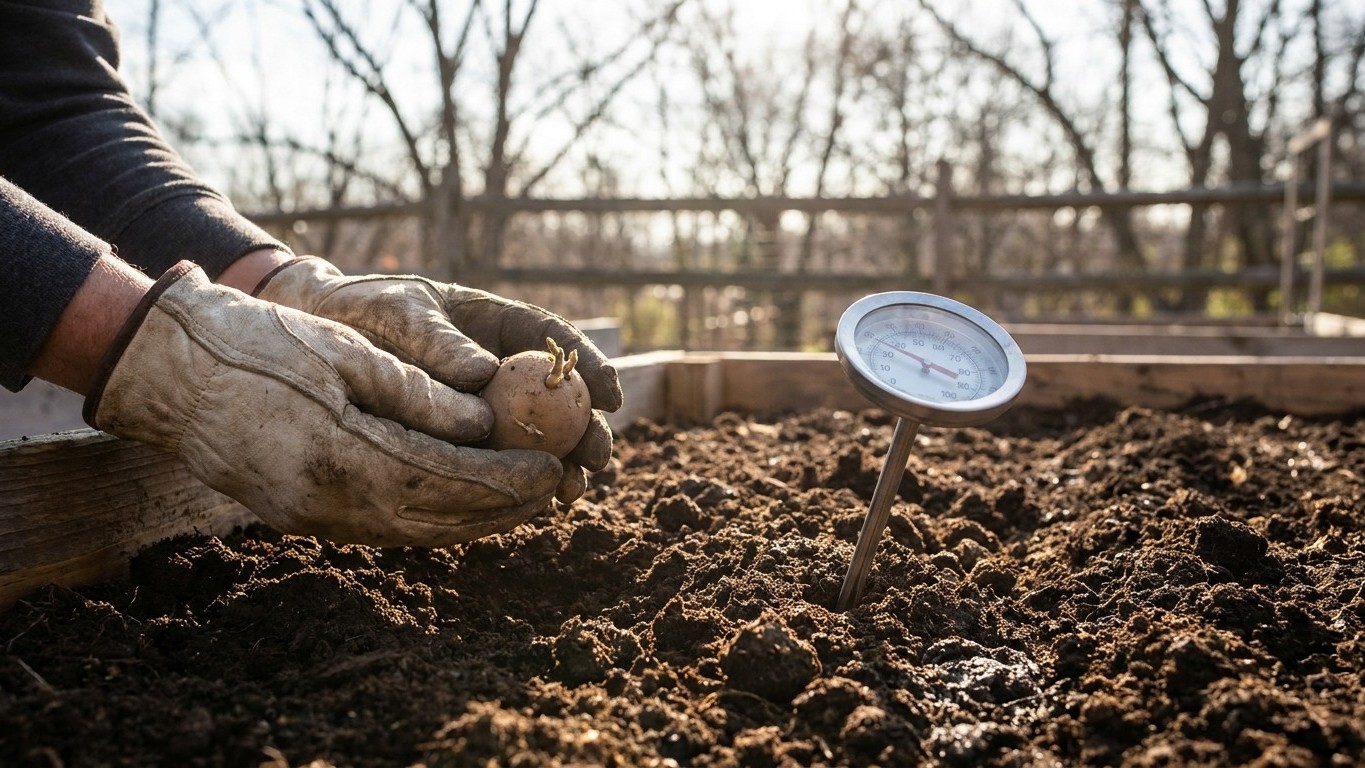

The short answer: count back 14 to 21 days from your last frost date, once soil temperature hits 50°F. For the Atlanta area, NOAA’s 1991-2020 Climate Normals put that last frost window between March 11 and March 29, which pushes seed potatoes into the ground somewhere between mid-February and mid-March. But that window shifts hard depending on where in Georgia you’re standing.
The short answer
NOAA NCEI’s 1991-2020 Climate Normals for station USW00013874 (Atlanta) put the last spring freeze at 32°F somewhere between March 11 and March 29. That’s the 30-70% probability band, meaning frost is a real possibility on either end and mostly gone by the far side of it. Potatoes don’t go in on the frost date itself. Utah State University Extension and the University of Maine Cooperative Extension both frame the planting trigger as soil temperature, not calendar date: seed potatoes go in the ground once soil reaches 50°F, and that point typically lands 14 to 21 days ahead of the last frost.
Run the math against the Atlanta window and you get a planting range, not a single date. Subtract 21 days from the earliest frost date (March 11) and you land on February 18. Subtract 14 days from the latest frost date (March 29) and you land on March 15. So for gardeners near the Atlanta reference station, the counting-back method points to a window roughly from mid-February to mid-March.
That’s Atlanta’s number, not Georgia’s. The station sits at an urban airport, which runs warmer than the surrounding countryside because pavement and buildings hold heat overnight. North Georgia and the mountain counties see their last frost weeks later than Atlanta does, and their first fall frost arrives weeks earlier too. The coastal plain runs the other direction, staying frost-free longer on both ends of the season. None of that changes the mechanism. It changes which date you count back from.
What doesn’t shift is the reasoning itself. Soil temperature triggers planting. A window of 14 to 21 days ahead of your local last frost is when that soil crosses 50°F in most years. If you garden outside the Atlanta metro, the honest move is to treat March 11-29 as a reference point for the middle of the state and adjust outward from there using your own soil thermometer, not a wishful guess.
What actually decides it
Soil temperature, not the calendar
A calendar date is a proxy. Soil temperature is the actual trigger, and the two don’t always line up. A cold, wet spring can leave soil sitting in the 40s well past the date a calendar-based plan would call for planting. A warm early spring can push soil past 50°F ahead of schedule. Utah State’s fact sheet and Maine’s Bulletin #2077 both anchor the planting decision to that 50°F mark because seed pieces sitting in colder soil are prone to rot before they sprout. The 14-to-21-day window before last frost is a useful estimate precisely because soil usually warms to 50°F in that stretch, not because the frost date itself matters to the tuber.
The heat ceiling that ends the season
The other end of the mechanism matters just as much, more in Georgia. Tuber set and fill shut down when soil temperature climbs above 90°F. Watering more doesn’t reverse it. Once that threshold hits, the plant stops sizing tubers regardless of how green the foliage looks above ground. This is the fact that should actually drive a Georgia gardener’s planning, more than the frost date does. Georgia racks up a lot more 90°F soil days than a place like Maine, so the practical strategy is to plant as early as soil allows and treat potatoes as a spring crop that finishes before summer heat locks in, rather than nursing them through a Georgia summer.
Why Atlanta’s date doesn’t travel
The frost window quoted above comes from one station, at one airport, in one city. Apply it uncritically to a mountain garden in the far north of the state and you’ll plant too early, hitting a fall or late-spring cold snap the Atlanta data never accounted for. Apply it to the coastal plain and you’re likely leaving weeks of safe planting time on the table. The mechanism (count back from local last frost, watch for 50°F soil, race the 90°F ceiling) travels everywhere in the state. The specific date does not.
How to do it
- Identify your local last-frost estimate. If you’re near the Atlanta metro, the reference window is March 11 to March 29. If you’re farther north or in the mountains, expect that window to run later; if you’re on the coastal plain, expect it earlier.
- Count back 14 to 21 days from that local estimate to set a target planting window, following the Utah State and Maine guidance on lead time before last frost.
- Check actual soil temperature with a soil thermometer rather than trusting the calendar alone. Planting begins once the soil reaches 50°F.
- Source certified seed potatoes. Uncertified seed, including potatoes bought for eating, can carry viruses that stunt or wipe out a planting with no visible warning until the crop fails.
- Cut larger seed potatoes into pieces with at least one or two eyes each, and let cut pieces cure for a day or two before planting so the cut surface seals over.
- Plant seed pieces in a trench a few inches deep, spaced apart, and cover with soil.
- Hill soil up around the stems as plants grow, which protects developing tubers from light and gives them more room to size.
- Track the forecast for when soil is likely to cross 90°F, and choose an early or mid-season variety so the crop finishes sizing before that ceiling shuts tuber growth down.
What goes wrong
- Planting by a fixed calendar date instead of checking soil temperature. A cold spring can leave soil in the 40s past the date a calendar plan called for. Check with a soil thermometer and wait for 50°F rather than planting on a fixed day.
- Using grocery-store potatoes as seed. Store potatoes aren’t certified and can carry viruses invisible until the crop underperforms. Buy certified seed potatoes instead.
- Waiting too long to plant. Since Georgia soil crosses 90°F well before a northern garden’s would, a late planting risks the tuber-set ceiling arriving before tubers finish sizing. Plant at the early edge of the 14-to-21-day window and choose an early or mid-season variety.
- Applying the Atlanta frost window statewide. A mountain garden or a north Georgia county can freeze weeks later in spring than the Atlanta reference station; a coastal plain garden can be safely plantable weeks earlier. Adjust the reference date to your own region before counting back.
- Planting into cold, waterlogged soil. Seed pieces sitting in soil below 50°F are prone to rot before sprouting. If a wet cold spell hits right at your planned window, hold off a few days rather than planting on schedule.
Common questions
Can I plant a second potato crop in Georgia later in the year?
The sources used on this page address spring planting timed to soil temperature and the last frost, and don’t publish a fall-planting protocol for Georgia specifically. Given the 90°F soil ceiling that shuts down tuber set, any later planting would need to avoid summer’s hottest soil temperatures, which narrows the window considerably in most of the state.
Which potato varieties work best in Georgia’s heat?
Neither Utah State nor the University of Maine publishes a days-to-maturity figure for potato varieties, so no specific number belongs here. What both sources do classify is season length: early, mid-season, or late. Given Georgia’s early arrival of 90°F soil, an early or mid-season variety gives the crop the best chance of finishing tuber fill before the heat ceiling shuts growth down. For use, look at what a variety is described as being for, such as baking or boiling, rather than texture terms not used in these fact sheets.
Do I need to wait until all frost risk has passed before planting?
No. The planting trigger is soil reaching 50°F, which lands 14 to 21 days ahead of the last frost date according to Utah State and Maine Extension guidance. Potato foliage that emerges before the last frost can take some cold, and gardeners commonly hill soil over young shoots if a late frost threatens.
How do I actually check if my soil has hit 50°F?
A basic soil thermometer inserted a few inches into the planting bed, checked in the morning over a few consecutive days, gives a more reliable answer than any calendar estimate. This matters more in Georgia than in a single-season northern climate, since local microclimates (raised beds, south-facing slopes, heavy clay versus sandy soil) can warm at different rates even within the same county.