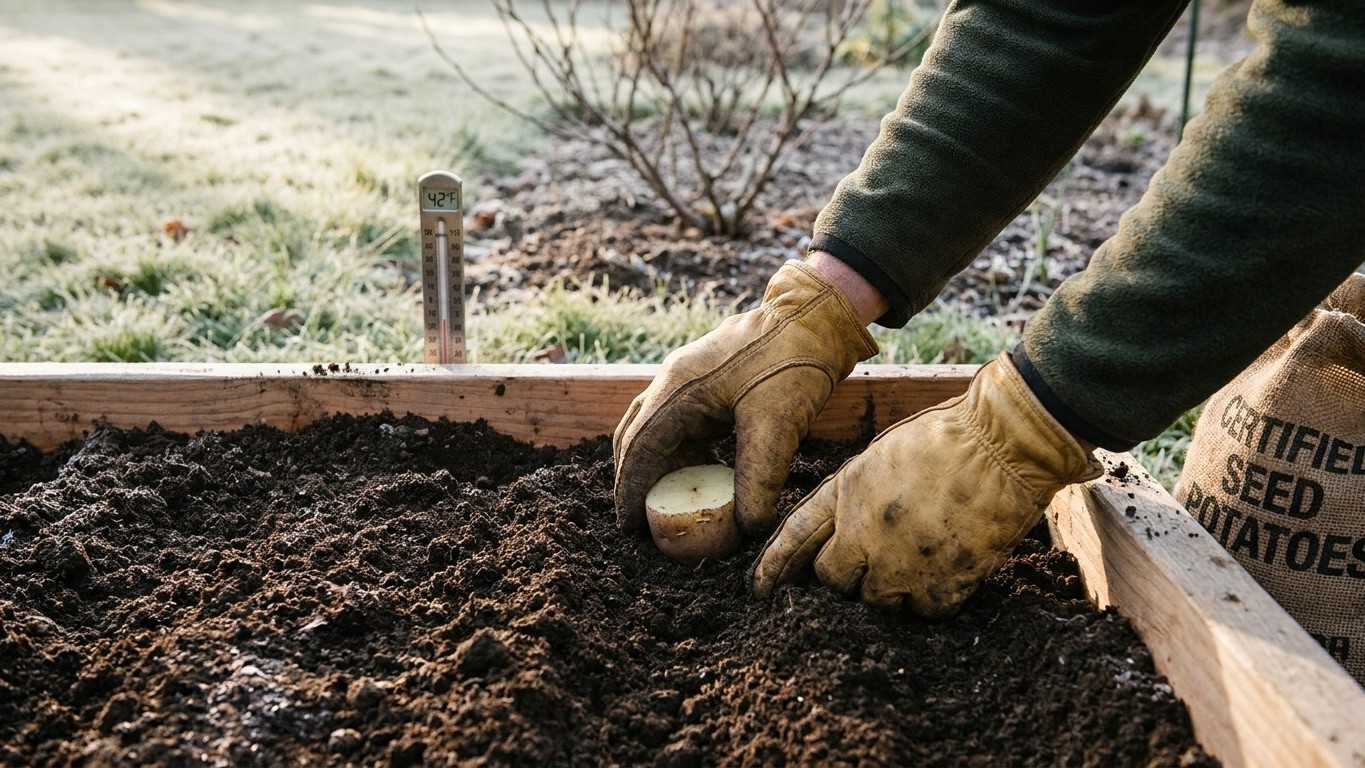

Plant potatoes in Illinois between roughly March 21 and April 8, counting back 14 to 21 days from the April 11 to April 22 last-frost window that NOAA’s National Centers for Environmental Information reports for the Chicago-area reporting station (1991-2020 Climate Normals). That window moves county by county. The real trigger isn’t a date on a calendar at all. It’s soil temperature.
The short answer
NOAA NCEI’s 1991-2020 Climate Normals put the 30-70% probability band for a 32 F freeze at the Chicago station between April 11 and April 22. That’s the figure this whole calculation runs on, and it’s worth saying plainly: it comes from one airport weather station, not from a statewide survey. Illinois runs roughly 380 miles from its northern border to its southern tip, and a frost date measured near Chicago tells you almost nothing about Cairo or Carbondale.
Working from that Chicago figure, Utah State University Extension and the University of Maine Cooperative Extension both describe the same mechanism for timing a potato planting: get seed in the ground 14 to 21 days before the expected last frost, because potatoes don’t wait for frost-free conditions the way tomatoes or peppers do. Applied to the April 11-April 22 window, that math lands the planting date somewhere between March 21 and April 8 for gardens near that reference station.
Your own yard is very likely not that station. NOAA’s own caution about these Climate Normals holds true here as it does everywhere: suburban and rural gardens, especially those tucked into low spots or away from the heat-holding pavement of a city, typically see their last spring frost land later than the airport figure, sometimes by one to two weeks, and more if you’re at higher elevation or in a valley that pools cold air. A gardener in a rural county well outside the Chicago metro area should treat April 22 as an early guess, not a hard date, and push their own planting window later rather than earlier if local frost patterns run behind the reference station.
None of this is about picking a single perfect day. It’s about a window, bounded on one side by frost risk and on the other by a much less obvious limit: how much summer heat is coming and how fast. That second limit is where a lot of Illinois potato crops actually fail, and it’s the subject of the next section.
What actually decides it
Two separate mechanisms set the planting window, and they pull in different directions. Frost risk says don’t rush. Soil biology says don’t wait. Understanding both lets you make a call for a piece of ground this page has never seen.
Soil temperature, not the calendar
Utah State University Extension’s fact sheet on garden potatoes is specific about the actual trigger: potatoes go into the ground as soon as the soil reaches 50 F, and that threshold is frequently reached before the last frost date arrives on the calendar. That’s why the 14-to-21-day count-back exists in the first place. It’s not a superstition or a rule of thumb pulled from a farmer’s almanac. It’s a translation of “wait for 50 F soil” into a date range a gardener can use without owning a soil thermometer, built around how long it typically takes soil to warm through that stretch of spring. Frost can still nip young potato foliage that emerges early, but the seed piece underground, sitting a few inches down, is more insulated than people expect, and light foliage damage from a late frost rarely kills an established planting.
The 90 F ceiling on tuber sizing
The other mechanism runs in the opposite direction, and it’s the one gardeners underestimate. Both Utah State University Extension and the University of Maine Cooperative Extension’s Bulletin #2077 describe the same heat ceiling: once soil temperatures climb above 90 F, tuber set and tuber fill are inhibited. Watering more does not fix this. The plant isn’t thirsty; it’s simply past the temperature range where it can size tubers efficiently. That single fact reframes the whole planting decision for a lot of Illinois ground. In counties that log a lot of days above 90 F, particularly across the southern half of the state where summer heat arrives earlier and holds longer, the answer isn’t to baby a potato crop through July and August. It’s to plant as early as soil conditions allow and treat the crop as a spring harvest, digging before the soil load of heat builds up, rather than trying to nurse it through a hot summer the way you might with a heat-tolerant vegetable.
How to do it
- Pull your own county’s frost data rather than defaulting to the Chicago-area figure; a local extension office or a personal record of past frost dates will get you closer than a single airport station.
- Count back 14 to 21 days from that local last-frost estimate to mark a planting window, adjusting later rather than earlier if your site is rural, low-lying, or at elevation.
- Buy certified seed potatoes rather than grocery-store tubers; uncertified seed carries a real risk of virus that a grocery potato gives no way to check for.
- Check actual soil temperature at planting depth with a soil thermometer instead of relying on air temperature or the date alone.
- Plant once soil reads at or above 50 F, even if that date falls earlier than the frost window suggests it should.
- Choose a season class, early, mid-season, or late, that matches how much cool growing time your ground realistically offers before summer heat builds.
- Track soil temperature through the growing season; if readings are trending toward the 90 F range well before the plants have finished sizing tubers, plan to dig sooner rather than let the crop sit in overheated soil.
What goes wrong
- Planting strictly by the calendar date instead of soil conditions. A date on paper doesn’t account for a cold, wet spring that keeps soil below 50 F well past the count-back window. Check soil temperature directly before planting rather than trusting the date alone.
- Using the Chicago-area frost window as a statewide rule. A gardener in a rural county with a later local frost pattern who plants on the Chicago-derived date can lose young foliage to a frost that hadn’t finished for their specific site. Adjust the window using local data, not the reference station’s figure.
- Planting uncertified seed potatoes from the grocery store. These carry a real risk of virus that certified seed programs are built specifically to screen out, and a virus problem shows up as weak plants and poor yield with no obvious fix mid-season. Buy certified seed from the start.
- Treating a hot Illinois summer like a minor inconvenience. Once soil temperatures push past 90 F, tuber set and fill shut down, and extra watering does nothing to reverse it. In areas that log a lot of days that hot, plant as early as soil allows and dig before peak heat rather than letting the crop sit through it.
- Ignoring the season class when choosing a variety. A variety suited to a longer, cooler season planted in ground that runs hot fast may not finish sizing before the 90 F ceiling arrives. Match the season class, early, mid-season, or late, to how much cool growing window your site actually offers.
Common questions
What if my county doesn’t match the Chicago-area frost dates NOAA reports?
It almost certainly doesn’t match exactly. The April 11-April 22 window comes from one specific reporting station, and NOAA’s own data shows this kind of figure varies meaningfully across a state as long as Illinois. Use it as a rough anchor, then lean on local records or a county extension office for a number closer to your actual garden.
Can I plant potatoes before the last frost date?
Yes, and both Utah State University Extension and the University of Maine Cooperative Extension describe this as the normal approach: potatoes are meant to go in once soil hits 50 F, which is commonly 14 to 21 days before the last frost date, not after it.
Do I really need certified seed potatoes, or will store-bought potatoes sprout fine?
Store-bought potatoes may well sprout. The issue is virus, which certified seed programs specifically screen for and grocery tubers don’t. A virus-affected planting can look fine early and still underperform badly by harvest, with no way to trace the cause back to the seed.
What happens if a heat wave hits before my potatoes finish sizing?
Once soil temperature crosses 90 F, tuber set and fill slow down regardless of watering. If that’s a regular pattern where you garden, particularly in the warmer parts of the state, the more reliable fix is planting earlier and harvesting before peak heat rather than trying to push a crop through it.