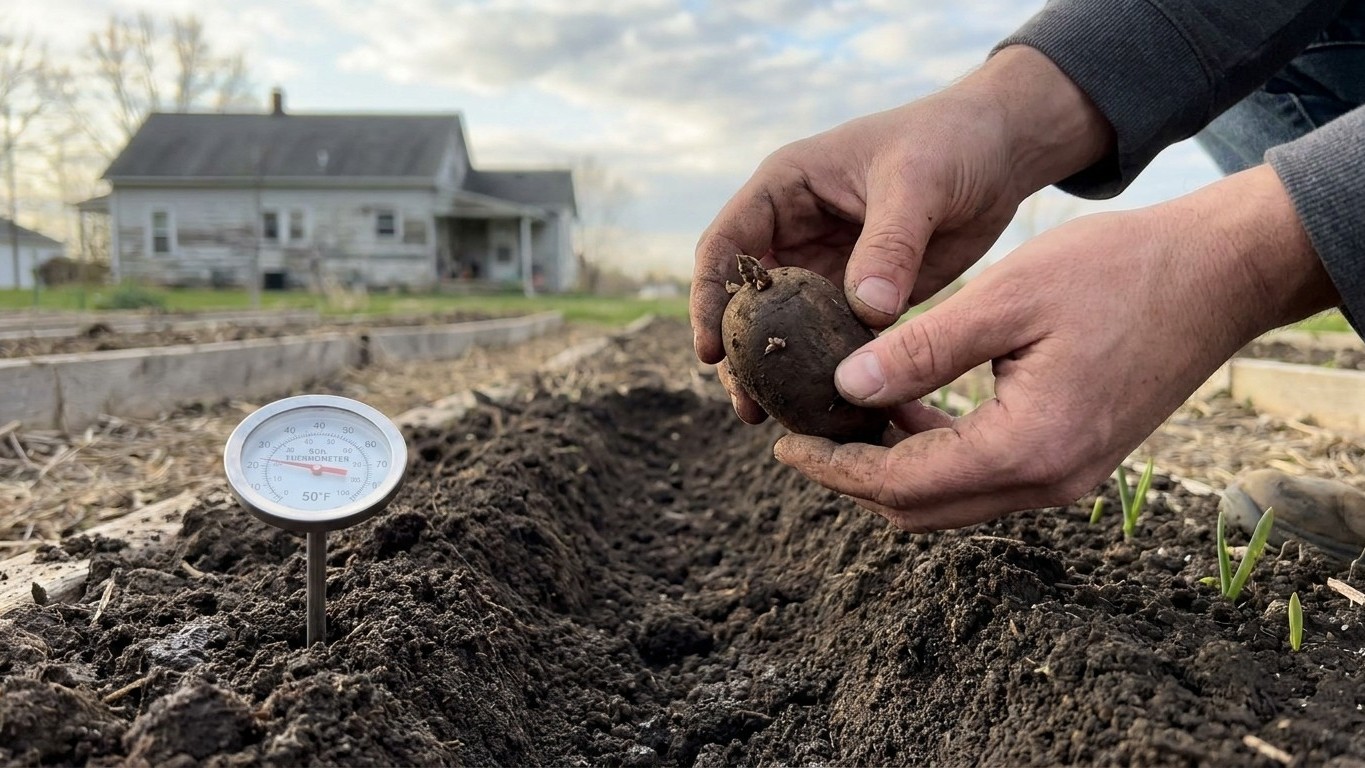

Count back 14 to 21 days from your last spring frost and plant when soil temperature hits 50°F, not by the calendar alone. In the Indianapolis area, that frost date falls between April 9 and April 21, based on NOAA climate data. That puts seed potatoes in the ground roughly mid-to-late March there, earlier south, later north.
The short answer
The reference point for this whole calculation is NOAA’s National Centers for Environmental Information, using the 1991-2020 Climate Normals for station USW00093819 in Indianapolis. That data sets the 32°F freeze probability window, meaning the range where the odds of a damaging frost drop from likely to unlikely, at April 9 to April 21. That’s not a single date you circle on a calendar. It’s a two-week band where the risk shifts, and gardeners have to decide where in that band they’re comfortable planting.
Potatoes don’t wait for the frost date itself. Both Utah State University Extension and the University of Maine Cooperative Extension describe the same planting trigger: get seed potatoes in the ground once soil temperature reaches 50°F, which lands 14 to 21 days ahead of the last frost date, not after it. So for the Indianapolis reference point, working back from April 9 to April 21 puts the planting window somewhere in the last half of March into early April, depending on how quickly that particular spring’s soil warms.
That’s the Indianapolis figure, and it’s worth saying plainly: it’s not a statewide figure. NOAA’s normals are calculated per station, and Indianapolis is one station. Southern Indiana counties along the Ohio River run earlier in spring and later in fall than the Indianapolis reference by two weeks or more. A gardener near Evansville working off the Indianapolis date is planting too late. A gardener near South Bend using that same date risks planting too early. The band itself, April 9 to April 21, is specific to the Indianapolis station and should be treated as a starting point for that region, not a rule for the state.
There’s also a residual risk built into that window that’s easy to miss. Even after the published spring frost date passes, Purdue notes there remains roughly a 10% chance of a 32°F event. Gardeners planting on the early edge of the range, especially in a year that feels warm in March, should have row cover or extra soil ready to hill over emerging shoots. Potato foliage that gets nipped by a late frost usually recovers from the base, but it costs the plant time and vigor it won’t get back.
What actually decides it
The frost date tells you when the air stops threatening young foliage. It doesn’t tell you when the ground is ready, and it says nothing about what happens later in the season when temperatures climb. Three separate mechanisms are stacked into that single planting window, and each one can override the others depending on where you garden.
Soil temperature, not air temperature
Seed potatoes don’t respond to the thermometer on the porch. They respond to what’s happening a few inches down, where the eyes are sitting in contact with soil moisture and warmth. Utah State University Extension and the University of Maine Cooperative Extension both anchor planting to that 50°F soil threshold, not to the air frost date. Soil warms unevenly. A raised bed in full sun can hit 50°F a week or more ahead of a heavy clay garden bed in shade, even on the same property, on the same day. That’s why the 14-to-21-day window before frost is a range and not a fixed number: it’s accounting for how differently soil behaves from one yard to the next, even within the same county.
The heat ceiling that ends the season early
The mechanism that decides whether a crop actually fills out has almost nothing to do with planting date and everything to do with what happens in July. Tuber set and fill get inhibited once soil temperatures climb above 90°F. That’s not a slowdown that more watering can undo. Once the soil crosses that line, the plant redirects its energy and the tubers simply stop sizing, regardless of how much irrigation follows. This is the fact that should shape a gardener’s whole approach in a state where summer soil temperatures regularly climb past that mark. The response isn’t to baby a struggling plant through August. It’s to plant as early as the frost window safely allows, so the bulk of tuber bulking happens before the soil ceiling gets crossed, and to think of the harvest as a spring-into-early-summer crop rather than a full-season one.
Frost risk isn’t uniform across the state
A gardener reasoning about a location this page hasn’t named should start with the same two questions: how does the local last-frost window compare to Indianapolis, and how many days a typical summer there spends above that 90°F soil ceiling. Southern counties get an earlier planting window but also hit that heat ceiling sooner, which shortens the safe bulking period from the other end. Northern counties get more breathing room from summer heat but a later, tighter spring window. The two mechanisms pull in opposite directions, and neither the frost date nor the heat ceiling alone answers the question. Both have to be weighed together.
How to do it
- Get a soil thermometer and start checking the planting bed in early spring, testing at planting depth rather than the surface, since surface soil can read warmer than what the seed piece will actually sit in.
- Track the local last-frost expectation for your part of Indiana, remembering that the Indianapolis station’s April 9 to April 21 window runs earlier in the south and later in the north by two weeks or more.
- Count back 14 to 21 days from that local frost expectation, and use that window as the target planting period rather than a single fixed date.
- Plant once soil temperature reaches 50°F, even if that happens on the early or late edge of the counted-back window, since soil temperature is the trigger the sources point to, not the calendar day.
- Source certified seed potatoes rather than grocery-store tubers or last year’s saved stock; uncertified seed carries virus that shows up as weak, stunted growth partway through the season, and there’s no in-season fix once it’s in the seed piece.
- Choose a season class suited to the local heat timeline, favoring early or mid-season types where summer soil regularly climbs past 90°F, since the harvest needs to land before that ceiling shuts tuber fill down.
- Keep frost protection, row cover, extra mulch, or soil for hilling, ready through the first few weeks after planting, since Purdue’s data shows roughly a 10% chance of a 32°F event even after the published spring frost date passes.
- Hill soil around emerging shoots as they grow, which also gives quick cover if a late cold snap threatens young foliage.
What goes wrong
- Planting by the calendar instead of the soil. A gardener plants on a date that worked in a different area, or a date pulled from a general guide, without checking actual soil temperature. The fix is simple: use a soil thermometer at planting depth and wait for 50°F, adjusting the calendar date year to year rather than treating it as fixed.
- Using the Indianapolis frost window for a location two weeks off from it. Southern Indiana gardeners who plant on the Indianapolis date are planting too late and losing bulking time before the summer heat ceiling arrives. Northern gardeners using that same date risk a frost hit on tender shoots. The remedy is to treat the Indianapolis station data as a reference point to adjust from, earlier south, later north, not as a statewide instruction.
- Assuming more water fixes a stalled crop in midsummer. Once soil crosses 90°F, tuber set and fill are inhibited regardless of irrigation. Extra watering at that point doesn’t restart sizing; it just keeps the plant alive without adding yield. The remedy is upstream, not downstream: plant early enough, and pick a season class suited to the local heat timeline, so the crop matures before soil temperatures climb that high.
- Saving grocery-store or last year’s tubers as seed. Uncertified seed potatoes routinely carry virus that isn’t visible when the seed piece is cut, but shows up later as weak, uneven growth that can’t be corrected once the plant is up. The remedy is buying certified seed potatoes each season rather than reusing tubers of unknown health.
- Planting too early without frost protection on hand. Gardeners aiming for the earliest edge of the counted-back window sometimes skip preparing row cover or extra hilling soil, assuming the frost date has passed. Purdue’s data shows a residual 10% chance of a 32°F event even after that date, so protection should be ready before, not scrambled for after a cold night is forecast.
Common questions
Does the same frost window apply across all of Indiana?
No. The April 9 to April 21 window comes from the Indianapolis station specifically. Southern Indiana’s last frost typically arrives earlier in spring, and northern Indiana’s arrives later, by two weeks or more in each direction.
Can I plant potatoes before the last frost date?
Yes, and both Utah State University Extension and the University of Maine Cooperative Extension describe this as normal practice. The 50°F soil trigger typically falls 14 to 21 days ahead of the last frost date, since potato foliage that emerges can tolerate light frost exposure better than many other garden crops, especially with hilling or row cover on hand.
What happens if summer gets too hot after planting?
Once soil temperatures climb above 90°F, tuber set and fill are inhibited, and irrigation doesn’t reverse that. Choosing an early or mid-season variety and planting as soon as the frost window safely allows helps the crop finish bulking before that heat ceiling arrives.
Is it safe to plant potatoes from seed saved out of last year’s harvest?
It’s not recommended. Uncertified seed potatoes, including grocery-store tubers or last year’s saved crop, commonly carry virus that weakens the plant partway through the season. Certified seed is the way both extension sources address this risk.