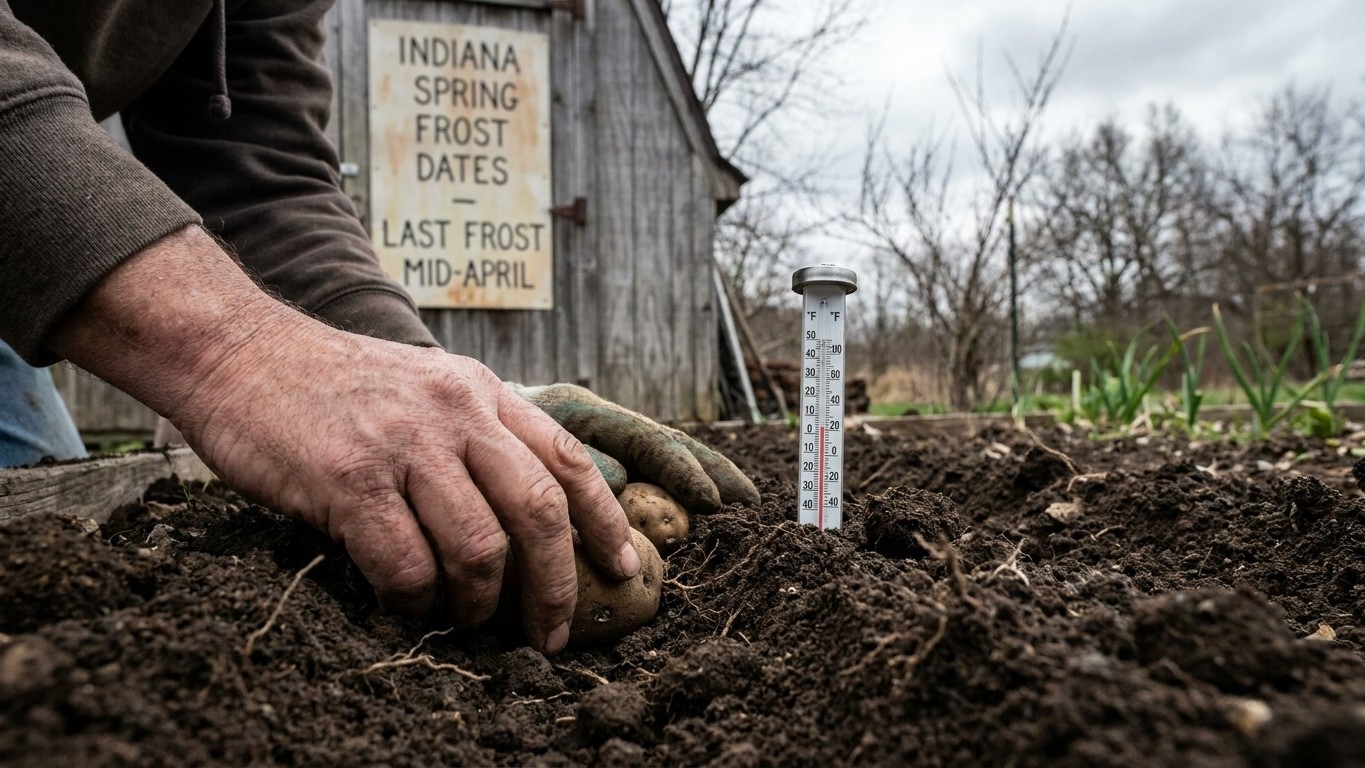

The direct figure to plant a season around is the frost window itself: in Indianapolis, the last spring frost falls between April 9 and April 21, according to NOAA’s 1991-2020 Climate Normals for station USW00093819. Potatoes go in the ground once soil hits 50 degrees, which lands 14 to 21 days ahead of that date. That single overlap of soil temperature and frost timing is what separates a variety that thrives in Indiana from one that struggles.
The short answer
Early-season and mid-season potatoes are the safer bet across most of Indiana, and the reason traces straight back to that NOAA frost window and the heat mechanism published by Utah State University Extension and the University of Maine Cooperative Extension. Soils above 90 degrees stop tuber set and fill outright, and no amount of watering reverses that once it happens. Indiana summers routinely run long stretches of heat that push soil past that ceiling, especially in the southern half of the state, which is exactly the kind of stretch that punishes a late-season variety still trying to size tubers in July.
Planting timed to the Indianapolis frost window, 14 to 21 days before April 9 to April 21 for the soil to reach 50 degrees, gives an early or mid-season crop enough runway to bulk tubers before the hottest weeks arrive. A late-season type planted on the same calendar is still filling out when the heat ceiling closes the door, and that’s the mismatch that shows up as small, disappointing potatoes at harvest.
None of this means late-season potatoes are off the table everywhere in Indiana. Northern counties, where summer heat breaks sooner and cooler nights return earlier, give a late crop a longer usable window before that 90-degree soil threshold becomes the norm rather than the exception. Southern Indiana, running a growing season that starts earlier and ends later than the north by two weeks or more, faces the opposite trade: an earlier spring start helps, but the string of hot soil days in the middle of summer runs longer too.
The practical takeaway for someone standing in a garden center reading variety tags: look for the season class printed on the label, early, mid-season, or late, rather than any promised days-to-maturity count, and match that class to how much cool soil time exists between the 50-degree planting mark and the first stretch of 90-degree soil in your part of the state. That’s the whole decision, reduced to two numbers most seed catalogs already give you.
What actually decides it
The frost-to-soil-temperature overlap
Potatoes aren’t planted on a frost date. They’re planted on a soil temperature, and that soil temperature happens to arrive 14 to 21 days before the last frost, according to Utah State University Extension and the University of Maine Cooperative Extension. That gap matters because it means the tubers are already underground and sprouting while frost risk is technically still active. Purdue’s own caution, folded into the NOAA data, notes roughly a 10 percent chance of a 32-degree event even after the published spring date, which is why gardeners on the early edge of that Indianapolis window keep row cover on hand rather than assuming the calendar has closed the door on frost.
The heat ceiling that ends the season early
The mechanism that actually decides variety choice is not frost at all, it’s the 90-degree soil ceiling. Above that threshold, tuber set and fill stop, full stop, regardless of season class. A gardener who never learns this will keep watering a stalled crop through August wondering why the potatoes stayed small. The fix isn’t more water, it’s timing: get an early or mid-season variety in the ground early enough that most of its bulking happens before soil temperature climbs into that range, rather than trying to push a long-season variety through a summer that closes the growing window on it.
The north-south split inside one state
Indiana isn’t one climate. Southern counties run a growing season that starts earlier and ends later than the north by two weeks or more, which sounds like an advantage until you account for how much longer the middle of that season spends above the heat ceiling. Northern Indiana trades a shorter frost-free season for a summer that breaks its heat sooner, which is often the better trade for anyone hoping to push a late-season variety to full size. A reader gardening somewhere the article never names, say a county on the Ohio River versus one near the Michigan line, should run this same two-part check: how many days sit between the local 50-degree soil mark and the local last frost, and how many weeks of 90-degree soil does the middle of summer typically bring.
How to do it
- Check soil temperature directly with a probe thermometer rather than guessing from air temperature; potatoes go in once soil reads 50 degrees.
- Count backward from the local last-frost window (April 9 to April 21 in Indianapolis, earlier in southern counties, later toward the Michigan line) to confirm that 50-degree soil mark falls 14 to 21 days ahead of it.
- Choose a season class, early or mid-season for most of the state, based on how many weeks typically pass before local soil crosses 90 degrees in summer.
- Source certified seed potatoes rather than saving grocery-store tubers or last year’s uncertified stock; uncertified seed carries virus that no amount of good soil management fixes later.
- Cut and cure seed pieces if needed, then plant once the soil temperature check from step one is met, not on a fixed date alone.
- Hill the rows as stems emerge, keeping developing tubers covered and cool, which helps buy a little extra margin against the heat ceiling later in the season.
- Watch soil temperature again as summer progresses; once it holds above 90 degrees, understand that tuber sizing has stopped for that stretch, regardless of watering.
- Dig early and mid-season varieties as their foliage dies back, before the longest heat stretch of summer fully sets in, rather than leaving them in the ground hoping for more size.
What goes wrong
- Planting on the calendar instead of the soil. A gardener who plants on a fixed date without checking soil temperature can miss the 50-degree mark by a wide margin in either direction. The remedy is simple: buy a soil thermometer and use it instead of the calendar alone.
- Choosing a late-season variety in a short-summer county. Where the gap between the 50-degree soil mark and the onset of 90-degree soil is narrow, a late-season type never finishes sizing. Switch to an early or mid-season class instead, matched to the local heat timeline rather than the seed catalog’s regional average.
- Watering a stalled crop through a heat spell. Once soil holds above 90 degrees, more water does not restart tuber fill; it just keeps foliage alive while nothing happens underground. The only fix is timing the crop earlier next season, not irrigating harder this one.
- Planting uncertified seed. Grocery-store potatoes or saved tubers from a home garden often carry virus that stunts the whole row invisibly until harvest. Certified seed potatoes, sourced fresh each season, remove that risk entirely.
- Ignoring the 10 percent late-frost chance. Planting right at the early edge of the Indianapolis frost window without cover on hand means a late freeze can still hit emerging sprouts. Keep row cover ready through the first two weeks after planting, especially in years the window runs on the early side.
- Treating the whole state as one climate. A planting plan built for Indianapolis alone can run two weeks off in either direction for a southern Indiana or far-northern garden. Adjust the frost date and the length of the summer heat window to the local county rather than defaulting to the Indianapolis figure.
| Factor | Northern Indiana | Southern Indiana |
|---|---|---|
| Growing season length | Shorter, frost lingers later into spring | Longer, starts earlier and ends later by two weeks or more |
| Summer heat stretch above 90 F soil | Tends to break sooner | Tends to run longer through midsummer |
| Best-fit season class | Early, mid-season, sometimes late where heat breaks early enough | Early, mid-season prioritized to finish before extended heat |
Common questions
What is the best potato season class for most of Indiana?
Early-season and mid-season classes fit most of the state best, since they finish sizing tubers before the longest stretch of 90-degree soil arrives, a threshold documented by Utah State University Extension and the University of Maine Cooperative Extension.
When should potatoes go into the ground in Indiana?
Once soil reaches 50 degrees, which falls 14 to 21 days before the last spring frost. In Indianapolis that frost window runs April 9 to April 21 per NOAA’s Climate Normals; southern counties run earlier, northern counties later.
Why does soil temperature matter more than the variety name on the seed bag?
Because tuber set and fill stop once soil exceeds 90 degrees, regardless of what variety is planted. The season class, early, mid-season, or late, determines how much bulking happens before that ceiling hits, which is why matching class to local heat timing matters more than any single variety’s reputation.
Is certified seed really necessary for a small backyard plot?
Yes. Uncertified seed, including saved tubers or grocery-store potatoes, can carry virus that stunts growth invisibly until harvest reveals small, weak yields. Certified seed removes that risk from the start.