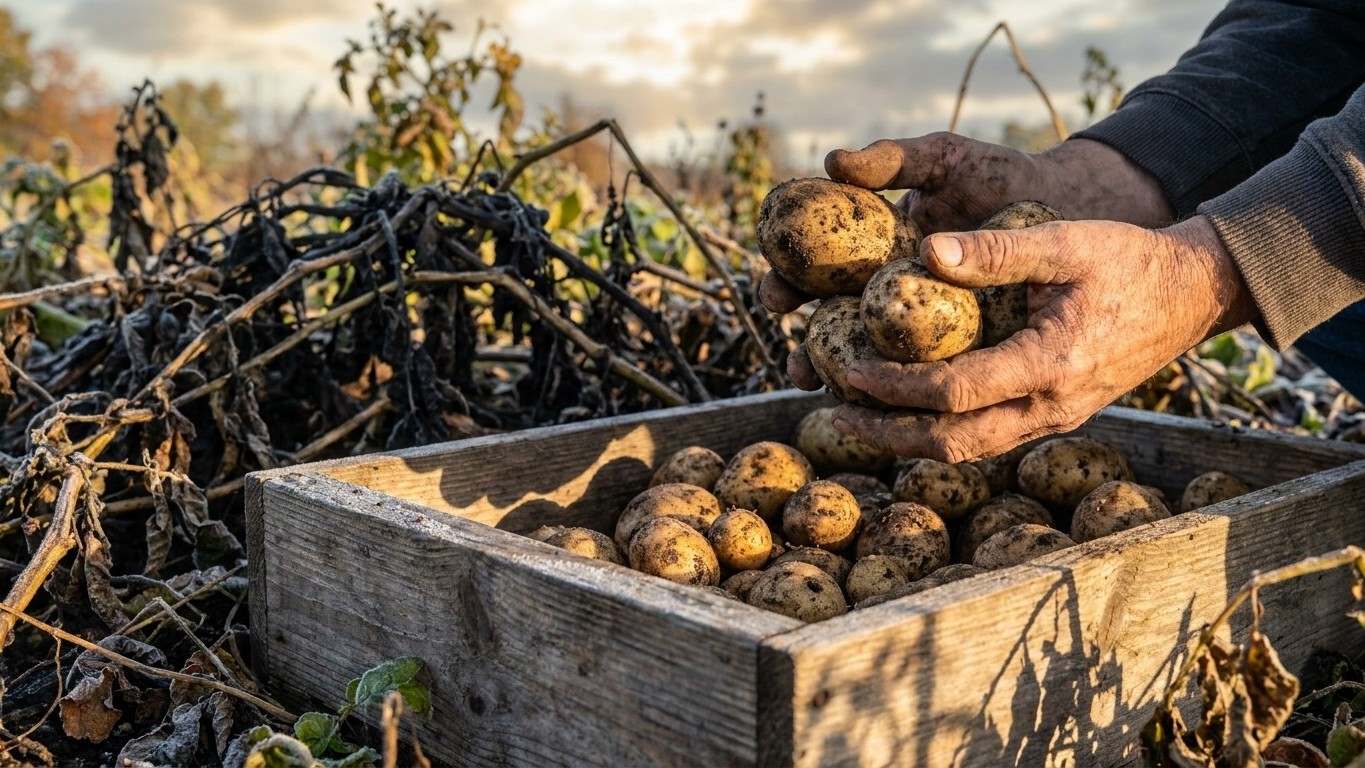

In Indiana, potatoes come out of the ground before the first fall frost knocks the vines down, usually in the back half of October, then spend two to three weeks curing before they go into cold, dark storage for winter. The hard part isn’t the digging. It’s finding a spot that holds close to 40-45°F without slipping below freezing, since the state’s coldest month runs well under that mark. Get the curing and storage numbers right, and a home crop keeps for months.
The short answer
Indiana’s first fall frost, measured at the Indianapolis reference station, arrives between October 21 and October 30 in a typical year, according to NOAA NCEI’s 1991-2020 Climate Normals. That’s the marker gardeners watch. Once frost blackens the potato vines, the tubers below have stopped bulking and it’s time to dig, not wait. Southern Indiana tends to run later than this window by a couple of weeks or more, while the far north can see frost arrive earlier, so a Evansville garden and a South Bend garden aren’t on the same calendar even though they’re in the same state.
The frost that ends the season
That October window matters for another reason: it tells you how much daylight and warmth is left to finish curing outdoors before the weather turns. Dig too close to the frost date and you’re racing falling temperatures to get the crop cured before real cold sets in.
What the coldest month means for storage
Here’s the number that decides whether a garage or shed will actually hold potatoes all winter: Indiana’s coldest month has a mean daily minimum of 20.9°F, per the same NOAA NCEI dataset. That’s not the record low for the season, it’s the average low on an ordinary night in the coldest stretch of winter. An unheated, uninsulated structure in Indiana is going to sit well below the 40-45°F range that Utah State University Extension calls for in storage, and well below the 38°F the University of Maine Cooperative Extension recommends at high humidity. Left unprotected in a detached garage through January, a bin of potatoes will freeze solid. That single fact drives almost every decision that follows, from where you cure the crop to where you store it.
Curing, and where
Curing is the step people skip and regret. Utah State University Extension calls for 55-60°F and high humidity, held for two to three weeks, before potatoes go into long-term storage. Skip it, and the skins stay thin and the tubers bruise and rot faster in the bin. The trouble in Indiana is timing: by the time frost has ended the season in late October, outdoor air is often already cooler than 55°F overnight, so a shaded porch that would work fine in September can undershoot the curing range by the time the crop is actually dug.
Step-by-step
- Dig on a dry day, once the vines have died back from frost or old age, and let the tubers sit on top of the soil for an hour or two to dry off, out of direct sun.
- Brush off loose dirt by hand. Don’t wash the potatoes and don’t scrub the skins; a damp potato going into curing is an invitation to rot.
- Move them somewhere holding 55-60°F with high humidity for two to three weeks. In most Indiana homes at this time of year, that’s a basement, not a porch or open garage, since basements stay buffered by the surrounding earth and hold steadier temperatures than any above-ground space once the weather turns cold.
- If the basement runs dry, cover the bins loosely with damp burlap or set an open pan of water nearby to keep humidity up without soaking the tubers.
- Check the pile after a week for soft spots or rot and pull any bad ones before they spread.
Storing through this winter
Once cured, potatoes want the opposite of curing conditions: cold and dark instead of warm and humid. Utah State University Extension puts long-term storage at 40-45°F, while the University of Maine Cooperative Extension recommends 38°F at 95 percent humidity for the best keeping quality. Both numbers sit far above Indiana’s coldest-month mean minimum of 20.9°F, which is the whole problem with storing potatoes here without some thought given to the space.
Basements and cellars
An unheated basement corner, away from a furnace or water heater, is usually the best bet in an Indiana home. The ground insulates it from the swings above, and it typically runs cooler than the living space but nowhere near freezing, landing close to the storage range both extension sources describe. A true root cellar, dug into a hillside or built below the frost line, does the same job even better and is worth the effort for anyone storing a large crop.
When the mercury drops
A detached, uninsulated garage or shed is the riskier choice. It might hold 40-45°F in October and November, but once Indiana settles into its coldest stretch, with nightly lows averaging under 21°F, that same space will drop well below freezing unless it’s insulated or gets some supplemental heat. Potatoes frozen in storage turn soft, sweet, and unusable within days. If a basement isn’t available, insulating the storage bin itself, with straw bales or old blankets, and moving it against an interior wall can buy several extra weeks of protection, but it’s not a substitute for a space that naturally holds the right range all winter.
What goes wrong here
Indiana’s climate creates a specific, repeatable set of mistakes for anyone growing and storing their own potatoes.
The mistakes that show up every year
- Digging too late. Waiting past the first frost window to dig risks the ground turning hard or wet from fall rain, making tubers harder to lift cleanly. Dig as soon as vines die back, using the October 21-30 frost window as the trigger, not a deadline.
- Curing on a porch that’s already too cool. By late October, outdoor evening temperatures in Indiana often sit below the 55-60°F Utah State University Extension calls for. Move curing indoors to a basement rather than trusting an open porch this late in the season.
- Storing in a space that freezes. A detached garage or shed will drop well below the 40-45°F storage range once Indiana’s coldest month sets in, with nights averaging near 21°F. Use a basement or insulate the storage area before the first hard cold snap, not after.
- Digging in wet soil. A rainy fall stretch leaves the ground soggy, and potatoes lifted from wet soil bruise easily and carry more soil-borne disease into storage. Wait for a dry day even if it means digging a few days later than planned.
- Skipping the humidity check in storage. A basement that’s cold enough but bone-dry will shrivel tubers over the winter. The University of Maine’s 95 percent humidity figure is a reminder that temperature alone doesn’t keep potatoes in good shape; a loosely covered bin or slightly damp storage medium helps hold moisture in.
Common questions
When should I dig potatoes in Indiana?
Dig once the vines have died back, which typically lines up with the first fall frost. For the Indianapolis area, NOAA NCEI’s 1991-2020 Climate Normals put that frost between October 21 and October 30, with southern Indiana running later and the north sometimes earlier.
Can I store potatoes in an unheated garage in Indiana?
Only for a short stretch in fall. Indiana’s coldest month averages a nightly low of 20.9°F, well below the 40-45°F range Utah State University Extension recommends for storage, so an uninsulated garage will freeze the crop once winter sets in.
How long do cured potatoes last in storage?
Neither Utah State University Extension nor the University of Maine Cooperative Extension publishes a fixed shelf life here; both focus on the conditions, 40-45°F or 38°F at 95 percent humidity, that keep tubers in good shape rather than a set number of weeks or months.
What’s the difference between curing and storage temperatures?
Curing calls for warmth and humidity, 55-60°F for two to three weeks per Utah State University Extension, to toughen the skins. Storage calls for the opposite: cold and dark, 40-45°F per Utah State University Extension or 38°F at high humidity per the University of Maine Cooperative Extension, to slow sprouting and rot.