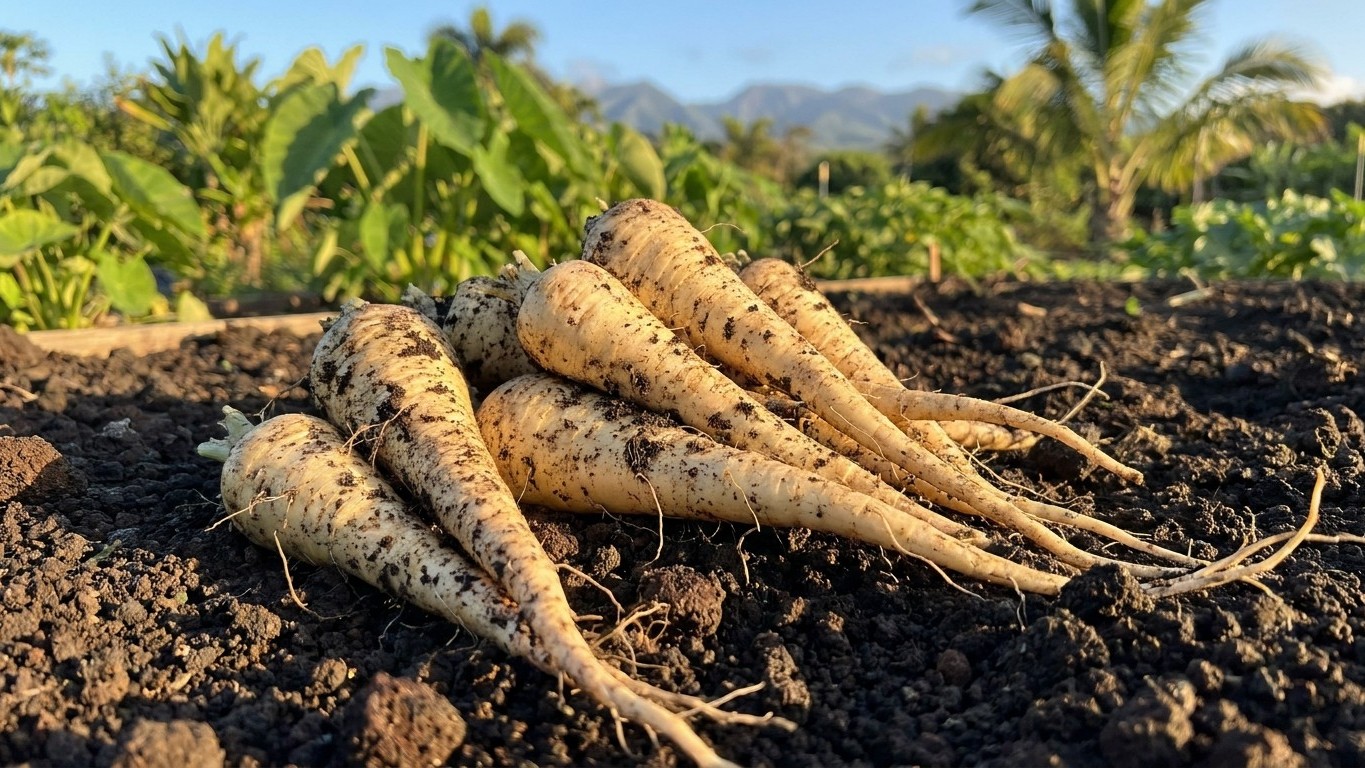

In Indiana, lift parsnips from mid to late November onward, once several weeks of frost have worked on the roots. You can keep digging through winter thaws. Pulling them in early October gets you a bigger, starchier, blander root. Stored properly, a parsnip can last four to six months. Stored beside the fruit bowl, it can turn bitter within weeks. The details below are the arithmetic, the storage rules, and the failures that cost Hoosier gardeners their crop.
The short answer
Does Indiana deliver several frosty weeks? It does, and by a comfortable margin. At the Indianapolis reference station, the mean daily minimum of the coldest month is 20.9 F, according to NOAA NCEI Climate Normals. That is the average overnight low, not a record, so nights spend that month more than 11 degrees under freezing. A parsnip grown here will sweeten, not merely grow. The crop needs weeks of cool, frosty weather to convert stored starch to sugar, and Indiana supplies them in most winters.
One caution on reasoning. The sweetening comes from exposure to frost, not from a hardiness zone label. A comfortable zone and several frosty weeks are different things, and only the second one matters to the root. For the sugar chemistry in more depth, see Will Parsnips Sweeten in Indiana?
When to dig
The first fall frost at the reference station falls between October 21 and October 30, based on 32 F freeze probabilities in the NOAA NCEI data (station data here). Count several weeks forward from that window and you land in mid to late November. That is the earliest sensible lifting date. From there, dig as needed all winter, ground permitting, and finish before the tops start pushing new growth in spring. Southern Indiana runs earlier in spring and later in autumn than the north by a fortnight or more, so shift your first dig later the farther south you garden.
How long they keep
USDA Agricultural Handbook 66 puts parsnip storage at 4 to 6 months at 32 to 34 F with 98 percent relative humidity (full handbook). That is a long keeper by any standard. It also assumes those conditions are held steady, which almost no house does. Expect less from a kitchen drawer, and more from a root cellar or an unheated space that stays cold and damp.
Cold itself is not the danger. The handbook states that parsnips are not chilling sensitive. The danger is ethylene. Parsnips make almost none of their own, but exposure to low levels in cold storage causes bitterness, likely through a buildup of a compound called xanthotoxin. Apples and other ripening fruit give off ethylene, so keep parsnips away from them, even at the right temperature. Top the roots after harvest, but do not trim into the crown.
Does the season fit?
Parsnips are sown in place, and Utah State University Extension gives them 100 to 120 days from seeding, with a sowing 2 to 3 weeks before the last frost. Here is the arithmetic in Indiana terms, step by step.
- Start with the last spring frost. At the Indianapolis reference station it falls between April 9 and April 21. Sowing 2 to 3 weeks ahead puts seed in the ground between about March 19 and April 7, depending on which end of each range you take.
- Allow for germination. Seed takes 14 to 21 days to come up, and parsnips are slow and patchy about it. Bare soil at day ten is normal. Do not dig it up and re-sow. Those weeks are already counted inside the 100 to 120 days, since the clock runs from seeding.
- Add the growing time. March 19 plus 100 days is June 27, and plus 120 days is July 17. April 7 plus 100 days is July 16, and plus 120 days is August 5. Roots reach full size somewhere between late June and early August.
- Compare with autumn. The first fall frost arrives October 21 to 30. Even the latest of those finish dates leaves about eleven weeks of slack before the first frost, and the earliest leaves more than sixteen. A sowing that slips to early May still finishes around the start of September.
- Add the frost weeks. Sweetening needs several frosty weeks after that first frost, which carries the harvest into mid to late November and beyond. That is a long time in the ground, but nothing here runs out. The season fits comfortably.
The real pressure in Indiana is not a short season. It is the long wait between a finished root and a sweet one, and what can go wrong during it. Parsnips also need a deep, loose root zone for all those weeks. Utah State University Extension recommends deep sandy soil and says heavy soil must be double dug. For the broader growing picture, start with Growing Parsnips in Indiana.
What goes wrong here
- Forked roots from heavy or stony ground. A root that hits clay, a buried rock or compaction splits and sends out extra legs. Double dig the bed, as Utah State University Extension advises for heavy soil, and pull out stones to the depth of the root. Heavy ground is common in parts of Indiana, but your own yard is the test. Push a spade down and see what you hit.
- Forked roots from overwatering. This is a separate cause with a separate fix. Constantly wet soil can also push a root to branch, even in good ground. Water deeply and less often, and let the top inch dry between soakings.
- Bare soil mistaken for failure. Germination takes 14 to 21 days. Mark the rows so you do not dig them up or sow over them at day twelve.
- Lifting too early. A root pulled in October is edible but not yet sweet. Wait for several weeks of frost after that first October 21 to 30 window, and use a thick mulch if you want the ground to stay workable into winter.
- A winter too mild to sweeten. Indiana usually delivers enough cold, but a mild stretch can leave you with a fine parsnip that never turns sweet. The only fix is patience. Leave the roots in until frosty weeks have actually stacked up, not just until the calendar says so.
- Bitter roots in storage. Ethylene from nearby apples or ripening fruit is the culprit. Keep parsnips in a separate, cold, humid spot.
- Rot from a damaged crown. Top the roots but do not cut into the crown, which invites decay in storage.
Pests are a separate matter. For what chews on parsnip foliage and roots through the season, read What Eats Parsnip in Indiana, and When.
Common questions
Can parsnips stay in the ground all winter in Indiana?
Yes. Parsnips are not chilling sensitive, so cold is not what hurts them. The practical limits are digging through frozen ground and the arrival of spring regrowth. Mulch heavily over the row if you want to dig in January, and lift what remains before new top growth begins.
How long do lifted parsnips keep?
USDA Agricultural Handbook 66 gives 4 to 6 months at 32 to 34 F and 98 percent humidity. A home refrigerator can approach the temperature, but humidity is the harder condition to hold. Plan on a shorter life than that ceiling unless you have a cold, damp cellar.
Why do my stored parsnips taste bitter?
Look first at what they sit near. Low levels of ethylene from apples or other ripening fruit cause bitterness in cold storage, even at the correct temperature. Move them away from fruit before you blame the variety or the soil.
Does southern Indiana lift later than the north?
Generally, yes. The Indianapolis dates are the reference point, and southern Indiana runs earlier in spring and later in autumn by a fortnight or more. You can sow earlier there, but the first frost arrives later, so the frosty weeks start later and the first dig moves back with them.