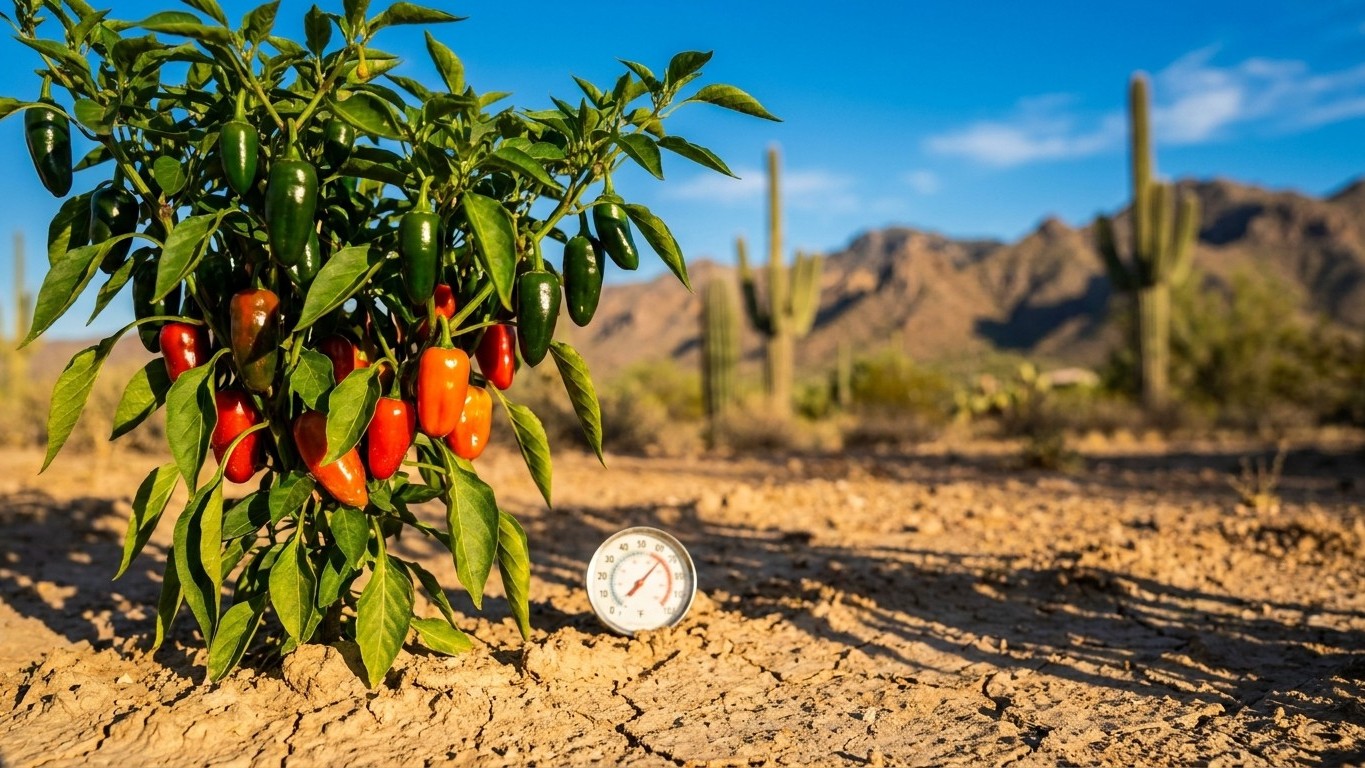

Pick peppers once they reach full size, which in Indiana usually means 70 to 85 days after the transplant went into the ground. Then keep them out of the refrigerator. Peppers store best at 45 to 50 °F, and a household fridge runs colder than that, which leaves them pitted and soft. Below you’ll find the heat and cold limits that shape the harvest here, the seed-starting arithmetic you can redo for your own county, and the problems that cost the most fruit. The wider crop plan lives in Growing Peppers in Indiana.
The short answer
Indianapolis, the reference station for this site’s climate numbers, averages 14.6 days a year at or above 90 F, according to NOAA NCEI Climate Normals. That figure measures heat load, meaning how many days push past the line where plants struggle. It says nothing about how warm an average summer feels. For peppers it is the hot-end number that counts, because Utah State University Extension is blunt about it: pepper fruit set fails when days climb above 90 F. At 14.6 days across a full calendar, Indiana hands a pepper bed a short list of risky afternoons rather than a summer-long squeeze.
The cool end gets less attention and does just as much damage. The same Utah State source says fruit set also fails when nights fall below 55 F. This site does not carry summer night minima, so there is no Indiana night number to give you, and guessing one from latitude or from how cold winter gets would be wrong. You have to watch your own nights. A cheap min-max thermometer clipped at plant height records the overnight low, and checking it each morning while the plants are flowering tells you more than any regional average could.
Put the two thresholds together and you get a window: nights at or above 55 F, days at or below 90 F. Flowers that open outside that window tend to drop. The plant itself survives, and flowers that open once the weather settles can still set fruit, so a bad week costs you a few blooms rather than the season. The full diagnosis is in Why Peppers Fail to Set Fruit in Indiana.
Harvest timing comes from Clemson Cooperative Extension, which says peppers should be ready in about 70 to 85 days after transplanting. Count from the day the transplant went into the bed, not from the day you sowed seed. Fruit can be cut green at full size, or left to turn red, yellow or orange. Waiting for color means more days on the plant, which means more exposure to hot spells and to the first fall frost. Use scissors or pruning shears rather than pulling, since pepper branches snap easily.
Then comes the mistake nearly everyone makes. Clemson’s storage guidance reads: “The optimal conditions for storage are temperatures of 45 to 50 °F and 80- to 90-percent relative humidity for two to three weeks.” (Clemson Home & Garden Information Center). That range is warmer than a domestic refrigerator. Below about 45 °F, peppers suffer chilling injury, showing up as pitting and softening. And “two to three weeks” is a ceiling under ideal conditions, not a promise.
When to start seed here
Peppers hate being rushed outdoors, so the calendar works backward from the day the transplants go in. Here is the arithmetic in order, so you can run it for your own county.
- Find your last spring frost. At the Indianapolis reference station, NOAA NCEI’s 32 F freeze probabilities put the last spring frost between April 9 and April 21 (the 30 to 70 percent band, station data here). Southern Indiana runs a fortnight or more earlier in spring than the north, and later in autumn. Purdue adds a caution: roughly a 10 percent chance of a 32 F event remains after the published date, so anything set out on the early edge of the range needs a cover ready.
- Wait for 60 F soil. Utah State says to transplant when the soil reaches 60 F, after frost. The frost date alone is not enough. A bed can be frost-free and still too cold, so your transplant date is whichever of the two comes later.
- Count back 8 to 10 weeks. That is how long transplants need indoors. As a made-up example, say your soil hits 60 F on May 10. Ten weeks earlier is March 1, and eight weeks earlier is March 15. Seed goes in between those two dates. Substitute your own transplant date and the window moves with it.
- Add 70 to 85 days for the first harvest. Clemson counts from transplanting. Using the same example, May 10 plus 70 days lands on July 19, and plus 85 days lands on August 3. That is when full-size fruit should be ready to cut.
- Check the result against the weather. Look at where flowering will fall. If it lands in a hot stretch, or if your own overnight readings are dipping under 55 F, shade cloth or a light row cover buys time. A start date that looks right on paper still needs a thermometer behind it.
If you garden in the south of the state, shift the frost date in step one earlier and let the rest of the chain follow. If you are in the north, shift it later. The 8 to 10 weeks and the 70 to 85 days stay fixed.
What goes wrong here
Indiana’s climate causes a short, predictable list of pepper failures. Most are fixable once you know what you’re looking at.
- Blossom drop in a hot spell or a cool night. Flowers fall off without setting fruit when days pass 90 F or nights sink below 55 F. Indianapolis logs 14.6 days at or above 90 F in an average year, but your nights are yours to measure. Remedy: shade cloth over the bed during a hot forecast, a light row cover on a cold night, and patience. Later flowers set when conditions return to the window.
- Sunscald. Fruit develops pale, papery patches on the side facing the sun. It happens when leaves that normally shade the pepper are lost to disease, pests or heavy pruning. Remedy: keep the canopy intact, skip leaf stripping, and add shade cloth in a heat wave. Chew marks and holes are a different problem, covered in What Eats Pepper in Indiana, and When.
- Blossom-end rot. A dark, sunken, leathery patch forms on the bottom of the fruit. It is a calcium delivery problem tied to uneven watering, and rarely a shortage of calcium in the soil. Remedy: mulch the bed, water on a steady schedule rather than letting it dry out and then soaking it, and run a soil test before adding any amendment. Pick off affected fruit so the plant puts energy into healthy ones.
- Chilling injury after harvest. Pitted, soft, sunken skin on peppers that looked perfect when picked. The cause is usually the refrigerator, which sits below the 45 to 50 °F range Clemson recommends. Remedy: store whole peppers somewhere cool and humid within that range, such as a cool cellar or basement corner if you have a thermometer to confirm it, and use them within the two to three weeks at the outside.
Common questions
Can peppers go in the refrigerator at all?
Whole peppers should not, if you can avoid it. Chilling injury shows up below about 45 °F, and a household refrigerator runs colder than the 45 to 50 °F range Clemson recommends. That guidance covers whole, uncut fruit. A pepper you have already cut into is a different case, and the fridge is the practical place for it.
How do I know when a pepper is ready to pick?
Use two checks together. First, count: Clemson says about 70 to 85 days after transplanting. Second, look at size, since the fruit should have reached the mature size listed for your variety. Color is optional. Green peppers can be cut at full size, and leaving them to turn takes longer.
When should I pick before the first fall frost?
This page does not carry a fall frost date, so watch your local forecast instead. Southern Indiana stays frost-free later in autumn than the north by a fortnight or more. When a frost is forecast, cut every pepper that has reached full size, because tender plants do not tolerate a freeze.
Does one hot week mean I lost the crop?
No. Utah State says fruit set fails when days pass 90 F, and a hot spell can drop the flowers open at that moment. The plant survives and keeps flowering. The 14.6 days is also an average from one reference station, so a given summer can run above or below it.