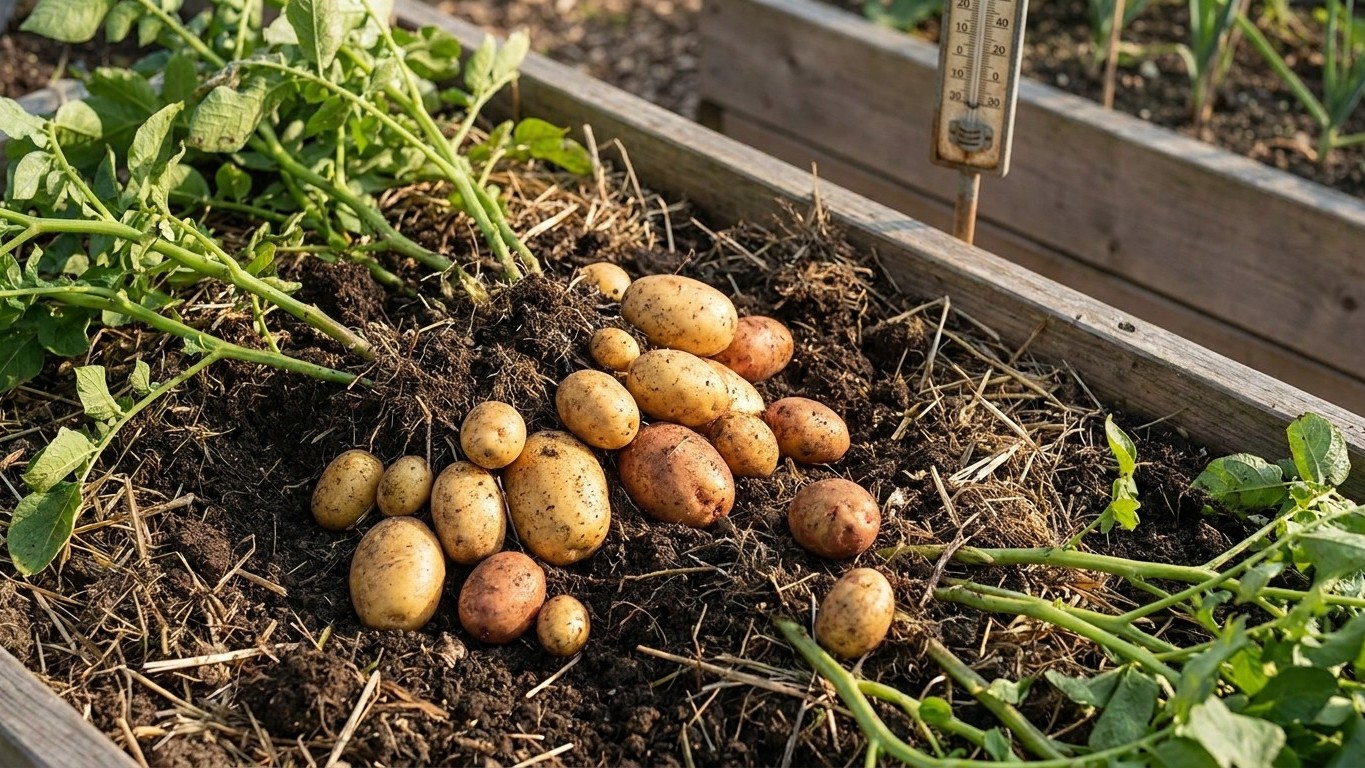

Nebraska gardeners get their best results from early and mid-season potato varieties, grown for baking or for boiling rather than left in the ground for a long late-season fill. The reason comes down to heat, not frost: once soil temperatures climb past 90 F, tuber set and sizing stall out, and no amount of extra watering brings that growth back. Planting early and choosing a shorter season class works around that window.
The short answer
The figure that matters most here comes from two land-grant extension sources, not from a seed catalog. Utah State University Extension and the University of Maine Cooperative Extension both document that potato tubers stop setting and filling once soil temperatures rise above 90 F, and that irrigation does not reverse the slowdown once it starts. That single threshold is why Nebraska gardeners lean toward early and mid-season potatoes rather than long-season storage types: the goal is to get the crop sized before the hottest stretch of summer soil temperatures arrives, not to chase maximum tuber size through August.
Timing the planting end of that equation depends on frost, and the only sourced figure for that comes from NOAA’s National Centers for Environmental Information, drawn from the 1991-2020 Climate Normals for the Lincoln airport weather station. There, the last spring 32 F freeze falls somewhere between April 12 and April 23. Potatoes go into the ground well before that date, not after it: both extension sources agree that seed potatoes are planted as soon as the soil itself reaches 50 F, which typically lands 14 to 21 days ahead of the last frost date. That planting window is what lets an early or mid-season variety finish its bulking phase before soil temperatures climb into the danger zone later in the summer.
The table below lines up the three season classes against that heat ceiling, using only what the two sourced extension programs publish.
| Season class | Exposure to Nebraska’s summer heat ceiling | Practical fit |
|---|---|---|
| Early | Lowest; tubers typically size before peak soil-heat stretch | Best default choice statewide, especially in warmer counties |
| Mid-season | Moderate; needs an on-time planting to finish ahead of the hottest soil days | Workable where spring planting starts promptly at the 50 F soil mark |
| Late | Highest; tuber fill often runs into soil temperatures above 90 F | Riskier statewide; best reserved for gardeners who can track soil temperature closely and dig early if heat arrives |
None of this replaces a local check. The Lincoln station figures are a reference point, not a guarantee for every county, and a garden in a low spot or at higher elevation can see its own last frost run one to two weeks later than that airport reading.
What actually decides it
Soil temperature and frost timing
Frost date and soil temperature are two different measurements, and gardeners who plant off the calendar instead of a thermometer often get the sequence backward. The NOAA NCEI Lincoln station data puts the last spring freeze between April 12 and April 23, but that is an air-temperature threshold. Soil warms more slowly than air, especially in clay-heavy ground or a shaded bed, so the 50 F soil mark that both extension sources use as the actual planting trigger can land later than a quick glance at the frost calendar would suggest. Waiting for the thermometer, not the date, is what keeps seed pieces from sitting in cold, wet soil where they rot before sprouting.
The 90 F heat ceiling
This is the mechanism that decides the whole crop, and it works quietly. Potato plants keep growing foliage in hot weather, so a gardener can watch a healthy-looking plant right up until harvest and still pull up small or few tubers. What happened underground is that soil temperatures crossed above 90 F during the tuber bulking stage, and set and fill simply stopped. Extra irrigation does not restart the process, according to both sourced extension programs, because the trigger is temperature, not moisture. A gardener anywhere in the state who tallies how many days their own soil typically sits above that mark during midsummer has, in effect, already decided which season class makes sense for their yard.
Seed source and disease carryover
Neither extension source frames this as optional. Potato seed pieces that are not certified disease-free carry a real risk of carrying viruses forward into the new crop, and a virus-infected seed piece produces a weaker plant no matter how well the frost and heat timing are managed. Certified seed potatoes are grown and inspected specifically to keep that risk out of the garden, and skipping that step undermines every other decision made around planting date and season class.
How to do it
- Check the last spring frost window for the Lincoln reference station (April 12 to April 23, per NOAA NCEI Climate Normals) as a starting point, then confirm with your own county extension office or your own frost history, since gardens away from the airport station often see frost run one to two weeks later.
- Start checking soil temperature at planting depth with a soil thermometer once the frost window approaches, rather than relying on the calendar date alone.
- Order certified seed potatoes ahead of the planting window; uncertified seed, including potatoes bought for eating, carries a higher risk of virus that can weaken the whole crop.
- Plant as soon as the soil reaches 50 F, which lands roughly 14 to 21 days before the local last frost date.
- Choose an early or mid-season variety as the default in Nebraska, reserving late-season types for situations where soil temperature can be tracked closely through the summer.
- Watch soil temperature again as summer progresses; once it holds above 90 F, understand that tuber sizing has effectively stopped for that crop.
- Dig early if a hot stretch arrives before a late-season variety has finished filling, since waiting longer will not produce bigger tubers once that heat ceiling has been crossed.
What goes wrong
- Planting a late-season variety and expecting a full-size storage crop. If soil temperatures cross 90 F before tuber fill finishes, the crop stalls for good. The remedy is to treat it as a spring crop and dig early rather than waiting for a size that will not come.
- Using grocery-store or leftover potatoes as seed. These are not certified and can carry viruses into the row. The remedy is certified seed potatoes from a known source, ordered ahead of the planting window.
- Planting by a fixed calendar date instead of soil temperature. Cold, wet soil below 50 F encourages seed pieces to rot before they sprout. The remedy is a soil thermometer at planting depth, checked in the days leading up to the expected window.
- Trying to water through a heat wave to save stalled tubers. Both sourced extension programs are clear that irrigation does not restart tuber set once soil passes 90 F. The remedy is accepting an earlier harvest rather than over-watering a crop that has already stopped sizing.
- Treating the Lincoln station frost dates as true for every yard in the state. A low-lying garden or a rural property away from the airport reading can see its last frost run one to two weeks later, and its first fall frost arrive earlier. The remedy is checking local, on-the-ground frost history rather than relying on a single reference city.
Common questions
Can I grow late-season potatoes in Nebraska?
It is possible, but riskier than an early or mid-season choice, since tuber fill for a late variety is more likely to run into soil temperatures above 90 F before it finishes. Gardeners who try it should track soil temperature closely and be ready to dig early if a hot stretch arrives.
When should I plant potatoes in Nebraska?
Both Utah State University Extension and the University of Maine Cooperative Extension point to soil temperature, not the calendar, as the trigger: potatoes go in once the soil reaches 50 F, generally 14 to 21 days before the last spring frost. For the Lincoln reference station, that frost date falls between April 12 and April 23, though your own garden may run later.
What’s the difference between a baking and a boiling potato?
The distinction is about culinary use rather than season class. Extension sources describe potatoes by what they are grown and used for, baking or boiling, rather than by texture labels, so checking a variety’s intended use is more reliable than guessing from its season class alone.
Do I really need certified seed potatoes?
Yes. Uncertified seed, including potatoes intended for eating, can carry viruses that weaken the resulting plants regardless of how well planting timing and season class are managed. Certified seed is inspected specifically to avoid that risk.