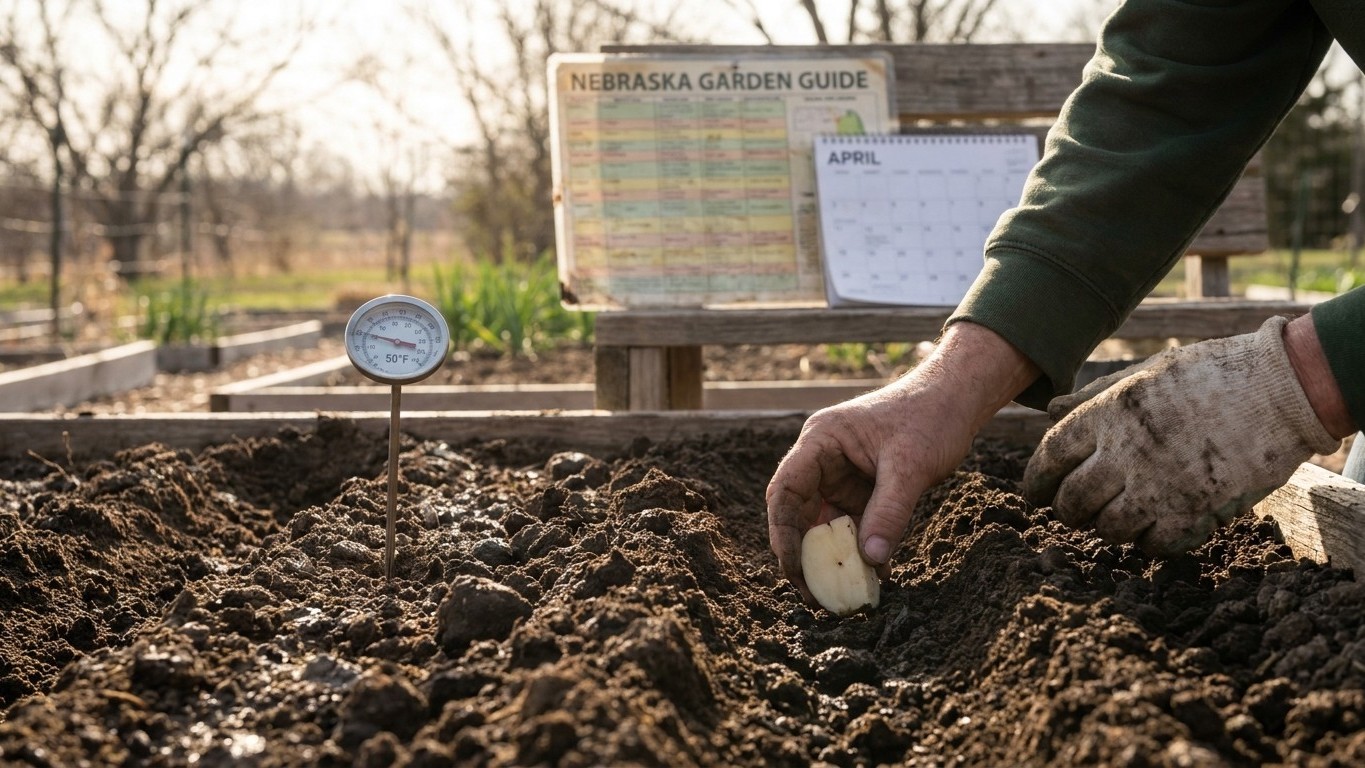

Plant potatoes in Nebraska 14 to 21 days before your area’s last spring frost, once soil temperature hits 50°F. For the Omaha area, NOAA NCEI’s 1991-2020 Climate Normals put that last freeze between April 12 and April 23, which pushes typical planting into late March or the first half of April. Counting back from your own county’s frost date, not a statewide average, is what actually gets this right.
The short answer
NOAA’s National Centers for Environmental Information tracked three decades of freeze data at the Omaha airport weather station and found a 30 to 70 percent probability band for the last 32°F freeze falling between April 12 and April 23. That’s the reference figure for eastern Nebraska. Counting backward 14 to 21 days from that window lands most gardeners in the region on a planting date somewhere between the last week of March and the middle of April.
That backward count isn’t arbitrary. Utah State University Extension’s potato fact sheet and University of Maine Cooperative Extension’s Bulletin #2077 both anchor planting to soil temperature, not calendar date: potatoes go in the ground as soon as soil reaches 50°F, and that threshold is typically reached two to three weeks ahead of a region’s last frost. Potato seed pieces can sit in cool soil and wait for conditions to turn without rotting the way a tomato transplant would if frost caught it.
The station behind the NOAA figure sits at the Omaha airport. If your garden is out in a river valley, up on the western plains near Scottsbluff, or tucked into a low frost pocket outside Lincoln, your actual last frost can run one to two weeks later than the airport number, and sometimes more at higher elevation. A statewide date doesn’t exist. What exists is a reference city’s number and a rule for adjusting it to your own dirt.
None of this means the calendar is irrelevant. It’s the starting point for a countdown that has to bend around whatever your particular patch of ground is doing that season. A cold, wet spring can delay soil warming by a week or two past what the frost-date math predicts, and a mild one can pull it forward. The frost date tells you when the air stops threatening the crop. The soil thermometer tells you when the ground is actually ready to work with.
So the short answer has two halves: a date range built off a documented frost record, and a temperature threshold that overrides the date whenever the two disagree. Growers who plant strictly by the calendar without checking soil temperature are the ones who end up with seed pieces rotting in cold, wet ground three weeks before anything would have sprouted.
What actually decides it
Soil temperature, not air temperature
The 50°F soil threshold is doing the real work here, more than the frost date itself. Air temperature swings by 20 or 30 degrees between a sunny afternoon and a clear night; soil temperature four inches down moves far more slowly and gives a truer read on whether a seed piece will rot or sprout. University of Maine Cooperative Extension frames the whole planting decision around that number because a cold, wet soil is what kills seed pieces, not a light frost on the leaves once they emerge. Potato foliage that gets nipped by a late frost after emergence usually recovers and pushes new growth from below the soil line.
The heat ceiling on the other end of the season
Utah State University Extension’s research points to the opposite failure mode, and it’s the one Nebraska gardeners underestimate. Once soil temperatures climb above 90°F, tuber set and tuber fill are inhibited. This isn’t a watering problem you can fix with more irrigation. The plant simply stops sizing tubers efficiently in soil that hot, regardless of how much moisture is available. In a Nebraska summer, soil under full sun in July or August routinely crosses that line, especially in the drier western and central parts of the state where there’s less cloud cover and humidity to buffer soil heat.
Why the two thresholds point to the same strategy
Put the cold-soil floor and the hot-soil ceiling together and the strategy becomes obvious: plant early enough that the crop sizes tubers before the ground turns hot, rather than trying to nurse a potato plant through a Nebraska summer. That’s why the backward count from frost date matters so much here. A late planting doesn’t just risk a shorter growing window; it risks pushing the critical tuber-bulking weeks into the exact stretch when soil temperatures are working against the plant. This is the mechanism a reader needs even for a location this page never covered: check when your local soil crosses 90°F in a normal summer, then work backward to make sure tuber set finishes before that point, using the 50°F spring threshold to start the clock as early as safely possible.
How to do it
- Find your local last spring frost date from your own county extension office or a nearby weather station, since the Omaha-area figure of April 12 to April 23 only applies directly to that reference city.
- Check soil temperature at a four-inch depth using a soil thermometer, checking mid-morning over several days rather than relying on a single reading.
- Once soil holds steady at 50°F, count back 14 to 21 days from your local last frost date to confirm the timing lines up; if soil hits 50°F earlier than that window, the soil temperature takes priority.
- Source certified seed potatoes rather than grocery-store tubers or saved stock from a previous garden. Uncertified seed carries viruses that stunt yield and spread to future plantings, and there’s no way to see that damage by looking at the tuber.
- Cut larger seed potatoes into pieces with at least one or two eyes each, and let the cut surfaces callus for a day or two in a cool, dry spot before planting, which reduces rot risk in cool soil.
- Plant seed pieces 3 to 4 inches deep in well-drained soil, since waterlogged, cold ground is the main cause of seed-piece rot before emergence.
- Watch for the plant’s own recovery ability: if a late frost nips emerged foliage, resist replanting immediately, since new growth typically pushes up from the seed piece below the frost line.
- Track soil temperature again as summer approaches, and if your area regularly crosses 90°F by mid-summer, plan on harvesting as a spring crop rather than trying to extend the plant through the hottest weeks.
What goes wrong
- Planting by calendar date alone, ignoring soil temperature. A gardener plants on a fixed date every season regardless of how cold or wet the ground is that year. The fix is simple: check soil temperature with a thermometer before planting, every season, since the 50°F threshold is what actually protects the seed piece, not the date on a calendar.
- Using uncertified seed potatoes from the grocery store or last year’s garden. These carry viruses invisible to the eye that reduce yield and can persist in the soil. The remedy is sourcing certified seed potatoes each season, which is the only way to know the seed stock is clean.
- Assuming the airport frost date applies to a rural or low-lying garden. The NOAA figure comes from one weather station, and gardens in valleys, near rivers, or at elevation commonly see frost linger one to two weeks longer. The fix is tracking a personal frost log for the specific garden site over a season or two, rather than trusting a single regional number.
- Letting the crop run through peak summer heat instead of harvesting early. Once soil crosses 90°F, tuber sizing stalls no matter how much water goes down. The remedy is planting as early as the 50°F soil threshold allows and treating the crop as a spring harvest in regions with hot summers, rather than trying to keep it in the ground through July and August.
- Skipping the callus step after cutting seed pieces. Freshly cut seed planted straight into cool, wet soil is far more prone to rot before it ever sprouts. Letting cut pieces dry for a day or two in a cool spot before planting cuts that risk substantially.
Common questions
Does the April 12 to April 23 frost window apply to the whole state of Nebraska?
No. That figure comes from NOAA NCEI’s 1991-2020 Climate Normals recorded at a single weather station near Omaha. Other parts of the state, particularly western Nebraska and areas at higher elevation, typically see their last frost fall later. Check a local source for the actual date in your county before counting backward.
What happens if I plant potatoes before the soil reaches 50°F?
Cold, wet soil is where seed pieces are most likely to rot before they ever sprout. University of Maine Cooperative Extension’s guidance ties planting timing to that 50°F soil threshold precisely because it protects the seed piece during the vulnerable weeks before emergence.
Can I still plant a mid-season or late-season potato in Nebraska given the summer heat?
Season class matters here. Early, mid-season, and late varieties all set and fill tubers most efficiently before soil temperatures cross 90°F, according to Utah State University Extension. In areas of Nebraska where summer soil regularly exceeds that mark, planting as early as the 50°F threshold allows, and choosing a class suited to a shorter window before peak heat, gives the crop more days to size before growth stalls.
Is it worth saving my own seed potatoes from this year’s harvest to plant next season?
Neither Utah State University Extension nor University of Maine Cooperative Extension recommends it. Saved tubers can carry viruses that aren’t visible on the outside, and those viruses reduce yield and spread through the soil. Certified seed potatoes are grown and inspected specifically to avoid that risk.