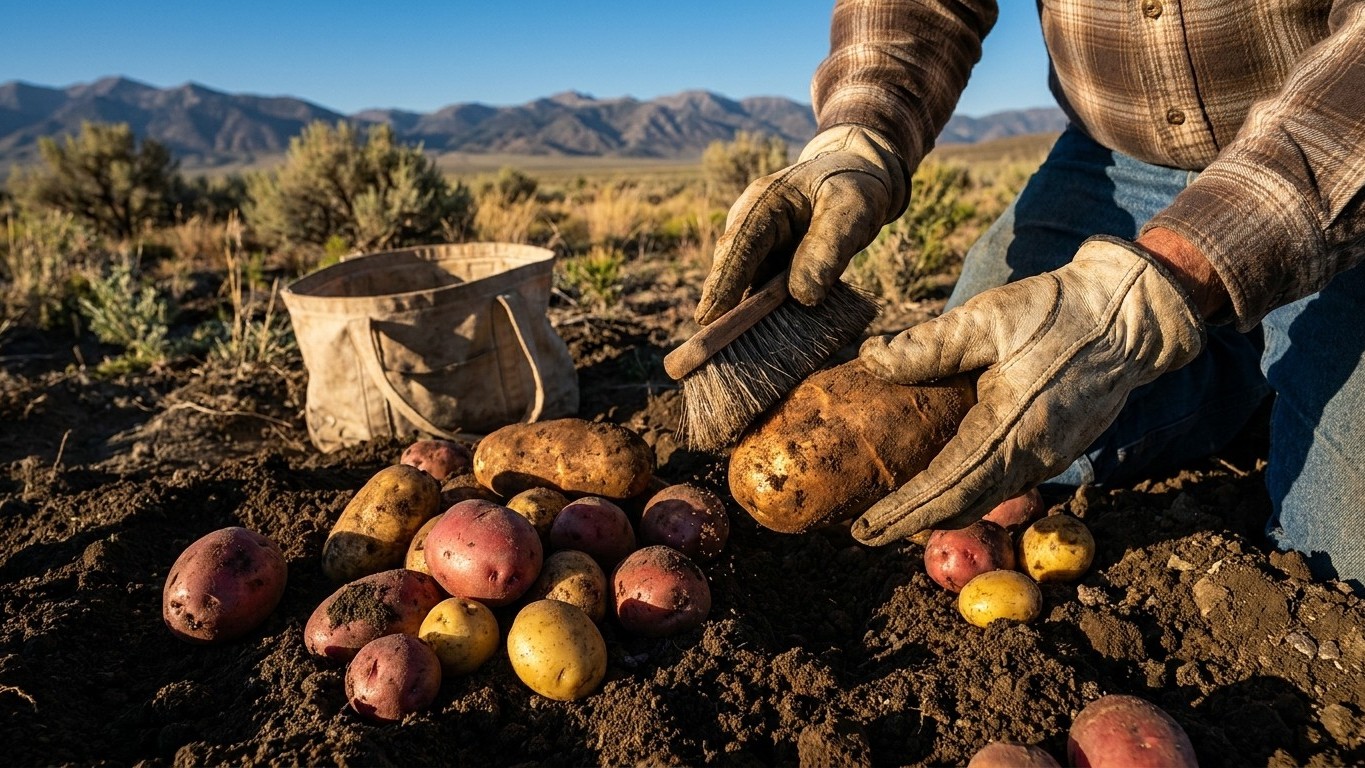

The short answer: match the variety’s season class, not its name, to how many soil-days above 90 F your part of Nevada racks up before summer sets in. That single number, drawn from Utah State University Extension and University of Maine Cooperative Extension fact sheets, decides more about your harvest than any seed catalog description ever will.
The short answer
There is no variety that “suits Nevada” as a whole, because Nevada is not one climate. Las Vegas sits at the bottom of a desert basin; Reno and Carson City sit a mile higher and cool off fast at night; rural valleys in the Great Basin can freeze in every month of the year. What ties them together is a single mechanism published by Utah State University Extension and confirmed by the University of Maine Cooperative Extension: tuber set and fill shut down once soil temperatures climb above 90 F, and once that happens, watering the plant does not restart tuber growth. That threshold, not a variety’s marketing name, is the number that actually governs whether a Nevada garden produces potatoes worth digging.
Both extension sources also agree on when to plant: potatoes go in the ground as soon as soil reaches 50 F, which lands 14 to 21 days before the last frost date. In a low desert basin like Las Vegas, NOAA’s 1991-2020 Climate Normals for the Las Vegas airport station put the window when a 32 F freeze has between a 30 and 70 percent chance of occurring at January 7 to February 1, an extreme case driven by the urban heat island around the airport, not a number any other part of the state should copy. Reno, Carson City, and anywhere at elevation will hit that 50 F soil mark, and their last frost, far later in spring and far earlier in fall. There is no substitute here for calling your county extension office and asking for the local soil-temperature and frost data.
Practically, that means the “right” variety for Nevada is whichever early, mid-season, or late type you can get into the ground early enough, and out of the ground, before your local soil crosses 90 F. In the low desert, that argues hard for early types dug as a spring crop. At elevation, where summers stay cooler and the growing window opens later, mid-season and even late types have room to mature before the ground freezes again in fall.
What actually decides it
Soil temperature, not calendar date
Gardeners plant by the calendar; potatoes respond to the thermometer buried in the dirt. The 50 F planting threshold and the 90 F tuber-fill ceiling, both published by Utah State University Extension and the University of Maine Cooperative Extension, are soil readings, not air temperatures and not dates on a seed packet. A patch of loose, sandy, south-facing soil in a Reno backyard can cross both thresholds days ahead of a shaded, clay-heavy plot two streets over. That is the reasoning tool worth carrying into any Nevada garden this page never specifically covers: check the soil, not the forecast.
Elevation rewrites the whole timeline
Nevada’s elevation range, from desert basins near sea-level-adjacent heat to mountain valleys well above a mile high, means the same variety behaves like two different crops depending on where it’s planted. At low elevation, the soil races past 50 F early and blows through 90 F by mid-summer, compressing the safe growing window into spring and pushing gardeners toward season classes that finish their bulking before the heat ceiling arrives. At higher elevation, the opposite problem shows up: soil is slow to warm past 50 F in the first place, but it also stays under the 90 F ceiling much longer into summer, giving mid-season and late types the runway they need.
Season class, not variety name, is the lever you control
Because neither Utah State nor Maine’s extension service publishes a days-to-maturity figure for named varieties, the only lever a gardener can actually plan around is season class: early, mid-season, or late. That classification tells you how much of the growing window a variety needs relative to the others, without pretending to a precision the science doesn’t back. When reasoning through a spot this page hasn’t named, the question isn’t “which variety is famous for baking” but “does my location’s window between safe soil temperature and the 90 F ceiling favor an early finisher or can it carry a longer-season type.”
Certified seed potatoes matter here as much as season class does. Uncertified seed carries viral disease into the row before the plant has a chance, and no amount of correct timing fixes a virus-compromised start.
How to do it
- Call your county extension office or check its published data for the local last-frost window and typical soil-warming pace; the NOAA figures for the Las Vegas airport are a desert extreme and should not be applied outside that specific reference city.
- Test soil temperature directly with a soil thermometer at planting depth rather than relying on air temperature or the calendar.
- Plant certified seed potatoes as soon as soil reaches 50 F, which falls 14 to 21 days before your local last frost date, per Utah State University Extension and University of Maine Cooperative Extension guidance.
- Choose an early season class if your location’s soil is projected to cross 90 F before mid-summer, so tuber fill finishes ahead of the heat ceiling.
- Choose a mid-season or late class only where elevation keeps soil under 90 F well into summer, giving the longer-season crop time to bulk.
- Track soil temperature through the season and plan the harvest date around the point the soil approaches 90 F, not around a fixed number of days after planting.
- Dig before soil temperature sustains itself above that 90 F ceiling, since tuber growth does not resume once it has stopped there.
What goes wrong
- Planting by the calendar instead of the soil. A gardener plants on a date that worked in a magazine or a neighboring state, and the soil hasn’t reached 50 F yet, or has already blown past it. Fix: measure soil temperature directly before planting, every season, at the actual planting depth.
- Treating the Las Vegas frost window as a statewide rule. The January 7 to February 1 window from NOAA’s Las Vegas airport data reflects an urban heat island at low desert elevation. Applying it in Reno, Carson City, or rural Nevada leads to planting weeks or months too early into ground that’s still frozen. Fix: get frost and soil-warming data specific to your county from the local extension office.
- Choosing a late-season variety in a hot, low-elevation garden. A longer-season type simply hasn’t finished filling tubers by the time soil crosses 90 F, and the plant stalls with small, underdeveloped potatoes. Fix: switch to an early class and treat the crop as a spring harvest, not a summer one.
- Assuming more water fixes a heat-stalled crop. Once soil holds above 90 F, tuber set and fill stop regardless of irrigation, according to Utah State University Extension. Fix: dig the crop before that threshold arrives rather than trying to push through it with water.
- Planting saved or uncertified seed. Home-saved tubers can carry viral disease invisibly, and the plant underperforms no matter how well timing and variety choice were handled. Fix: buy certified seed potatoes each season.
Common questions
Does one potato variety work across all of Nevada?
No. Nevada’s elevation and temperature range is too wide for a single variety recommendation. What transfers statewide is the mechanism: plant when soil hits 50 F, and get the crop out before soil sustains 90 F, then pick a season class, early, mid-season, or late, that fits the local window between those two points.
Can I use the Las Vegas frost dates for my part of Nevada?
Only if you garden at the Las Vegas airport itself. NOAA’s 1991-2020 Climate Normals data for that station reflect a desert urban heat island and run far earlier than frost dates anywhere at elevation in the state. Contact your county extension office for local figures instead.
Are early varieties always the safer choice in a hot climate?
In low-elevation, high-heat locations, yes, because an early season class finishes tuber fill before soil crosses the 90 F ceiling. At higher elevation, where soil stays cooler longer into summer, mid-season and late classes have room to mature and aren’t automatically the riskier pick.
Is it worth paying more for certified seed potatoes?
Yes. Uncertified seed can carry viral disease into the crop before it has a chance to establish, undermining even a perfectly timed planting. Certified seed removes that risk at the source.