
Nevada doesn’t have one pumpkin sowing date. It has several, depending on whether you’re gardening in a low desert valley or up near 6,000 feet outside Reno or Carson City. The rule that holds everywhere: sow once soil hits 65°F, timed so flowering finishes 45 to 55 days before your local first fall frost. Everything else is local math.
The short answer
Start with the one hard frost figure available for the state: at the Las Vegas airport, the first fall freeze arrives somewhere between December 8 and December 23, according to NOAA’s 1991-2020 Climate Normals (NOAA NCEI). That looks like a gift of a long season. It isn’t representative of Nevada as a whole, and it shouldn’t be used as a planting guide outside that specific station. Las Vegas sits in a desert basin wrapped in pavement and buildings, an urban heat island that pushes frost weeks or months later than the surrounding valley floor, let alone the mountains. Reno, Carson City, and most of the elevated basins across the state freeze far earlier in fall and thaw far later in spring than that airport reading suggests.
So the mechanism matters more than the single number. Pumpkins need 45 to 55 days from the moment a female flower opens to the moment the fruit is fully colored and the rind has hardened enough to store. That clock starts at flowering, not at the day you drop seed in the ground. A vine can look thriving in late summer, throw a flower in early September, and still fail if the count-back from your local frost date doesn’t leave room for that flower to finish.
The way to use this in Nevada is to work backward from your own county’s first frost window, not from the Las Vegas figure. Whatever date your local extension office gives you as the average first freeze, subtract 45 to 55 days from the earliest edge of that window. That subtraction gives you the last calendar date a flower can safely open and still produce a pumpkin that colors up before cold kills the vine. Any flower that opens after that cutoff is a gamble the season usually loses.
Because flowering itself happens weeks after seeding, not on the same day, the real planning window is even tighter than it first appears. A grower in a high desert basin with an early September frost has to count back from that frost, then count back again from seeding to first flower, before ever touching soil temperature. That double subtraction is the actual short answer this page exists to give: know your local frost date first, work back through the flowering clock second, and treat the Las Vegas figure as an illustration of the method, not a number to copy.
When to sow here
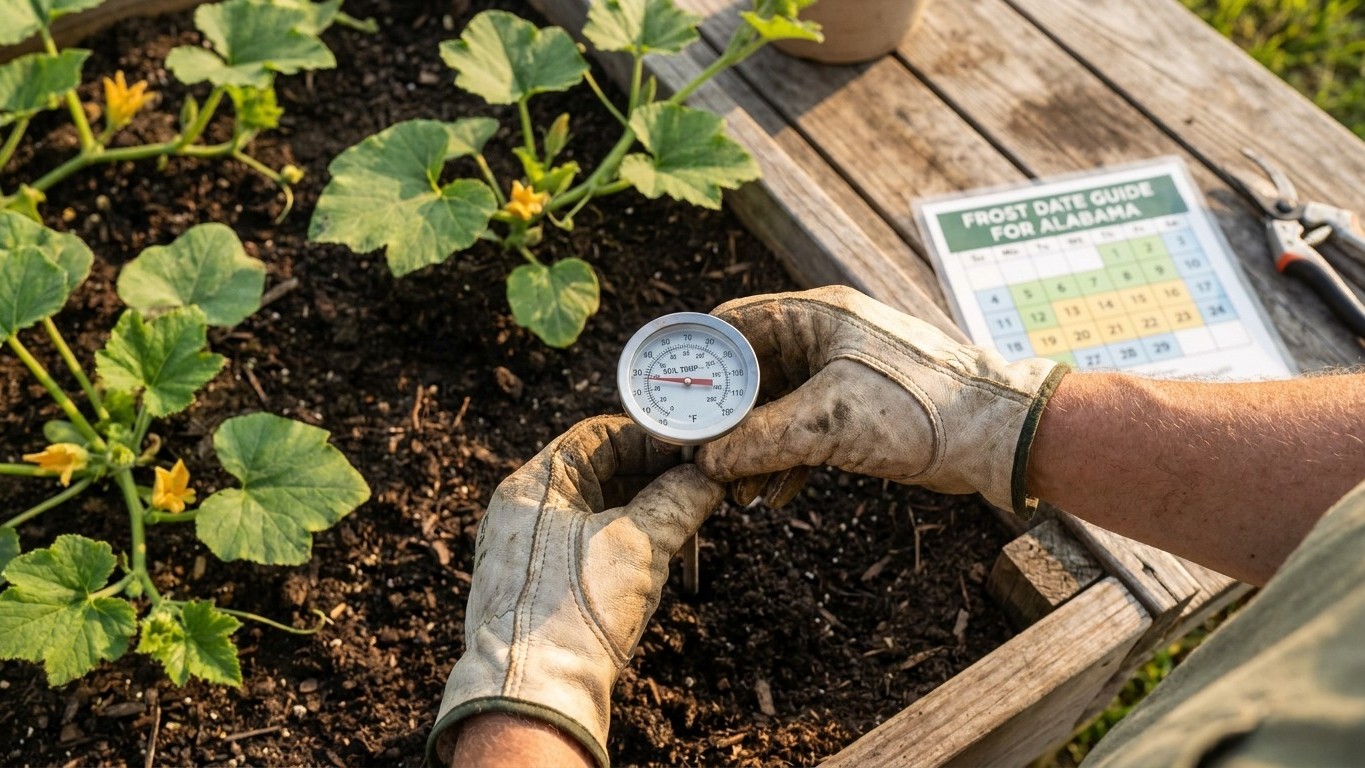
The other half of the equation is soil temperature, and it’s easy to conflate with the last frost date. It shouldn’t be. Utah State University Extension is specific that pumpkin seed wants soil at 65°F before it goes in the ground, and soil at that depth warms on its own schedule, well after the air has cleared of frost. Air temperature can sit safely above freezing for weeks while the top few inches of soil, especially clay-heavy or shaded ground, still lag behind. Treat the last frost date as the earliest air-safety marker, and treat the 65°F soil reading as a separate, later checkpoint you confirm with a thermometer, not a calendar guess.
- Find your local last spring frost window through your county extension office rather than relying on a statewide average. Nevada’s last spring freeze at the Las Vegas airport falls between January 7 and February 1 by NOAA’s normals, and that figure is, again, a desert urban-heat-island extreme that does not transfer to Reno, Carson City, or elevated basins, where the last freeze lands months later.
- Wait past that local frost date, then keep checking soil rather than the calendar. The gap between the air clearing of frost and the soil reaching 65°F at seed depth is where most early plantings fail, since seed sown into cold soil simply sits and rots instead of germinating.
- Use a soil thermometer at the two-inch planting depth rather than trusting the recommended date on a seed packet, since a shaded or heavy-clay bed can trail a sunny sandy one by a wide margin.
- Consider row covers if you want to move earlier. A row cover over freshly seeded ground buys roughly two weeks of warming, letting a gardener push sowing ahead of the open-air 65°F date without exposing seedlings to lingering cold.
- Count forward from sowing to flowering once the seed is in, then check that projected flowering date against the 45-to-55-day backward count from your local first fall frost, closing the loop the short answer opened.
What goes wrong here
- A late flower opens but the fruit never colors. This happens when a vine keeps setting new flowers into late summer instead of stopping. The remedy is to pinch off any flower that opens after your county’s calculated cutoff date, forcing the plant’s energy into the fruit that still has time to finish rather than fruit that’s doomed from the start.
- A nearly-ripe fruit gets caught by an early frost. In elevation basins where the first freeze can arrive well ahead of the desert-valley average, a fruit that’s colored but not fully hardened can still be lost overnight. Utah State University Extension’s guidance is to harvest with the stem attached once the rind resists a fingernail, rather than waiting for a “perfect” finish that frost may not allow.
- The vine collapses before the rind hardens. Squash bugs and cucumber beetles are common culprits behind a vine that dies back weeks early, cutting the plant’s ability to finish sizing and hardening fruit already set. This site covers both pests in state-specific detail: see the Nevada pages on squash bugs and cucumber beetles for identification and control timed to this state’s season.
- Seed sown too early rots in cold soil. Chasing the last frost date instead of the 65°F soil mark is the single most common miscalculation, and it costs a grower two to three weeks of restarting from scratch. Checking soil temperature directly, rather than counting days from frost, avoids the loss entirely.
Common questions
Does the Las Vegas frost window apply to Reno or Carson City?
No. The December 8 to December 23 first-frost figure and the January 7 to February 1 last-frost figure both come from the Las Vegas airport station, an urban desert site that freezes later in fall and clears earlier in spring than most of the rest of the state. Reno, Carson City, and elevated basins freeze months earlier in fall and thaw later in spring. Confirm your own dates with your county extension office.
Can transplants shorten the season instead of direct seeding?
Utah State University Extension’s guidance centers on direct seeding once soil reaches 65°F rather than transplanting timelines, so no seed-to-transplant figure is published here to compare against direct sowing.
How do I check if my soil has actually reached 65°F?
Push a soil thermometer to the depth you plan to seed, roughly two inches, and take the reading in the morning before the sun has warmed the surface, since afternoon readings can overstate how warm the root zone really is.
What if my vine is still flowering close to the first frost?
Any flower opening inside the last 45 to 55 days before your local first frost is unlikely to finish. The practical move is to stop new flowers from setting and focus the plant’s remaining energy on fruit that already has enough time on the clock.