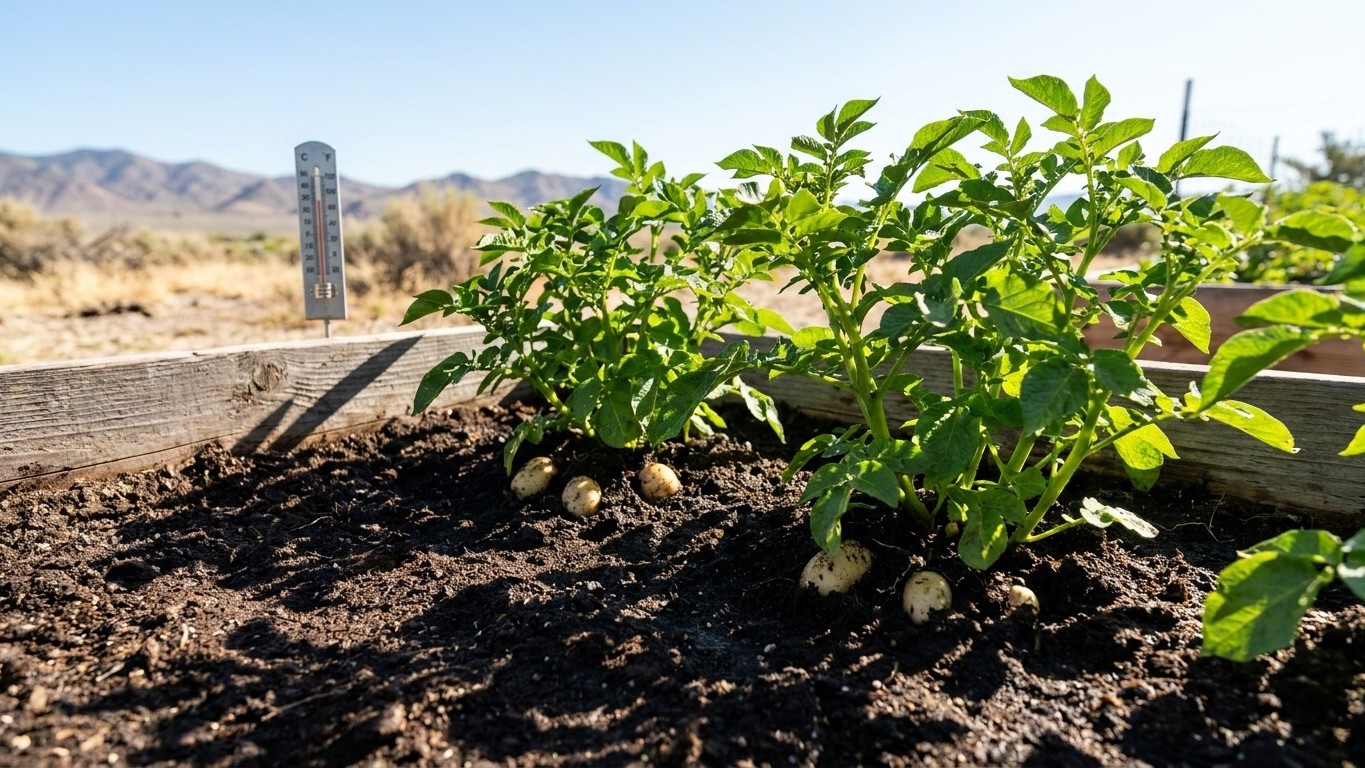

Nevada’s low desert stops potatoes cold in summer, but not because of frost. In Las Vegas, air temperatures reach 90 F or higher on 131.3 days a year, according to NOAA NCEI’s 1991-2020 Climate Normals, and soil that hot halts tuber set and fill, per Utah State University Extension. The fix isn’t more water. It’s timing: dig a spring crop before the heat lands, especially in the low desert, while higher elevations carry a lighter heat load and more room to work with.
The short answer

Las Vegas averages 131.3 days a year at 90 F or hotter, according to NOAA NCEI’s 1991-2020 Climate Normals. Its last spring frost date, from the same dataset, falls somewhere between January 7 and February 1, a window so early it only exists because the airport’s pavement and desert exposure create one of the sharpest urban heat islands in the country. That frost date describes the Las Vegas airport station. It is not a planting instruction for Nevada, and it shouldn’t be treated as one anywhere outside that immediate valley floor.
What those 131 heat days do describe is the ceiling this crop runs into. Utah State University Extension’s potato fact sheet is direct on the mechanism: tuber set and fill are inhibited once soil runs above 90 F. In the Las Vegas Valley and similar low-desert pockets, soil crosses that line for a large stretch of the year, not just a handful of afternoons. A crop still trying to size tubers in July is fighting soil the plant can’t build a potato in, regardless of irrigation.
Reno, Carson City and most of the Sierra-fringe valleys sit thousands of feet higher, with fewer 90-plus days and a frost-free season that opens later and closes earlier than the desert floor. Cooler summers paired with a later spring give northern growers more room to run something closer to a full-season crop instead of racing to dig ahead of summer heat.
Both Utah State University Extension and the University of Maine Cooperative Extension group Potato Varieties That Suit Nevada by season class, not by a fixed day count, which matters here because the season class tells you how much heat exposure a crop is likely to see before it finishes.
| Variety | Season class | Best use |
|---|---|---|
| Red Norland | Early | Boiling |
| Yukon Gold | Early to mid-season | Baking, boiling |
| Kennebec | Mid-season | Baking |
| Russet Burbank | Late | Baking |
For the low desert, early and mid-season varieties dug ahead of peak heat are the safer choice. Where summers run cooler, at elevation, late-season varieties have more time to size before the ceiling closes in. For a full breakdown of When to Plant Potatoes in Nevada, along with guidance on timing the dig and curing tubers properly once they’re out of the ground, see Harvesting and Storing Potatoes in Nevada.
When to plant here
The planting date isn’t really a calendar date. It’s a soil temperature, and the calendar is only a way to estimate when that soil temperature shows up. Both Utah State University Extension and the University of Maine Cooperative Extension put the trigger at 50 F, reached 14 to 21 days before the local last frost date. Here’s how to work that out for wherever you actually garden in Nevada.
- Find your own county’s last spring frost date. Don’t use the Las Vegas figure above for this unless you garden within that immediate valley; elevation shifts frost dates by weeks across the state.
- Check soil temperature directly with a probe thermometer at about 4 inches deep, rather than guessing from air temperature, since soil warms more slowly.
- Count backward 14 to 21 days from your local last frost date. That’s the general window when soil in most Nevada locations is climbing into the 50s.
- Plant seed potatoes once the soil actually reads 50 F, even if that lands a few days earlier or later than the window above. The soil reading is the trigger; the 14-to-21-day count is just a planning estimate.
- In the low desert, weigh that planting date against the run of 90 F days ahead. If planting late pushes tuber formation into summer, an earlier start (or accepting a smaller harvest dug before heat arrives) beats losing the crop to soil over the ceiling.
This backward count is the same method used across cool-region and hot-region states alike; what changes in Nevada is how tightly the two ends squeeze together in the low desert, where a late frost date and an early run of 90 F days can leave less room to work with than gardeners further north.
What the heat does to the crop
The mechanism is worth sitting with, because it’s the one thing watering can’t undo. Utah State University Extension states plainly that once soil runs above 90 F, tuber set and fill are inhibited. That’s not a stress response the plant recovers from with more moisture. It’s closer to a switch: above that soil temperature, the plant stops directing resources into forming and bulking tubers, even while the foliage above ground looks green and healthy.
In Las Vegas, where soil sits over that line often enough to add up to 131.3 days a year of 90 F-plus air temperature (NOAA NCEI, 1991-2020 Climate Normals), those hot days aren’t scattered evenly across the calendar. They cluster in the exact stretch, roughly June through September, when a spring-planted crop would otherwise be forming and filling tubers underground. Plant late, or run a crop into midsummer, and the plant spends its hottest weeks unable to do the one thing a gardener is growing it for.
Irrigation doesn’t reset that switch. More water keeps the plant alive and the foliage green, but it doesn’t lower soil temperature enough to matter once ambient heat is running consistently above 90 F for weeks at a stretch. Mulch and afternoon shade can shave a few degrees off soil temperature, which helps at the margins, but neither substitutes for timing the crop around the heat rather than through it.
Given Nevada’s low-desert heat load, the answer isn’t a longer season with more irrigation. It’s a spring crop planted early enough to size and fill tubers before soil crosses 90 F, then dug out, rather than a summer-long crop nursed through the hottest stretch of the year.
What goes wrong here
- Uncertified seed potatoes. Seed saved from a grocery-store potato or an uncertified source can carry viruses that show no visible symptoms at planting but weaken the whole crop later. Buy certified seed potatoes from a known source every season, rather than replanting from a prior harvest.
- Planting into cold, wet soil. Seed pieces set into soil that hasn’t reached 50 F sit in cold, damp ground and are prone to rotting before they ever sprout. Wait for an actual soil temperature reading of 50 F, not just a date on the calendar, before planting.
- Skipping the hilling. Tubers that develop near the surface and get exposed to light turn green and develop solanine, making them unsafe to eat. Hill soil up over the row as the plants grow so developing tubers stay covered throughout the season.
- Digging too early. In the low desert, the urge to beat the heat can push gardeners to dig before tubers have finished sizing, cutting yield short. Let foliage yellow and die back as the normal signal to harvest, and if summer heat is closing in fast, dig what’s there rather than risk losing the whole planting to soil that’s crossed 90 F.
Checking this against your own county
A statewide frost figure, or a statewide count of 90 F days, is a starting point, not an instruction. Nevada’s elevation swings from desert floor to mountain valley within a single day’s drive, and that difference moves both the last frost date and the number of extreme-heat days by weeks in either direction. A garden in Elko sits under a very different calendar than one in Pahrump, even though both are technically the same state.
The reliable next step is a call or visit to University of Nevada, Reno Extension, where local offices track frost dates and planting windows specific to their own county rather than a single statewide average. That’s the figure worth planning a planting date around, not a valley floor reading from an airport station 200 miles away.
Common questions
Can you grow potatoes in Las Vegas?
Yes, but as a spring crop planted early and dug before summer heat sets in. With 131.3 days a year averaging 90 F or hotter (NOAA NCEI, 1991-2020 Climate Normals), soil crosses the 90 F tuber-set ceiling described by Utah State University Extension for a large stretch of the growing season, so a crop still trying to size tubers in midsummer won’t finish well.
What is the best time to plant potatoes in Nevada?
It depends on soil temperature, not a single statewide date. Plant once soil reaches 50 F, roughly 14 to 21 days before your local last frost date, according to Utah State University Extension and the University of Maine Cooperative Extension. Check that date with your county extension office, since elevation shifts it by weeks across Nevada.
Does watering more help potatoes survive Nevada’s heat?
No. Once soil runs above 90 F, tuber set and fill are inhibited regardless of soil moisture, per Utah State University Extension. Irrigation keeps the plant alive but doesn’t lower soil temperature enough to restart tuber formation once the heat threshold is crossed.
Which potato varieties suit Nevada’s low desert?
Early and mid-season varieties, such as Red Norland or Yukon Gold, are better suited to a spring crop dug ahead of peak heat than late-season varieties, which need more time in the ground to finish sizing before soil crosses the 90 F ceiling.