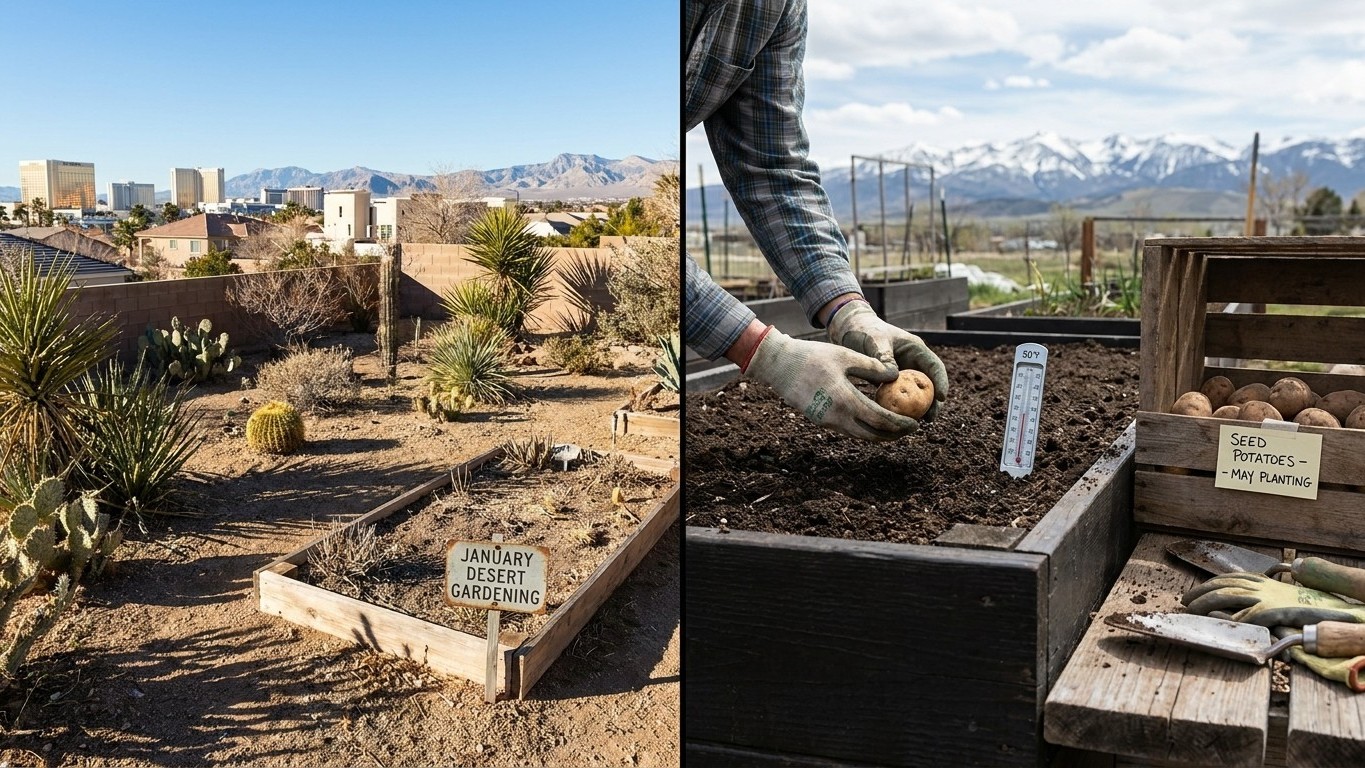

Nevada has no single planting date because it has no single climate. In Las Vegas, the last spring freeze can fall as early as January 7, according to NOAA NCEI’s 1991-2020 climate normals for that airport station. In Reno or Carson City, gardeners are often still watching for frost in May. The number that actually matters isn’t a date at all: it’s when your soil hits 50°F, roughly 14 to 21 days before your local last frost.
The short answer
NOAA NCEI’s 1991-2020 U.S. Climate Normals put the last spring frost window for the Las Vegas airport station at January 7 to February 1, based on the 30-70% probability band for a 32°F freeze. That’s a real, sourced figure. It is also almost useless as a statewide planting guide, and here’s why.
Las Vegas sits in a low desert basin with a heavy urban footprint. Pavement, buildings, and reflected heat push that station’s frost dates weeks, sometimes months, earlier than anywhere else in Nevada. Call it what it is: a desert urban-heat-island extreme, not a template. If you garden in Henderson, you might get close to that window. If you garden in Reno, Carson City, Elko, or anywhere with real elevation, that January date will get you nothing but frozen seed potatoes and a wasted trip to the garden store.
So what’s the actual answer for the rest of the state? There isn’t one number, because Nevada’s elevation swings from under 500 feet along the Colorado River to well over 6,000 feet in the Sierra foothills and the Great Basin valleys. Every thousand feet of elevation shifts your growing season meaningfully, both pushing spring planting later and pulling fall frost earlier. A gardener in Pahrump is not working with the same calendar as a gardener in Elko, even though both are technically Nevada.
The workable answer, the one that applies whether you’re at 2,000 feet or 6,000, comes from the plant itself rather than the calendar. Potatoes go in the ground when soil temperature reaches 50°F, and that point typically arrives 14 to 21 days before your area’s last frost date, according to Utah State University Extension and the University of Maine Cooperative Extension. That’s the figure worth planting your season around, not a single frost date pulled from one desert airport.
To use it, you need two things: your own last-frost estimate (from your county extension office, not the Las Vegas number) and a soil thermometer. Everything else in this article builds from that pairing.
What actually decides it
Soil temperature, not calendar date
A calendar date is a guess. Soil temperature is a measurement. Potato seed pieces planted into cold, wet soil don’t die outright the way a tomato transplant would in a frost, but they sit and rot before they sprout, inviting disease and losing the whole point of an early planting. Once soil reaches 50°F, the seed piece sprouts reliably and the plant can tolerate a light frost on its foliage without losing the crop. That’s why both Utah State and University of Maine Extension anchor their planting guidance to soil temperature, with the 14-to-21-day window before last frost as the practical estimate of when that threshold typically arrives.
The 90°F heat ceiling
The other end of the season matters just as much, and it’s the mechanism most home gardeners never hear about. Once soil temperatures climb above 90°F, tuber set and tuber fill are inhibited. The plant can look green and healthy above ground while doing almost nothing below it. Watering more does not fix this; it’s a temperature response, not a drought response. In much of low-elevation Nevada, where summer soil temperatures routinely blow past 90°F, this ceiling is the real deadline. It’s the reason gardeners in hot regions plant potatoes as a spring crop timed to finish before the heat arrives, rather than treating potatoes like a summer-long crop the way a Midwest gardener might.
Elevation and microclimate in Nevada
These two mechanisms, the 50°F floor and the 90°F ceiling, interact differently depending on where you sit in Nevada. At higher elevations (Reno, Carson City, the Great Basin valleys), the growing window between those two temperatures is longer but arrives later in the year and closes earlier in fall. At low desert elevations (Las Vegas, Laughlin, Pahrump), the window opens far earlier but also slams shut sooner, because summer heat arrives fast and hard. Neither pattern is better; they just require different counting-back math from your own local last frost, which is exactly why a single statewide date can’t do the job.
How to do it
- Contact your county extension office or check locally reported frost history for your specific town, since the NOAA figure most gardeners find online is often a single distant station, not your backyard.
- Buy a basic soil thermometer and start checking soil temperature at a 4-inch depth two to three weeks before your estimated last frost date.
- Plant certified seed potatoes only. Certified seed has been inspected and is free of the viruses that build up in potatoes saved from the grocery store or a neighbor’s harvest; uncertified seed carries that risk forward into your soil for years.
- Cut larger seed potatoes into pieces with at least one or two eyes each, and let the cut surfaces callus for a day or two before planting to reduce rot risk.
- Once soil reads 50°F, which Utah State University Extension and University of Maine Cooperative Extension place at roughly 14 to 21 days before your last frost date, plant the seed pieces 3 to 4 inches deep.
- Choose a season class, early, mid-season, or late, based on how much time your site has between the 50°F soil floor and the point where summer soil temperature crosses 90°F. Shorter windows favor early-season types; longer, cooler windows can support mid-season or late types.
- Hill soil up around the stems as plants grow, which keeps developing tubers covered and shaded from surface heat.
- In low-elevation, hot-summer areas, plan the harvest to land before soil temperatures push past 90°F for extended stretches, since that’s when tuber fill stalls regardless of watering.
What goes wrong
- Using the Las Vegas frost date for the whole state. A gardener at elevation who plants based on that January window will lose the crop to a hard freeze weeks or months later than that figure suggests. Get your own local last-frost estimate instead of borrowing one desert station’s number.
- Planting by the calendar instead of the soil. A date on a seed packet doesn’t know if your soil is still 40°F from a wet spring. Check with a soil thermometer before planting rather than trusting a fixed day.
- Assuming more water fixes a stalled crop in midsummer. If soil has crossed 90°F, tuber set and fill are inhibited by temperature, not moisture. The remedy is timing the whole season earlier next time, not irrigating harder now.
- Planting uncertified seed to save money. Seed saved from a previous harvest or bought as table potatoes can carry viruses invisible at planting time that reduce yield and spread through your soil. Buy certified seed potatoes each season.
- Skipping the curing step on cut seed pieces. Planting freshly cut pieces straight into cold, damp soil invites rot before sprouting. Let cut surfaces callus for a day or two in a cool, dry spot first.
- Treating potatoes like a full-summer crop in the low desert. In Las Vegas-area heat, a potato planting timed for continuous summer growth runs straight into the 90°F ceiling. Treat it as a spring crop that finishes before peak heat instead.
Common questions
Does the Las Vegas frost date apply anywhere else in Nevada?
No. NOAA NCEI’s January 7 to February 1 window is specific to the Las Vegas airport station and reflects an urban desert heat island. Reno, Carson City, and other elevated areas see frost far later in spring and earlier in fall. Use your own county’s frost history, not this single station’s figure.
What temperature should the soil be before planting potatoes?
Utah State University Extension and University of Maine Cooperative Extension both point to 50°F soil temperature as the planting trigger, typically reached 14 to 21 days before an area’s last frost date.
Can I keep growing potatoes through a hot Nevada summer?
Not productively in low-elevation, high-heat areas. Once soil temperature climbs above 90°F, tuber set and tuber fill are inhibited, and irrigation doesn’t reverse that. Where summer soil heat is a given, plant early enough to finish before that ceiling hits.
Is it fine to plant potatoes saved from last year’s harvest?
It’s a risk rather than a rule violation, but certified seed potatoes are inspected specifically to be free of viruses that accumulate in saved or store-bought potatoes. Starting with certified seed each season protects yield and soil health going forward.