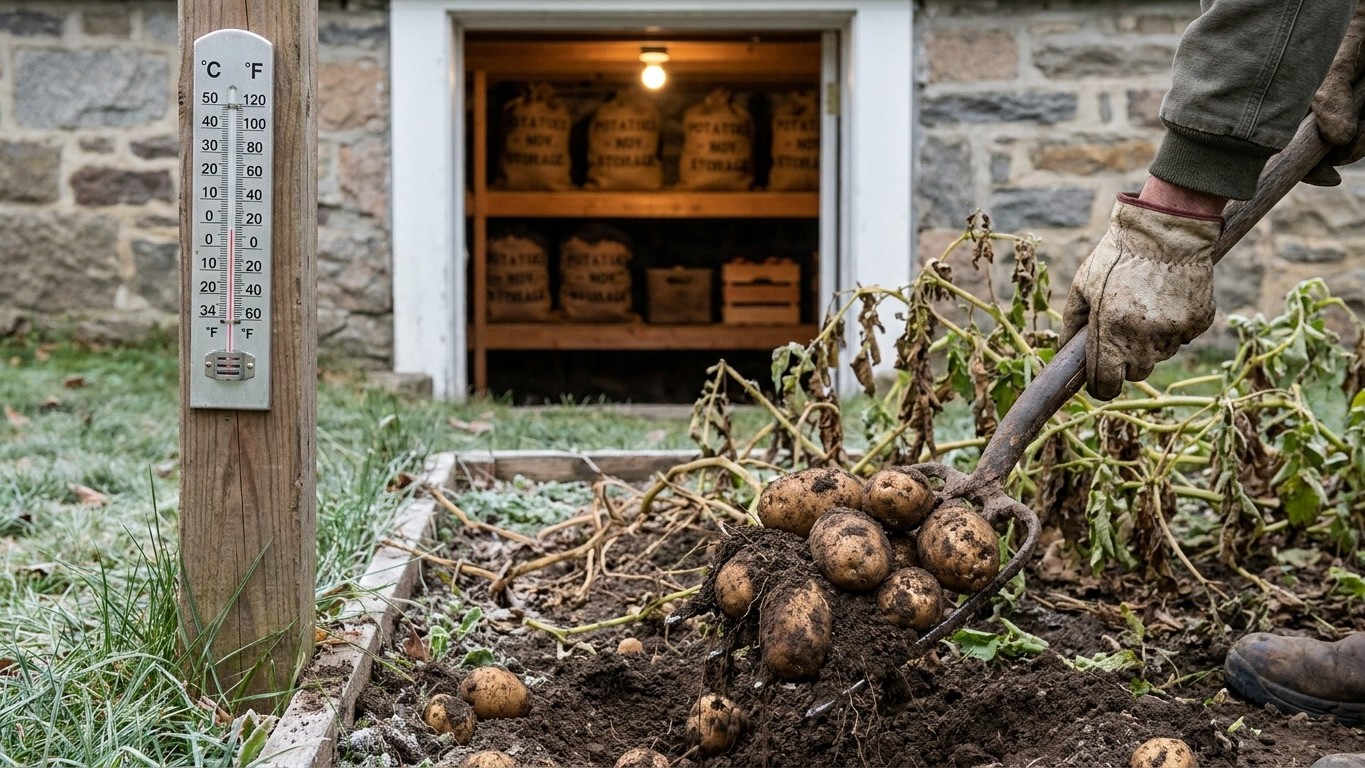

Dig New York potatoes before the ground locks up, then hold them in the coldest room in the house that never actually freezes. In New York City, that means harvest wraps up before November 14 to November 27, and winter storage has to survive a coldest-month low that averages 27.9 F, a basement usually clears that bar, an unheated garage often doesn’t.
The short answer
Two numbers frame everything about this crop in New York. The first fall frost at 32 F arrives between November 14 and November 27, based on NOAA NCEI’s 1991-2020 Climate Normals for the New York City reference station. The second is the mean daily minimum for the coldest month: 27.9 F. That’s not a record low or a monthly average, it’s the typical overnight floor in January, and it’s the figure that decides whether an unheated space can hold potatoes all winter without freezing them solid.
Vines start dying back on their own in late summer, and the tubers should come out of the ground in the weeks after that, well ahead of the first frost window. Waiting past mid-November in the city, or later than that upstate, risks digging into ground that’s already stiffening. Potatoes left in frozen soil turn soft and sweet-tasting as their starch converts to sugar, and that damage doesn’t reverse once they’re in the bin.
The caution matters here because Central Park sits in one of the mildest pockets in the state. It’s a dense urban site, and upstate New York and the Adirondacks see frost weeks earlier in fall and weeks later in spring. A grower in Buffalo or Saranac Lake should treat the city’s November window as the late end of the range, not a target date, and plan to have the crop out of the ground earlier.
As for storage, the 27.9 F figure answers the second half of the question directly. An unheated garage, shed, or three-season porch in New York will spend stretches of January well below 40 F, and on cold nights it can drop under 32 F. That’s below the range potatoes need and cold enough to freeze them outright. Holding potatoes at 40-45 F through a New York winter almost always requires an insulated space, a basement, or a root cellar dug into the ground, something with enough thermal mass or heat leakage to stay above freezing when the outdoor air doesn’t.
Curing, and where
Curing sets the skin before the flesh spends months in storage, and Utah State University Extension puts the target at 55-60 F with high humidity, held for 2 to 3 weeks. In New York, that window falls right when outdoor temperatures are already trending down, so the space matters as much as the timing. Here’s the order that works.
- Dig on a dry day and let the tubers sit on top of the soil for an hour or two so loose dirt can flake off. Don’t wash them, and don’t scrub the skin.
- Pick the curing spot before you dig, not after. A shaded porch can hit 55-60 F during an early harvest in New York, but as nights cool through the season that window narrows fast and the porch drops below range within days. An unheated garage tracks outdoor temperature closely and can swing both directions in a single week this time of year.
- Default to a basement if the harvest runs into mid-fall. Basements in New York hold a steadier band, usually cooler than the living space above but buffered from outdoor swings by surrounding soil and the house itself.
- Spread tubers in a single layer, not piled, so air reaches all sides, and keep the area dark to stop greening.
- Hold humidity high by covering the layer loosely with burlap or newspaper rather than plastic, which traps moisture against the skin and invites rot.
- Give the full 2 to 3 weeks before checking. Skins that don’t slip or tear under light thumb pressure are cured and ready to move to winter storage.
A garage works for curing only if the harvest lands early enough that overnight lows haven’t yet dropped into the 40s. Once they have, the basement is the more reliable choice for the rest of the season.
Storing through this winter
Once cured, potatoes want the opposite of a bright kitchen counter. Utah State University Extension calls for dark storage at 40-45 F, and the University of Maine Cooperative Extension gives a tighter figure of 38 F at 95 percent humidity. Both ranges sit well above New York’s coldest-month mean minimum of 27.9 F, which is exactly why the storage space itself has to do the work the outdoor air won’t.
A basement is the most dependable option across most of the state. Ground contact and heat rising from the living space above tend to keep basement temperatures well above freezing even when the coldest-month average dips close to 28 F outside, and many basements land naturally in or near the 40-45 F band without any added insulation. A root cellar, dug partly or fully into the earth, does the same job through mass rather than heat leakage, and it can often hit the tighter 38 F target Maine describes if it’s built with good ventilation and no direct exposure to outdoor air.
An attached, unheated garage is the riskier middle ground. Early in the storage season it may sit close to the right range, but as the coldest month approaches and overnight lows regularly threaten that 27.9 F mean, the garage can slide below freezing on the harder nights even if daytime temperatures look fine. A detached, uninsulated shed is worse still, since it has no shared wall with a heated structure to borrow warmth from.
Upstate growers face a harder version of this same math. Colder winters push the coldest-month minimum further below the New York City figure, which means a space that just barely holds the line in the city can freeze solid further north. The safest approach anywhere in the state is to check the actual temperature in the intended storage spot with a thermometer left in place for a few cold nights, rather than assume a basement or garage will land in range just because it did in a milder year.
What goes wrong here
- Digging too late and hitting frozen ground. Waiting past the local frost window, especially upstate where frost arrives well ahead of the New York City dates, means fighting soil that’s already stiffening or freezing potatoes in place. Dig as soon as vines die back rather than waiting for a calendar date.
- Curing on a porch that cools too fast. A shaded porch can meet the 55-60 F curing range early in the season, then drop out of it within a week as fall nights deepen. Move the batch to a basement rather than leaving it on a porch through a cold snap.
- An unheated garage freezing in the coldest month. With a mean minimum of 27.9 F, an uninsulated garage in New York will drop below freezing on a regular basis in January. Potatoes stored there without added insulation or a heat source can freeze and turn sweet and soft.
- A basement warmed by a furnace or water heater. The corner nearest mechanical equipment often runs well above 45 F, which encourages sprouting long before spring. Locate the storage bin in the coolest, farthest corner of the basement instead.
- Rot from moisture trapped under plastic. Covering cured potatoes in plastic during New York’s humid fall holds condensation against the skin. Burlap, cardboard, or open bins breathe better and keep rot down.
- Disease carried in from the field. Tubers with visible damage or disease symptoms should be set aside and treated with an appropriate fungicide before storage rather than mixed in with the healthy crop, since one bad potato can spread rot through an entire bin over winter.
Common questions
When should I dig potatoes in New York?
Dig once the vines have died back, well ahead of the first fall frost. In New York City that frost falls between November 14 and November 27; upstate and in the Adirondacks, plan on an earlier date, since those areas frost well ahead of the city.
Can I store potatoes in an unheated garage in New York?
Only for part of the season. Once the coldest month arrives, with a mean daily minimum of 27.9 F, an uninsulated garage will regularly drop below freezing, which ruins stored potatoes. A basement or insulated root cellar is the more reliable choice through winter.
Do I need to cure potatoes before storing them?
Yes. Utah State University Extension recommends curing at 55-60 F with high humidity for 2 to 3 weeks before moving potatoes into winter storage. Skipping this step leaves skins thin and more prone to rot and moisture loss.
How cold can potato storage get before the crop is ruined?
Storage should stay in the 40-45 F range per Utah State University Extension, or as low as 38 F at high humidity per the University of Maine Cooperative Extension. Temperatures that drop to freezing or below convert starch to sugar and break down the tissue, and that damage does not reverse.