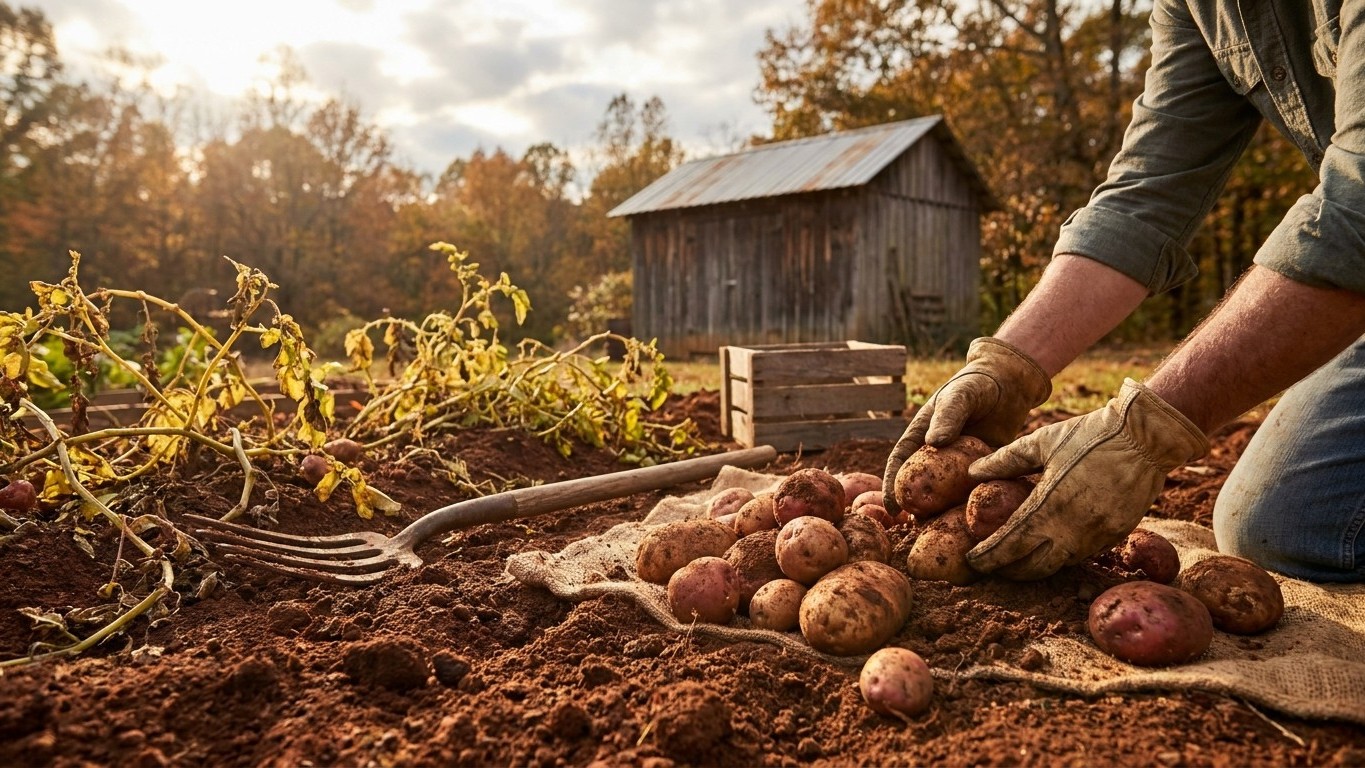

In most of Utah, potatoes come out of the ground before the first fall frost hits, sometime between October 18 and October 29 in the Salt Lake valley (later at higher elevation, earlier in the mountains). After that, the real problem starts: an unheated garage or shed here won’t hold the 40-45 F that stored potatoes need, because the coldest month averages a nightly minimum of just 24.2 F. That gap between what potatoes want and what an unheated Utah space delivers is the whole story of storage in this state.
The short answer
Two numbers frame everything about growing and storing potatoes in Utah. The first fall frost arrives sometime between October 18 and October 29, based on NOAA NCEI 1991-2020 Climate Normals for the Salt Lake City reference station. The second number matters more once the crop is dug: the coldest month of the year averages a mean daily minimum of 24.2 F. That’s not the record low for a brutal night. It’s the average low across the whole coldest month, which is the figure that decides whether an unheated structure can hold produce all winter.
Those two figures point in different directions for a Utah grower. The frost date tells you when to dig. Potatoes left in the ground past that window risk frost damage to the tubers near the soil surface, and vines killed by frost stop feeding the crop below ground anyway. So harvest happens at or just before that date, weather and soil moisture permitting.
The 24.2 F figure tells you something less convenient: once the potatoes are out of the ground, an unheated space in most of Utah will not sit at 40-45 F on its own through the winter. A garage, a shed, an unheated porch, all of these track outdoor air temperature closely once night after night drops toward the mid-20s. That means they’ll dip well below the 40-45 F that Utah State University Extension recommends for storage, and likely below freezing on the coldest nights of January. A freeze doesn’t just chill a potato. It turns the starch to sugar, breaks down the cell walls, and turns a firm tuber into a soft, sweet, unusable mush within days of thawing.
Salt Lake City sits in a comparatively mild valley. Most of Utah is higher in elevation and colder than that reference station, meaning the coldest-month minimum is very likely worse than 24.2 F away from the valley floor. Southern Utah runs warmer. If you’re storing potatoes in Cedar City, St. George, or the lower Colorado Plateau, expect a milder coldest month than the Salt Lake number and a bit more slack in an unheated space. If you’re at elevation in the Wasatch Back, the mountains, or the high desert of the eastern part of the state, expect the cold to be more severe than 24.2 F, not less. Either way, the takeaway holds: don’t assume an unheated Utah structure will hold storage temperature through winter without checking it with a thermometer.
Curing, and where
Before potatoes go into winter storage, they need to cure. Utah State University Extension recommends curing at 55-60 F with high humidity for two to three weeks. That window heals the skin over cuts and bruises from digging, thickens the outer layer, and lets the crop shed excess field moisture before it sits in a dark space for months. Skip curing, and the odds of rot in storage climb fast.
The trick in Utah is finding 55-60 F at the exact moment potatoes come out of the ground, which is right around that mid-to-late October frost window. Outdoor air at harvest time in most of the state is already trending toward the 40s and 50s, and dropping fast at night, so an open porch or an outdoor table works for only a few days before overnight lows undercut the target range. A basement, by contrast, tends to sit in the high 50s to low 60s year-round in much of Utah, largely insulated from the swings happening outside, which makes it one of the more reliable curing spots available to an ordinary home. An attached garage can work too, but only if it stays warmer than the outdoors, not if it’s essentially an unheated shed.
- Dig on a dry day, and handle gently. Bruised and cut potatoes cure poorly and rot first in storage.
- Move the crop out of direct sun immediately. Sunlight and warm outdoor air swing well outside the 55-60 F target, especially by afternoon in a Utah October.
- Set up the curing spot before harvest day. A basement corner, a shaded and enclosed porch, or a heated garage bay, checked with a thermometer, not guessed at.
- Hold humidity high. Damp burlap, a loosely covered bin, or a humid basement corner all help; a bone-dry garage does not.
- Let the crop sit two to three weeks before moving it to long-term storage, per Utah State University Extension.
- Sort before storing. Cull anything soft, cut, or showing rot; curing does not fix damage that’s already too severe.
Storing through this winter
Once cured, potatoes want darkness and 40-45 F, according to Utah State University Extension. The University of Maine Cooperative Extension gives a slightly tighter target for longer-term storage: 38 F at 95 percent humidity. Both ranges sit well above freezing and well below room temperature, which is exactly the narrow band that an ordinary Utah home rarely offers without some adjustment.
Set that against the coldest-month minimum of 24.2 F, and the storage problem becomes concrete. A root cellar dug into the ground, or a basement corner away from heating ducts, tends to track soil temperature more than air temperature, and soil several feet down changes far more slowly than the air above it. That’s why a basement or a true cellar is the standard advice for Utah storage: it buffers against both the freeze risk of an unheated shed and the too-warm risk of a heated living space. A spot near a furnace, a water heater, or a sunny window will run warmer than 45 F even in January, and warmth is what tells a stored potato to sprout.
A detached garage or shed, on the other hand, has no such buffer. Without insulation or supplemental heat, it will follow outdoor air closely, and outdoor air in the coldest month averages a nightly low of 24.2 F across the reference period. That’s roughly 15 to 20 degrees colder than the 40-45 F Utah State University Extension target, and well past freezing. A single hard freeze can ruin an entire bin of stored potatoes in one cold snap, which is why an unmonitored, unheated Utah outbuilding is one of the riskiest storage choices available, despite being the most common one people reach for out of convenience.
The fix isn’t complicated, just deliberate: insulate the storage container itself (a straw-lined bin, an insulated cooler, a box set inside a larger box with newspaper packed between), check the space with a thermometer through the first hard cold snaps, and move the crop to a basement or interior closet if the garage or shed drops toward freezing. Darkness matters too, separate from temperature: light exposure turns potato skins green and bitter, so a cardboard box or opaque bin beats a clear one regardless of where it sits.
What goes wrong here
- Digging too late and hitting frost in the ground. Waiting past the October 18-29 window risks frost reaching tubers near the surface. Dig on schedule, and if a hard freeze is forecast early, move the harvest date up rather than gambling on a late window.
- Curing outdoors after the weather has already turned. Utah’s air drops out of the 55-60 F curing range fast once frost season starts. Move the crop indoors, to a basement or enclosed porch, instead of leaving it on an open table exposed to swinging fall temperatures.
- Storing in an unheated garage or shed through the coldest month. With a mean nightly minimum of 24.2 F in the coldest month, an uninsulated outbuilding will freeze a bin of potatoes outright on the coldest nights. Move stored potatoes to a basement, insulate the container, or add heat before deep winter arrives.
- Storing too close to a furnace or in a heated room. The opposite failure: warmth above 45 F triggers early sprouting and softening. Keep stored potatoes away from mechanical rooms and heating vents, even inside a heated home.
- Storing in light. A clear bin or an open shelf under a window lets potatoes green and turn bitter regardless of temperature. Use an opaque container and a genuinely dark corner.
- Skipping the cure entirely because harvest ran late in the season. Uncured potatoes rot faster once binned for winter. Even a shortened cure in a basement beats none at all, though the full two to three weeks recommended by Utah State University Extension gives the best result.
Common questions
When should I dig potatoes in Utah?
Around the first fall frost date, which falls between October 18 and October 29 in the Salt Lake valley based on NOAA NCEI Climate Normals. Higher elevations across the state typically see frost earlier; southern Utah typically sees it later.
Will an unheated shed keep potatoes all winter in Utah?
Not reliably. The coldest month averages a nightly minimum of 24.2 F at the Salt Lake City reference station, well below the 40-45 F that Utah State University Extension recommends for storage. An uninsulated, unheated shed will likely freeze the crop on the coldest nights.
What temperature is best for curing potatoes before storage?
Utah State University Extension recommends 55-60 F with high humidity, held for two to three weeks. A basement or an enclosed, unheated porch checked with a thermometer are the most realistic Utah spots for hitting that range at harvest time.
Is a basement a good place to store potatoes in Utah?
Generally yes, because basements buffer against both winter freezes and indoor heat, tracking ground temperature more than air temperature. Keep the storage spot dark, away from furnaces and heating ducts, and as close to the 40-45 F range (Utah State University Extension) or the 38 F, 95 percent humidity range (University of Maine Cooperative Extension) as the space allows.