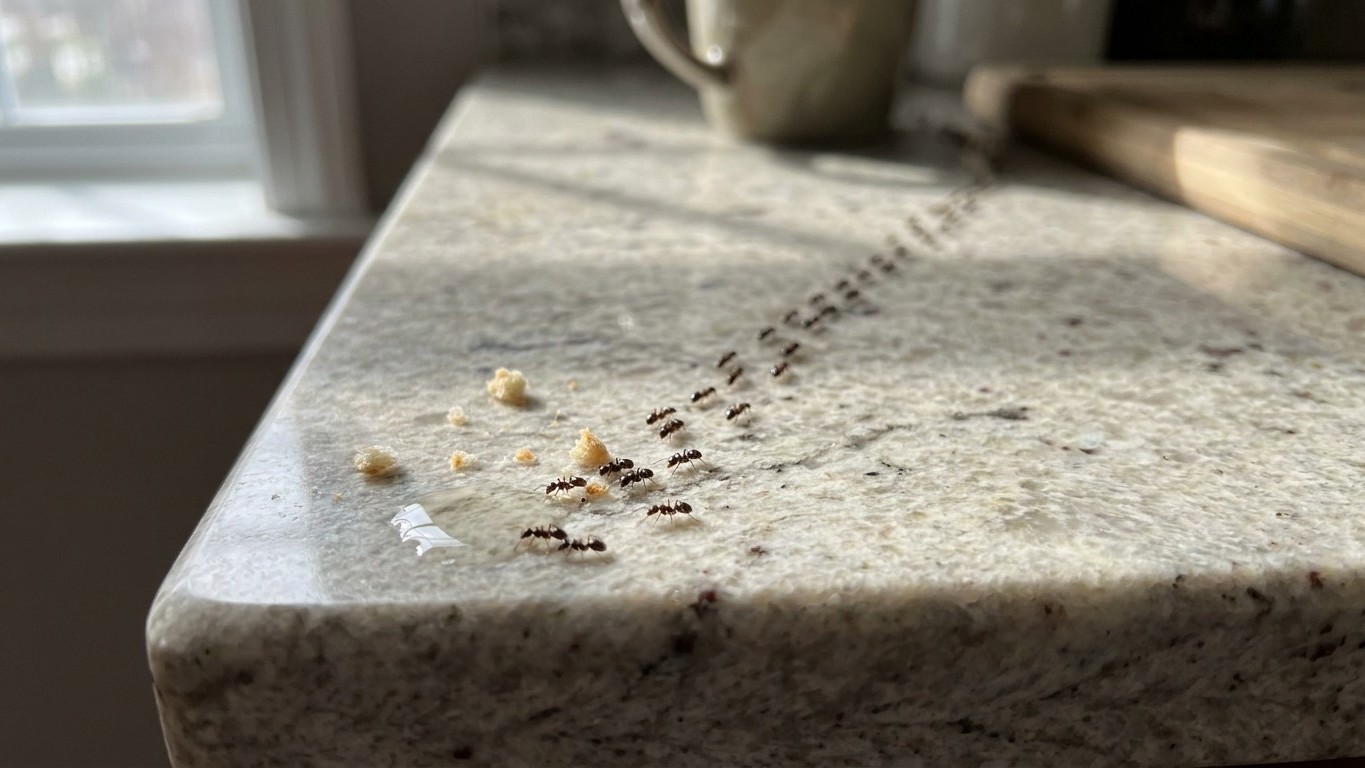

A single ant crossing your kitchen counter means little. A steady line of them means a scout already reported a food or water source back to the colony, and dozens of workers are now following that trail. Killing the ants you see does nothing to the nest itself. Fixing the problem means knowing which ant you have, what drew it in, and which control step actually matches the level of the problem.
What you are dealing with

Most household ant problems in the United States come down to a handful of species: odorous house ants, pavement ants, carpenter ants, and in warmer regions, Argentine ants or fire ants. Each one nests differently, eats differently, and responds to different fixes, which is why a single can of spray rarely solves anything for long. What decides everything is the trail. A worker ant that finds food does not eat and leave. It eats, returns to the nest, and lays down a chemical trail so other workers can follow the same route back to the source. That is the line you see marching across the floor.
This matters because it flips the instinct most people have. Wiping up the ants in front of you, or spraying the visible trail, kills the workers on the surface but leaves the nest, the queen, and the rest of the colony untouched. New scouts simply find the same crumb or the same drip under the sink within a day or two, and the trail reappears. The fix has to reach the colony’s habits, not just the ants standing on your countertop.
Three questions drive almost every ant problem in a home, and each one points to its own answer.
- What species is this, and what does the trail, the nest location, or the ant’s size tell you? That is a question of signs.
- Why did this colony pick your kitchen, bathroom, or window sill over the yard next door? That is a question of causes.
- What actually stops it, and when does the job go past what a homeowner should try alone? That is a question of control.
The rest of this page walks through each of those in brief, with links to the full detail on each one.
Recognizing them
Identification starts with looking closely at the trail itself rather than guessing from memory. Odorous house ants are small, dark brown to black, and release a rotten-coconut smell when crushed, which is an easy field test. Pavement ants are similarly small but tend to nest under slabs, sidewalks, and foundations, showing up as small mounds of displaced soil near cracks in concrete. Carpenter ants are larger, often black or reddish-black, and their presence, especially near window frames, bathrooms, or anywhere wood has stayed damp, is a signal worth taking seriously since they excavate galleries in wood rather than eat it the way termites do.
People confuse a lot of these species with one another, and the confusion that matters most is carpenter ants versus termites. Both can show up near moisture-damaged wood, but the wood damage looks different, the insects look different, and the response is different. A magnifying glass and a few minutes spent comparing antennae shape, waist segment, and wing pairs (on the reproductive forms) usually settles it. So does noticing what the ant is actually doing: carrying food back toward a wall crack points to a foraging ant colony; sawdust-like debris (called frass) piling up near a baseboard points toward wood-nesting activity that needs a closer look.
Time of day and season are signs too. Some species trail heavily at night, others in daylight, and many ant problems spike in spring when colonies expand and again after a period of rain drives outdoor colonies to seek drier ground indoors. None of these details prove a species on their own, but together they narrow the list fast.
The full breakdown of what each trail, nest, and body type actually looks like, species by species, with the specific confusions to watch for, is covered on the signs page.
Why they are here
Every ant colony that moves into a house is solving the same three problems: food, water, and shelter. A dish left in the sink overnight, a pet bowl with standing water, a trash can without a tight lid, crumbs under a toaster, all of these are invitations a foraging scout can find within hours. Moisture matters just as much as food. A slow leak under a bathroom sink, a damp crawl space, or condensation around a window frame gives a colony the humidity many species need to survive, and it is often the water source, not the food source, that keeps a colony coming back to the same spot.
Shelter is the part homeowners tend to underestimate. Ants do not need much of a gap. Hairline cracks in a foundation, gaps around utility lines, and spaces behind siding are enough for a colony to establish a satellite nest close to a reliable food and water supply. Carpenter ants take this further, seeking out wood that has already been softened by moisture damage, which is why a colony showing up near a bathroom or an old roof leak is rarely a coincidence.
The federal government’s approach to this kind of problem starts well before any product enters the picture. As the U.S. EPA puts it, “As a first line of pest control, IPM programs work to manage the crop, lawn, or indoor space to prevent pests from becoming a threat.” For a house, that means closing the specific gaps that gave this colony food, water, or shelter in the first place, not just treating the ants that already found their way in. A full walkthrough of what draws each species indoors, with the specific entry points and moisture sources to check room by room, is on the causes page.
What works
The EPA frames effective pest control as Integrated Pest Management, describing it directly: “Integrated Pest Management (IPM) is an effective and environmentally sensitive approach to pest management that relies on a combination of common-sense practices.” The order of that approach matters as much as the individual steps, and it is not the order most people reach for instinctively.
The first step is not a product at all. “Before taking any pest control action, IPM first sets an action threshold, a point at which pest populations or environmental conditions indicate that pest control action must be taken.” A few scouts near an open window is a different problem than a daily trail from three rooms converging on the kitchen, and the response should scale with what is actually happening.
The second step is identification, because “IPM programs work to monitor for pests and identify them accurately, so that appropriate control decisions can be made.” This is exactly why the species question comes before any fix; a treatment aimed at a pavement ant colony under the porch slab does nothing for a carpenter ant colony inside a damp wall stud.
Only after prevention has been addressed does the EPA describe reaching for an active control measure, and even then with a clear hierarchy: “Effective, less risky pest controls are chosen first, including highly targeted chemicals, such as pheromones to disrupt pest mating, or mechanical control, such as trapping or weeding.” Broad chemical treatment sits at the bottom of that list, not the top. “Broadcast spraying of non-specific pesticides is a last resort.”
Pesticides are built to be toxic to the pests they target, and the EPA is clear that they can be toxic to people when used improperly, with children, older adults, and people with compromised immune systems named as especially vulnerable. Anyone with a question about a specific product they already own should call the National Pesticide Information Center at 1-800-858-7378 rather than guess, since registered products and their instructions vary by state and change over time. The full sequence for ants specifically, including which situations call for bait versus which call for sealing entry points first, is laid out on the control page.
Some ant problems are past what a can from the hardware store can fix. A carpenter ant colony established inside structural wood, or a colony that keeps returning to the same spot despite sealing and cleaning efforts, is a reasonable point to call a licensed pest control professional rather than continuing to guess at home. That call is not a failure; it is the same threshold logic the EPA describes, just applied at the point where the problem has outgrown a household response.
Common questions
Does killing the ants I see get rid of the colony?
No. Workers you see on a counter or windowsill are a small fraction of the colony. The nest, and the queen producing new workers, stays untouched unless the control method reaches the colony itself.
Why do ants suddenly appear after rain?
Heavy rain can flood outdoor nests or push soil moisture to levels some species avoid, driving colonies to seek drier ground, and a house offers exactly that along with food and water in one place.
Are the ants in my house the same as the ones outside?
Often yes. Many household ant problems are an outdoor colony sending foragers indoors rather than a colony nesting inside the structure itself, which is one reason sealing entry points matters as much as anything done inside.
When should I stop trying home fixes and call a professional?
When the species is a wood-nesting ant near structural lumber, when a trail keeps returning despite sealing and cleaning, or when the colony’s location cannot be found. At that point a licensed pest control professional can locate and treat the nest directly rather than repeating a cycle of temporary fixes.