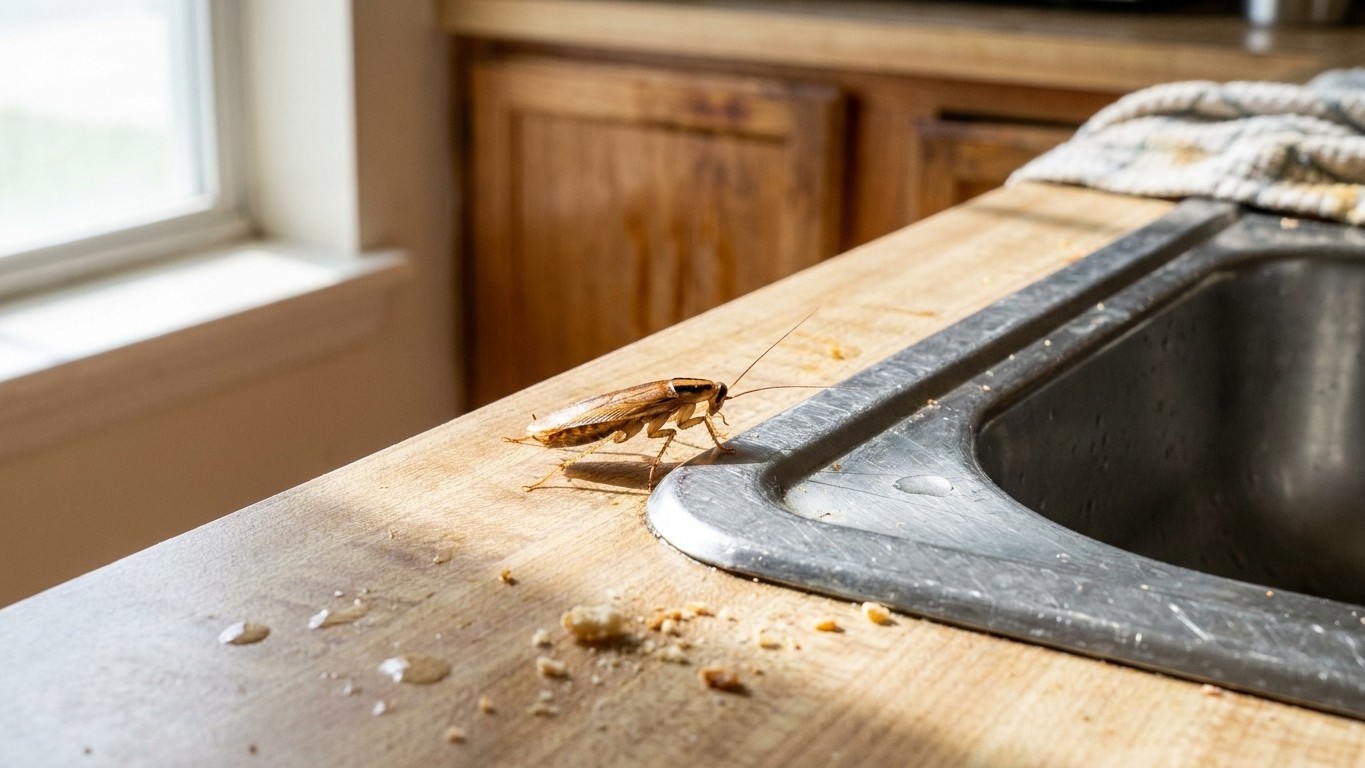

Cockroaches in a house mean grease, crumbs, and warm damp hiding spots have gone unchecked long enough for a colony to settle in. Seeing one crossing the kitchen floor at night is common and often manageable. Seeing one in daylight is a different signal entirely, and it usually means the population behind your walls and under your appliances is already larger than you think.
What you are dealing with

Of the roughly 4,500 cockroach species worldwide, only a handful regularly move into American homes. German cockroaches, small and tan with two dark stripes behind the head, dominate kitchens and bathrooms. American cockroaches, reddish-brown and over an inch long, favor basements, sewers, and crawl spaces. Oriental cockroaches, dark and slow-moving, turn up in damp, cool areas like drains and mulch beds close to a foundation. Each species has its own habits, but they share the same three requirements: food residue, a water source, and a warm, sheltered crack to hide in during daylight.
That last point is the one homeowners underestimate. Cockroaches are nocturnal by instinct, not by choice. When food and shelter are scarce, they stay hidden and only forage after dark, which is why an occasional nighttime sighting doesn’t always mean trouble. But when a colony outgrows its hiding spaces, competition pushes some individuals out into the open during the day, searching for food because the usual supply lines are exhausted. A daytime cockroach isn’t an outlier. It’s an overflow.
Grease buildup on stovetops and range hoods, unwashed dishes left overnight, pet food bowls, and even the residue inside a garbage disposal all count as food to a roach. Water matters just as much, sometimes more, since some species can survive weeks without eating but only days without moisture. A dripping pipe under the sink or condensation around a water heater can sustain a population long after the food source has been cleaned up.
Answering the cockroach question in a home really comes down to three separate but connected issues: knowing how to tell a real infestation from a stray sighting, understanding what in your specific house is drawing them in, and knowing which control steps actually work versus which ones just move the problem around. Each of those deserves its own close look. The signs page walks through what to check for beyond a live sighting. The causes page breaks down the conditions, room by room, that invite them in. And the control page lays out the sequence that pest management professionals actually follow, rather than the scattershot approach most people try first.
Recognizing them
A single roach sighting rarely tells the whole story, and that’s where a lot of confusion starts. The signs that matter more are the ones left behind: dark, pepper-like droppings along baseboards and inside cabinets, a musty odor that thickens in enclosed spaces like pantries, and oval egg cases, called oothecae, tucked into corners or behind appliances. German cockroach egg cases can hold dozens of embryos at once, which is part of why a small early problem can look like a large one within a few weeks.
Shed skins are another marker people miss. Cockroaches molt several times as they mature, leaving behind a pale, hollow outline of their exoskeleton that looks unsettling but confirms an active population rather than a one-time wanderer. Finding several of these in one drawer or behind one appliance points to a nest site, not a passing visitor.
People also mix up cockroaches with other household insects, and the mistake matters because the fixes are different. Water bugs, a common regional nickname, are usually just large cockroach species like the American cockroach, not a separate insect. Beetles are sometimes mistaken for roaches at a glance but have hard, shell-like wing covers and don’t share the same greasy, fast-scuttling movement. Crickets get confused with roaches too, particularly camel crickets in damp basements, but crickets have distinctly larger hind legs built for jumping and don’t leave the same droppings or egg cases.
Getting the identification right changes everything downstream, since a misidentified pest means wasted effort on the wrong prevention steps or the wrong product entirely. The signs page goes into the specific markers for each species, including what droppings and egg cases look like up close, and how to tell early-stage activity from an infestation that’s been building for months.
Why they are here
Cockroaches don’t pick a house at random. They respond to three conditions, and a home that offers all three in one place is the one that ends up with a persistent problem rather than an occasional stray. Food residue is the most obvious draw, but it doesn’t have to be a mess. Grease film on a stovetop, crumbs under a toaster, or an open bag of pet food left out overnight are enough to sustain a small population indefinitely.
Water access often matters more than food. Leaky pipes under sinks, condensation around window units, standing water in a drain pan, or a poorly sealed dishwasher all create the moisture cockroaches need to survive, and fixing a slow leak sometimes does more to reduce a population than any amount of cleaning.
Shelter is the third piece, and it’s the one that explains why the same house can have a problem year after year even after a thorough cleaning. Gaps around pipes, cracks in foundation walls, cluttered storage boxes, and the warm, dark space behind a refrigerator all give cockroaches a place to hide during the day and reproduce undisturbed. Cardboard boxes are a particular favorite since the material holds moisture and provides both food value and shelter at once.
The U.S. Environmental Protection Agency frames prevention as the foundation of any real pest strategy, not an afterthought to chemical control. As the agency puts it, “As a first line of pest control, IPM programs work to manage the crop, lawn, or indoor space to prevent pests from becoming a threat.” That principle applies as directly to a kitchen as it does to a farm field. The causes page breaks these three conditions down room by room, including the specific spots in a kitchen, bathroom, and basement where each one tends to show up first.
What works
The EPA’s Integrated Pest Management framework gives a clear, tested order for dealing with any household pest, cockroaches included, and the sequence matters as much as the individual steps. The agency describes IPM as “an effective and environmentally sensitive approach to pest management that relies on a combination of common-sense practices.”
The first step isn’t a spray. It’s a threshold decision: “Before taking any pest control action, IPM first sets an action threshold, a point at which pest populations or environmental conditions indicate that pest control action must be taken.” A single cockroach spotted once doesn’t necessarily meet that bar. Repeated sightings, droppings, or egg cases usually do.
Next comes accurate identification, since the EPA notes that “IPM programs work to monitor for pests and identify them accurately, so that appropriate control decisions can be made.” Knowing which species you’re dealing with determines where to focus, since German cockroaches cluster near kitchens while American cockroaches tend toward basements and drains.
Only after prevention measures are in place does the EPA turn to active control, and even then it favors the least aggressive option first: “Effective, less risky pest controls are chosen first, including highly targeted chemicals, such as pheromones to disrupt pest mating, or mechanical control, such as trapping or weeding.” Broad chemical treatment sits at the very end of that list, not the start. The agency is direct about this: “Broadcast spraying of non-specific pesticides is a last resort.”
When to call a professional
A German cockroach infestation that’s spread across multiple rooms, or one that returns repeatedly after cleaning and sealing efforts, is usually beyond what over-the-counter products can resolve on their own. Pesticides are designed to be toxic to pests and can be toxic to people when misused, with children, older adults, and anyone with a compromised immune system facing the highest risk. If you have questions about a specific product’s safety or use, the National Pesticide Information Center takes calls at 1-800-858-7378 and can answer more reliably than guesswork. The control page walks through the full IPM sequence in more detail, including what a licensed pest control technician typically does differently from a homeowner working alone.
Common questions
Does one cockroach mean an infestation?
Not necessarily. A single sighting at night, especially near an entry point, can be an isolated wanderer. A sighting during the day, or any droppings and egg cases found afterward, points to a larger population already established.
Can cockroaches make a house unsanitary in ways beyond appearance?
Cockroach droppings, shed skins, and body fragments are documented allergens and asthma triggers, a concern the CDC and many local health departments track closely, particularly in homes with children. Anyone with respiratory concerns tied to a cockroach problem should talk to their local health department or a physician rather than relying solely on pest control steps.
Why do cockroaches keep coming back after cleaning?
Cleaning removes food residue but doesn’t address water sources or shelter, the other two legs of the EPA’s prevention framework. A slow pipe leak or an unsealed crack behind an appliance can sustain a population indefinitely even in an otherwise spotless kitchen.
Are store-bought sprays enough on their own?
Broadcast sprays are considered a last resort under the IPM approach the EPA outlines, used after threshold-setting, identification, and prevention have already been addressed. Used alone and without those earlier steps, sprays tend to scatter a population rather than eliminate it, which is often why the problem seems to worsen briefly before it improves.