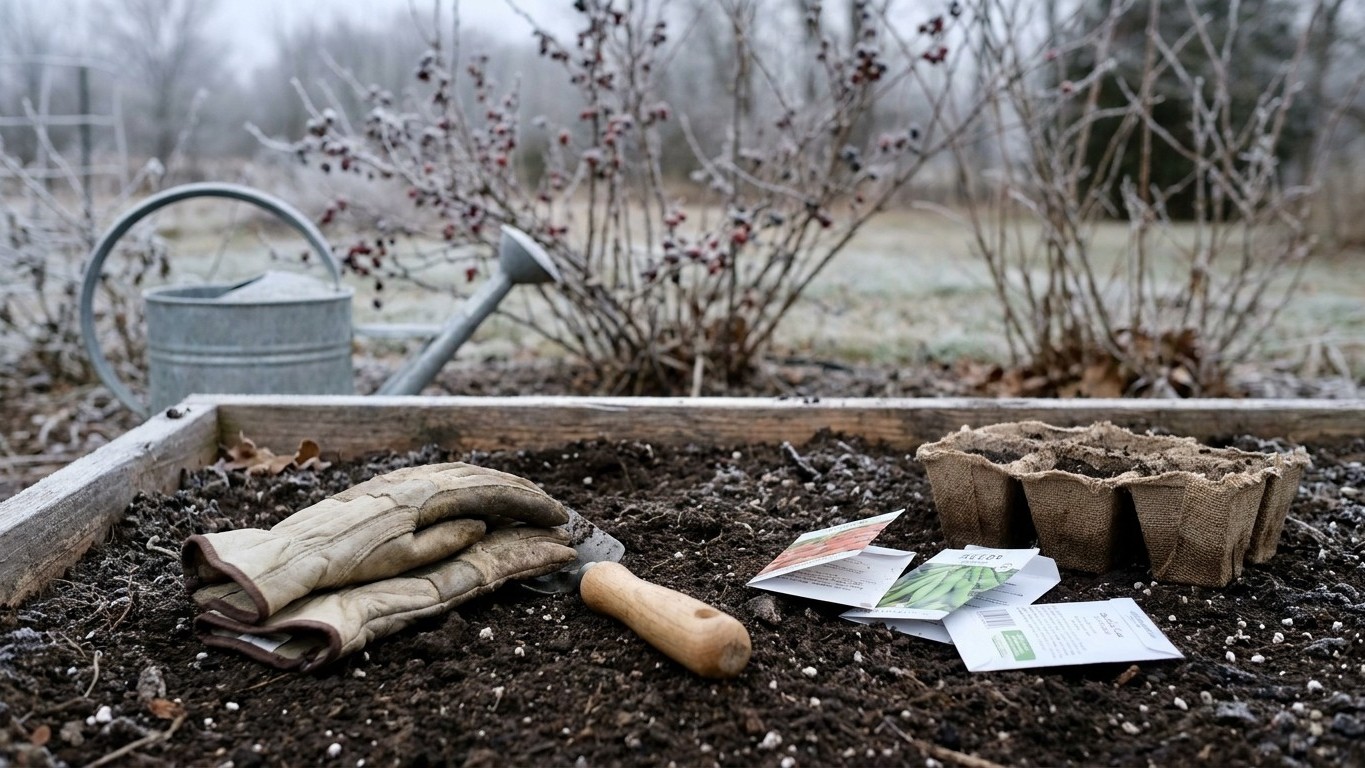

In February, nothing goes into open ground in Nunavut. The territory sits in Canadian hardiness zone 0a at the Rankin Inlet reference station, and the average frost-free window doesn’t open until around June 19, closing again by mid-September. This is a month for indoor starts, community greenhouse prep, and planning, not planting.
What goes in the ground in February
The honest answer is none of it. Nothing goes into outdoor soil in Nunavut this month, and that is not a gap in this guide, it is the actual state of the ground: frozen solid, buried under snow, months away from being workable. There is no fall garlic bed to mulch and no shallot row to tuck in, because the planting windows that make those jobs possible in southern climates simply don’t apply at zone 0a. Saying otherwise would set a reader up to fail.
What does exist, and what a lot of Nunavut gardeners lean on, is indoor and structure-based growing. Community greenhouses in hamlets across the territory are typically dormant or just beginning their pre-season checks this month, not planting. If a household has a heated, insulated growing space (a sunroom, a heated porch, a grow-light shelf), that is where any February activity happens, not outdoors and not in an unheated cold frame, which offers little protection against Nunavut’s February temperatures and near-total darkness at this latitude.
One real option for this month is forcing stored roots indoors. If rhubarb crowns or chicory roots were lifted and stored cold before freeze-up, February is a reasonable time to bring a few into a dark, cool indoor space and coax an early harvest of forced shoots or chicons. It is a small-scale project, not a substitute for a garden bed, but it is genuinely doable and it gives a returning gardener something to check on through the darkest stretch of the year.
Everything else this month is about preparation rather than planting: sorting seed stock, checking that any stored bulbs or tubers haven’t started rotting, and making sure growing structures are still sound under snow load. That work matters more here than almost anywhere else, because the actual growing season, once it arrives, will be short.
What to start under cover
Counting backward from the average frost-free date of June 19 is the only way to make sense of a start date here, and the arithmetic is unforgiving. Onions and leeks, among the slowest common vegetables to reach transplant size, need roughly 10 to 12 weeks indoors before they go out. Counted back from June 19, that lands in late March to early April, not February. Most other transplants (brassicas, lettuce, herbs) need less lead time still, closer to 6 to 8 weeks, which pushes their start dates even later into spring.
That leaves February as, for almost everything, too early. The exceptions are the slowest-growing plants in a household’s plan: certain perennial flowers or herbs that take 12 to 16 weeks from seed to a plantable size, or anything being grown for a community greenhouse that won’t be ready to receive transplants until well into late spring or early summer regardless of how big the seedlings get. For nearly all vegetable seedlings, starting now guarantees the first failure mode: rootbound, leggy plants sitting under lights for two extra months before there is anywhere warm enough to put them, stretching thin and going stressed long before transplant time.
The safer approach is to hold most seed packets until the counted-back date arrives, and to use February instead for inventorying what’s on hand, checking germination rates on older seed if a cold frame or indoor test tray is available, and confirming which greenhouse or grow-light space will actually be ready by the time seedlings need to move up in pot size. Given June 19 is a mean date and frost can run later in roughly half of all years at this station, building in a buffer rather than starting early is the more reliable habit.
What is ready to pick
Outdoors, nothing. There is no harvest happening in an open Nunavut garden in February, and no amount of season-extension gear changes that at this latitude and this point in the calendar. What feeds a household this month comes from storage and from indoor growing, not from a bed under snow.
Stored crops are the main event. Potatoes, onions, and any squash brought in before freeze-up should get a hands-on check now: look for soft spots, sprouting eyes on potatoes, or the faint give in squash flesh that signals it’s starting to break down. Pull anything questionable before it spreads rot to the rest of the bin. This is also a good month to rotate stored stock, using up anything showing early signs of decline before it’s wasted.
Indoors, microgreens and sprouts are the fastest, most reliable fresh food a Nunavut household can produce in February. A tray of pea shoots or a jar of sprouting lentils goes from seed to harvest in one to two weeks under nothing more than a sunny windowsill or a basic grow light, which makes them one of the few crops genuinely suited to this month rather than something squeezed in around it. If rhubarb or chicory was set to force earlier in the month, this is roughly when the first forced shoots or chicons become ready to cut, giving an early, if modest, taste of the growing season still months away outside.
The jobs that matter this month
February carries real weight for a Nunavut garden even with nothing in the ground, and skipping this month’s work shows up later as a scramble in May and June. Seed ordering tops the list, and it matters more here than in most of the country: shipping to Nunavut communities runs through longer freight and mail timelines than southern Canada or the Lower 48, so seed ordered late can easily arrive after the narrow planting window has already opened. Getting an order in now, while catalog stock is full, is one of the few February tasks with a hard, unforgiving deadline attached.
Planning next season’s plot or greenhouse layout is equally worth doing now, while there’s time to think it through rather than decide on the fly. That means sketching which beds or containers held which crops in the last cycle, so root vegetables, brassicas, and anything else that benefits from rotation don’t land in the same soil two seasons running. Soil testing, where a sample can be sent out or a home kit used on stored container mix, also belongs in this window, giving enough lead time to source amendments before the short window opens for using them.
Tool maintenance is unglamorous but genuinely useful now: cleaning soil and rust off hand tools, sharpening pruners and hoes, and checking that any greenhouse heating, ventilation, or lighting equipment survived the cold months in working order. Anything that needs a part ordered or a repair scheduled should get flagged this month, again because of how long replacement parts can take to arrive. Finally, keep working through the stored-crop check described above; a rotten potato left in a bin doesn’t stay a one-vegetable problem for long.
What not to do in February
The clearest mistake in a Nunavut February is treating any indoor warmth or a brief calm spell as a signal that outdoor planting season is close. It is not. The average frost-free date doesn’t arrive until around June 19, and that is a mean figure, not a guarantee: in roughly half of all years, the last frost falls later than that. Nothing about February weather changes that math, however mild a particular stretch feels indoors or out.
A second common error is starting too many seedlings too early under the assumption that more lead time is always better. It isn’t. Given the 10-to-12-week window needed even for the slowest vegetable transplants, starting most seed in February means weeks of extra time under lights with nowhere for the plants to go, producing weak, overgrown seedlings by the time real transplant weather finally arrives in early summer.
Feeding stored bulbs, forced roots, or seedlings heavy nitrogen this early is another misstep worth avoiding. Forced rhubarb and chicory are drawing on stored energy in the root itself, not on soil fertility, and heavy feeding at this stage does nothing useful and can actually stress the plant. Seedlings started this early are usually better served by a light hand on fertilizer until they’re closer to their actual transplant date, when active root growth can make use of it. Patience, more than any input, is the resource that matters most in a Nunavut February.
Checking this against your own county
A single frost-free date for the whole territory is a starting point, not an instruction to follow blindly. Nunavut spans an enormous range of coastal, inland, and high-latitude communities, and the Rankin Inlet figures used here won’t match conditions in a community sitting further north or in a spot with different exposure to open water. Local microclimate can shift a realistic planting window by weeks in either direction.
Before committing seed or transplant timing to this guide’s dates, check conditions with a local grower or community greenhouse coordinator, and use the federal Department of Agriculture’s resources at agriculture.canada.ca as a starting reference point for broader planning.
Common questions
Can anything survive outdoors in Nunavut through February?
No cultivated garden crop survives unprotected in open ground in Nunavut in February. The ground is frozen well below any active root zone, and daylight and temperature conditions rule out outdoor growth entirely at this point in the year.
Is it too early to start seeds indoors in February?
For most vegetables, yes. Counting back from the average June 19 frost-free date, even the slowest crops like onions and leeks only need about 10 to 12 weeks of indoor time, which points to a late March or April start, not February.
What is the fastest fresh food to grow indoors this month?
Microgreens and sprouts, ready in one to two weeks from seed under a window or basic grow light, are the quickest indoor option available during this stretch of the year.
How reliable is the June 19 frost-free date?
It is a mean date from Environment and Climate Change Canada’s climate normals, not a guaranteed cutoff. In about half of all years on record, the last frost at the reference station falls later than June 19, so it should be treated as the midpoint of a window rather than a safe planting date.