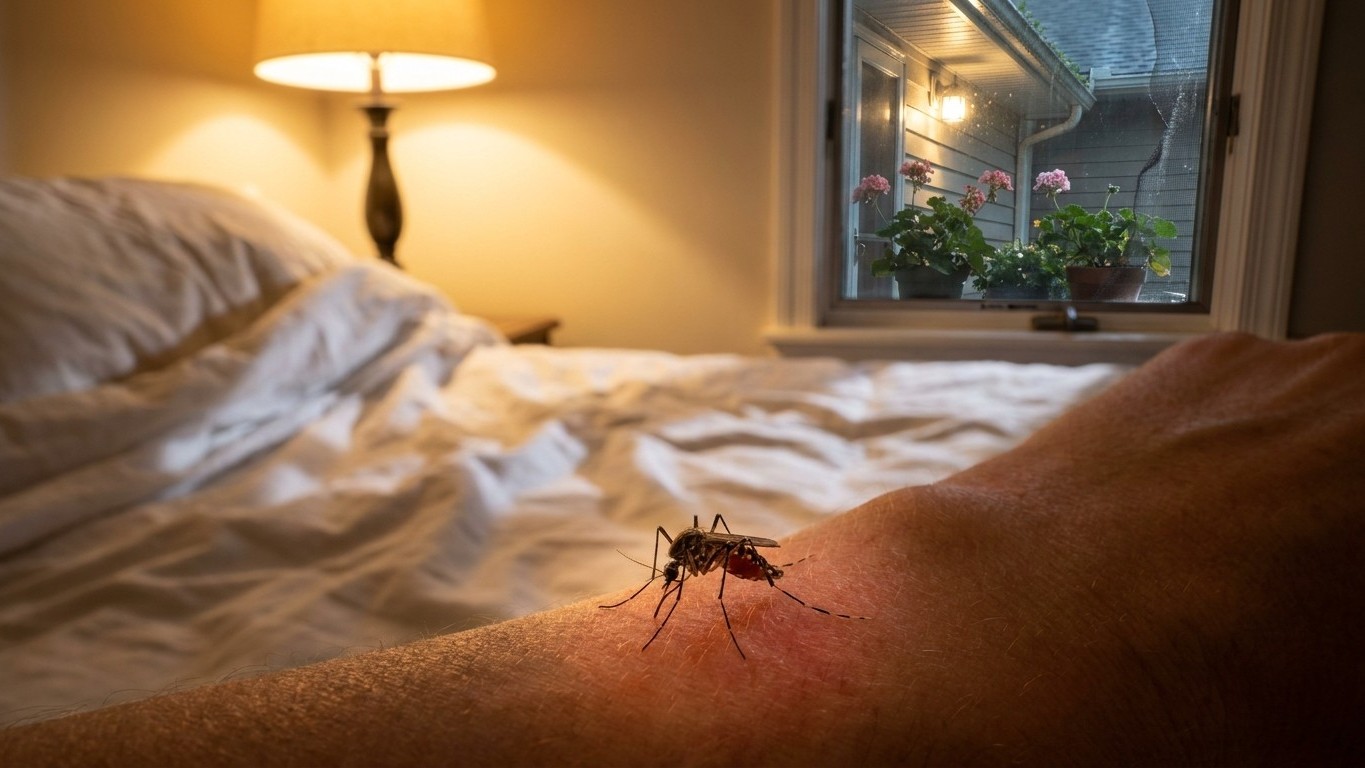

Mosquitoes in the house almost always trace back to a small pool of standing water somewhere close by, indoors or within a few hundred feet outside. Fix that water source and screen the entry points, and the problem usually clears up within a couple of weeks. The species matters less than the puddle.
What you are dealing with

The mosquitoes buzzing around your bedroom at 2 a.m. didn’t fly in from a swamp three miles away. Most species that bother homeowners breed within 300 feet of where they bite, and the female landing on your arm right now may have hatched in a bottle cap’s worth of water sitting in a clogged gutter or a forgotten plant saucer on the porch. Adults are mobile and hard to swat, but the water they need to reproduce is often small, still, and shockingly close.
A female mosquito needs three things to keep the cycle going: a blood meal for egg development, standing water to lay those eggs in, and shelter from wind and sun between meals. Take away any one of those and the population collapses fast, because most mosquito species complete their full life cycle, egg to biting adult, in as little as a week to ten days in warm water. That’s why a single rainy weekend can turn a quiet backyard into a biting nuisance almost overnight.
There’s no single “house mosquito” species in the U.S. Depending on where you live, you might be dealing with Culex species that favor stagnant, organically rich water like clogged drains, or Aedes species that prefer clean water in small containers, tires, or tree holes. Both end up in the same place: your living room, wherever there’s a warm body to bite and a gap they can slip through.
Solving a mosquito problem indoors comes down to three questions, each with its own logic. First, are you actually looking at mosquitoes, and not something else entirely, like fungus gnats or midges that get mistaken for them constantly? Second, why are they choosing your house specifically, and what’s feeding the breeding site nearby? Third, once you’ve confirmed the species and found the source, what’s the right order of action, starting with the least aggressive option and working up only if needed? The next three sections walk through each in turn, starting with how to tell you’ve actually got mosquitoes.
Recognizing them
Not every small flying insect that bites or hovers around your ankles is a mosquito, and getting the ID wrong wastes time and sometimes money on the wrong fix. The classic signs are a whining, high-pitched hum near your ears at night, bites that show up as raised, itchy welts (often in clusters on ankles, wrists, or exposed skin), and the insect itself: long legs, a narrow body, and a visible proboscis extending from the head. Mosquitoes tend to rest on walls or curtains with their back legs raised at an angle, a useful visual tell if you can get close enough to look without swatting first.
The confusion usually runs one of two ways. People mistake biting midges or “no-see-ums” for mosquitoes because the bite feels similar, even though midges are smaller and lack that audible whine. Others mistake non-biting crane flies (the big, gangly “mosquito hawks” on window screens) for giant mosquitoes, when crane flies don’t bite at all. Fungus gnats, drawn to overwatered houseplants, get lumped in too, though they’re weaker fliers and don’t draw blood.
Timing helps narrow it down. Mosquitoes that bite indoors are typically most active at dawn and dusk, though some species, particularly day-biting Aedes types, will feed any time light levels are low enough, including inside a shaded room at midday. If you’re only getting bitten at night and hearing that telltale hum near a lamp or by the bed, that’s a strong mosquito signal.
For a full rundown of what separates mosquitoes from their most commonly confused look-alikes, see our detailed guide to recognizing mosquitoes indoors. Getting this step right before you act saves you from prevention efforts aimed at the wrong pest.
Why they are here
Once you’ve confirmed it’s mosquitoes, the next question is what’s keeping them coming back. It almost never comes down to bad luck. Mosquitoes need standing water to breed, and that water doesn’t have to be a pond. Clogged gutters, saucers under potted plants, birdbaths that go a week without a refill, tarps that pool rainwater, even an overturned trash can lid all qualify. Indoors, the list shortens but doesn’t disappear: a slow drain, a humidifier reservoir left standing too long, or a leaking pipe under a sink can be enough in the right conditions.
Shelter matters almost as much as water. Adult mosquitoes rest during the day in cool, humid, shaded spots, thick shrubbery near the foundation, tall grass, stacked firewood, or the underside of a deck. A house surrounded by dense landscaping with poor airflow gives them a place to wait out the heat before moving indoors or biting at dusk. Combine that shelter with a blood source and a nearby breeding site, and you’ve built exactly the habitat mosquitoes look for.
The U.S. Environmental Protection Agency frames prevention as the foundation of any effective pest control approach, and it applies directly here: “As a first line of pest control, IPM programs work to manage the crop, lawn, or indoor space to prevent pests from becoming a threat.” For mosquitoes, that means eliminating standing water and closing off entry points before reaching for any treatment, because a yard that keeps generating new mosquitoes will outpace whatever indoor measures you take.
Entry points deserve equal attention. Torn window screens, gaps around door sweeps, and unscreened attic or foundation vents all give adults a way in, especially right after sunset when they’re most active and a house is warm and lit from inside. Our full breakdown of breeding sites, shelter conditions, and entry routes is in the guide to why mosquitoes get into a house.
What works
The EPA’s Integrated Pest Management framework gives a useful order of operations for mosquitoes, and the order itself is the point. It describes IPM as an approach relying on “common-sense practices,” a combination that starts well before any product gets involved.
The first step is deciding whether action is even warranted yet: “Before taking any pest control action, IPM first sets an action threshold, a point at which pest populations or environmental conditions indicate that pest control action must be taken.” One mosquito that got in through a torn screen isn’t the same problem as a dozen resting on your bedroom ceiling every evening. The second step is confirming what you’re dealing with, since IPM programs “monitor for pests and identify them accurately, so that appropriate control decisions can be made,” which loops back to the identification questions above. Only after those two steps does prevention, eliminating standing water and sealing entry points, come into play as “the first line of pest control.”
If prevention alone doesn’t clear the problem, the EPA’s guidance is specific about what comes next: “Effective, less risky pest controls are chosen first, including highly targeted chemicals, such as pheromones to disrupt pest mating, or mechanical control, such as trapping or weeding.” For a household, that translates to physical measures first, mosquito traps, repairing screens, using fans on porches (mosquitoes are weak fliers and struggle against moving air), before considering chemical treatment. The EPA is blunt about where broad spraying fits: “Broadcast spraying of non-specific pesticides is a last resort.”
Any product used to treat mosquitoes is designed to be toxic to the pest, and the EPA notes these products can also be toxic to people when used improperly, with children, older adults, and people with compromised immune systems named as especially vulnerable. Read and follow the label exactly as written; registered products vary by state. If you have questions about a specific product, the National Pesticide Information Center takes calls at 1-800-858-7378 rather than leaving you to guess.
A professional is the right call when standing water can’t be located or eliminated on your own property (a stagnant catch basin, a neighbor’s unmaintained pool, a low spot that floods after every rain), or when bite counts stay high after screens are repaired and obvious water sources are gone. That points to a breeding site outside your control, which is exactly what a licensed pest control operator or local mosquito control district is equipped to assess. Full method-by-method detail is in the mosquito control guide.
Common questions
Can mosquitoes actually breed inside a house?
It’s uncommon but possible if standing water sits indoors long enough, such as a neglected humidifier tank, a clogged floor drain, or water sitting in a plant saucer for more than a week. Most indoor mosquitoes flew in from an outdoor breeding site rather than hatching inside.
Do mosquitoes in the house spread disease?
Some mosquito species can transmit pathogens, and health risk varies by region, species, and local disease activity. For current health information, check the CDC’s mosquito-borne disease resources or your local or state health department.
Why do I only get bitten at night indoors?
Several common indoor-biting species are most active at dusk and through the night, timing their feeding to lower light and cooler temperatures. If bites happen mainly during the day in a shaded room, a day-biting species may be involved, pointing to a different nearby breeding site.
Will a bug zapper or citronella candle solve an indoor mosquito problem?
Neither addresses the standing water producing new mosquitoes, so both tend to give limited, short-term relief at best. They’re not a substitute for finding and removing the breeding source, which is the step that actually stops the cycle.