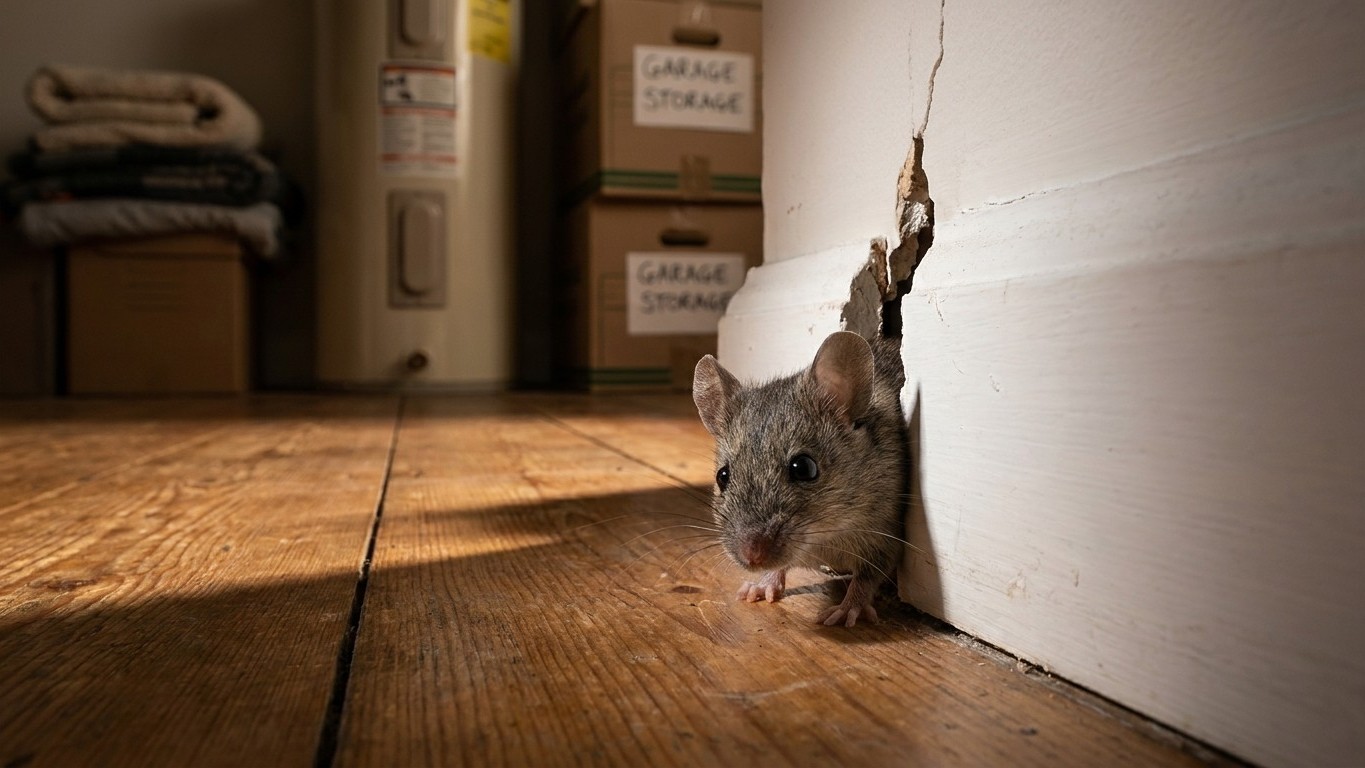

A single house mouse can squeeze through a gap the width of a pencil, about a quarter inch, because its skull is the only rigid part of its body. That’s the fact that should reshape how you think about the droppings under the sink or the scratching in the wall at night. Sealing that gap does more than a dozen traps ever will, and knowing why they picked your house in the first place changes what you do next.
What you are dealing with

The house mouse (Mus musculus) is the species behind nearly every indoor rodent problem in the United States. It’s small, gray-brown, and built for exactly the kind of tight, cluttered spaces a home offers in abundance: behind a water heater, inside a box of holiday decorations, under a stove. Unlike rats, mice don’t need much of anything to get comfortable. A quarter-inch gap under a door, a torn screen, a pipe chase that was never packed with anything, and they’re in.
Three things pull a mouse toward a structure and keep it there: food, warmth, and an opening. Take away any one of those and the odds shift. Take away all three and you generally don’t have a problem worth calling anyone about. The trouble is that most houses, especially older ones or those backing onto fields and wooded lots, offer all three without the owner ever noticing.
Mice are also fast breeders. A female can produce a litter every three weeks under the right conditions, and a handful of mice that moved in during a cold snap in October can be a real infestation by the time spring arrives. That timeline is why waiting to “see if it’s really a problem” often backfires. What looks like one mouse is rarely one mouse for long.
Three questions worth answering in order
Anyone dealing with a suspected mouse problem is really working through three separate questions, and they build on each other. First: are these actually mice, or is it something else entirely (a squirrel in the attic, a large cockroach, even a bird in the soffit)? Second: why did they choose this house, this season, this room? Third: what’s the right response, given the scale of what’s happening? Each of those questions has enough depth to deserve its own answer, which is exactly what the rest of this hub is built around.
Recognizing them
Mouse signs cluster in a predictable set: droppings shaped like small dark grains of rice, a musky odor in enclosed spaces like cabinets or drawers, gnaw marks on cardboard or wood, and greasy rub marks along baseboards where mice repeatedly travel the same route. Scratching sounds in walls or ceilings, especially at night when mice are most active, round out the usual list.
Confusion is common, though. Droppings from young rats can look similar in size to mouse droppings, and homeowners sometimes mistake cricket or cockroach frass for rodent sign. Scratching in an attic is just as often a squirrel as a mouse, and the two require very different responses in terms of scale and urgency. Getting the identification right matters because it determines everything downstream, from where you place traps to whether you’re dealing with an evening’s work or a structural repair.
The signs page in this series breaks down each indicator in detail, including how to tell mouse droppings apart from other pest sign and what a genuine infestation looks like versus a single mouse that wandered in during a cold night. If you’re still in the “is this even mice” stage, that’s the place to go before doing anything else.
Why they are here
Every mouse in a house is there because the house is offering something. Food sources don’t need to be obvious: pet food left out overnight, a torn bag of birdseed in the garage, crumbs behind an appliance, even soap and cardboard, which mice will gnaw for nesting material and to a lesser extent for nutrients. Water is a smaller factor for house mice, which can survive on the moisture in food alone, but a dripping pipe or a pet’s water bowl left down still helps.
Shelter is where most houses fail without realizing it. Cluttered basements, stacked storage boxes, gaps around utility penetrations, unscreened vents, all of these read as safe nesting sites to a mouse looking for a place to overwinter and raise young. Cooling weather in fall is the single biggest driver of indoor mouse activity nationwide, as mice that spent summer in a field or a woodpile look for warmth as temperatures drop.
The U.S. Environmental Protection Agency frames the fix in terms of prevention first, not chemical response. As the agency puts it, “As a first line of pest control, IPM programs work to manage the crop, lawn, or indoor space to prevent pests from becoming a threat.” For a homeowner, that means denying food, water, and shelter before reaching for anything else, because a house that still offers all three will keep attracting new mice even after the current ones are gone.
The causes page in this series goes deeper into the specific entry points and attractants by room, including which parts of a typical house are most often overlooked during a sealing job.
What works
The EPA’s Integrated Pest Management framework isn’t a rodent-specific program, but it maps cleanly onto a mouse problem, and the order matters as much as the content. The agency describes IPM as “an effective and environmentally sensitive approach to pest management that relies on a combination of common-sense practices,” and that combination follows a specific sequence rather than jumping straight to a product.
The first step is deciding whether action is even warranted yet. As the EPA explains, “Before taking any pest control action, IPM first sets an action threshold, a point at which pest populations or environmental conditions indicate that pest control action must be taken.” One mouse seen once is a different situation than droppings in three rooms and gnaw marks on stored food.
Next comes accurate identification, because “IPM programs work to monitor for pests and identify them accurately, so that appropriate control decisions can be made.” This is where the signs page becomes useful in practice, not just in theory. Once the problem is confirmed as mice specifically, prevention comes before control: sealing entry points, removing food access, clearing clutter that offers nesting sites.
Only after prevention does the EPA move to active control, and even then the guidance is specific about order. “Effective, less risky pest controls are chosen first, including highly targeted chemicals, such as pheromones to disrupt pest mating, or mechanical control, such as trapping or weeding,” the agency states, adding plainly that “broadcast spraying of non-specific pesticides is a last resort.” For mice, that generally translates to mechanical trapping as the first active measure, not a chemical approach.
Pesticides carry real risk when misused. The EPA is clear that these products are designed to be toxic to pests and can be toxic to people when handled improperly, with children, older adults, and people with compromised immune systems named as especially vulnerable. No product, brand, or active ingredient should be chosen without reading its label in full, since registered products and their rules differ by state and change over time. Anyone with questions about a specific product should call the National Pesticide Information Center at 1-800-858-7378 rather than guess.
A genuine infestation, meaning mice established in wall voids, insulation, or multiple rooms with an active breeding population, is generally beyond what sealing and a few traps will resolve on a homeowner’s own timeline. That’s a reasonable point to call a licensed pest control professional, the same way a termite problem or a bed bug infestation in a structure calls for one. The control page in this series walks through trap types, placement, and the specific point at which professional help becomes the sensible call rather than a shortcut.
Common questions
How many mice usually mean an infestation, not just a stray visitor?
There’s no fixed number, but consistent droppings in more than one room, gnaw marks on stored food, and nighttime scratching heard repeatedly over several nights all point toward an established population rather than a single mouse passing through.
Do mice carry disease risks worth worrying about?
Rodents are documented carriers of certain pathogens transmissible to humans through droppings, urine, or bites. For specifics on which conditions are relevant in your area and how to clean up rodent droppings safely, the CDC and your local health department are the right sources, not general pest advice.
Can mice get into a house even if it looks well-sealed?
Yes. A quarter-inch gap is enough, and openings that small are easy to miss around utility lines, vents, garage door edges, and foundation cracks. A visual walk-around often misses what a hand run along the same surfaces will catch.
Is it safe to handle mouse control entirely without a professional?
For a small, newly noticed problem, sealing and trapping are within most homeowners’ reach. Once mice are established in wall cavities or across multiple rooms, or if health-vulnerable people live in the home, a licensed professional is the more reliable route.