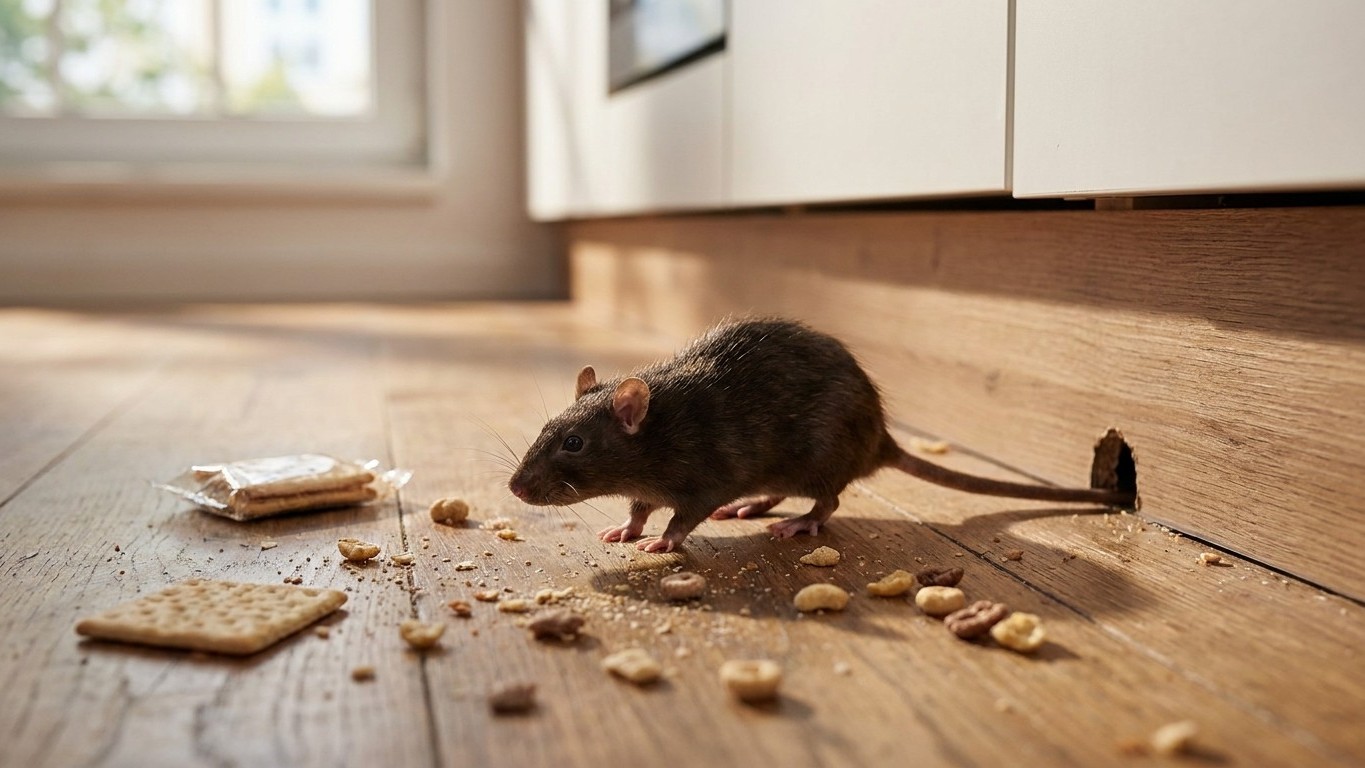

Rats in the house almost always mean three things at once: a food source they can reach, a water source nearby, and a gap wide enough for a body that can squeeze through a hole the size of a quarter. The animal itself is a Norway rat or a roof rat, both common across the United States, both nocturnal, and both cautious enough that the first trap you set often catches nothing. Confirming which signs are real, why the rat picked your house, and which control method actually works are three separate questions, and each one has its own answer.
What you are dealing with

Two species show up in American homes with any regularity: the Norway rat (Rattus norvegicus), a heavier burrowing animal that tends to stay low, and the roof rat (Rattus rattus), a leaner climber that favors attics, upper walls, and tree limbs overhanging the roofline. Both are rodents, both breed fast, and both share one trait that decides how any control effort plays out: they are neophobic. A new object dropped into their territory, a trap, a bait station, even a rearranged box, gets avoided for days before a rat will approach it. That single behavioral fact explains why a trap set on night one and checked empty on night two doesn’t mean the rat is gone. It usually means the rat is still deciding whether the trap is safe.
What draws them in the first place is unglamorous: food waste left accessible, a dripping outdoor faucet or pet water bowl, and a gap or crack near the foundation, roofline, or utility line that offers dry, hidden shelter close to that food and water. Remove any one of the three and the location becomes less attractive; remove all three and most rats will move on rather than stay and fight for scraps.
A note on health risk
Rodents in a structure are also a documented health question, not just a nuisance. Public health agencies track rodent-associated illness, and a household dealing with an active infestation, especially involving droppings in enclosed spaces like attics or crawlspaces, should follow cleanup guidance from the CDC or a local health department rather than guessing at the right precautions.
From here, the practical path splits into three questions worth answering in order. First, are you actually looking at rat activity, or at mouse droppings, squirrel noise, or something else entirely? Second, what in or around this specific house is feeding, watering, or sheltering the animal? Third, once the source is confirmed, what actually gets rid of it without wasting money on the wrong tool? Each of those questions has a dedicated answer on this site: signs and identification, the causes behind an infestation, and the control methods that follow a tested sequence rather than guesswork.
| Trait | Norway rat | Roof rat |
|---|---|---|
| Body size | Larger, stockier | Smaller, leaner tail |
| Preferred location | Ground level, burrows, basements | Attics, upper walls, trees |
| Movement | Poor climber, good digger | Excellent climber |
| Common entry point | Foundation gaps, floor drains | Roofline, utility lines, vents |
Recognizing them
Droppings are the most common giveaway, dark, roughly capsule-shaped, and usually clustered along a travel path rather than scattered randomly. Gnaw marks on wood, wiring, or plastic storage bins are another reliable sign, along with greasy rub marks along baseboards and wall junctions where a rat’s coat repeatedly brushes the same surface on its nightly route. Homeowners also report scratching or scurrying sounds inside walls or the attic after dark, which lines up with the species’ nocturnal habits.
Where this gets confused is with other pests entirely. Mouse droppings are noticeably smaller and thinner, roof damage from squirrels tends to be louder and occur during daylight, and a musty odor alone, without droppings or gnaw marks, is often something else, like moisture damage, rather than rodent activity. Because a false identification leads to the wrong control plan, and because rat behavior differs enough from a mouse’s that bait placement and trap spacing both change, it’s worth confirming the species before buying anything. A full walk-through of what counts as a genuine sign, what doesn’t, and how to tell the two rat species apart from their droppings and gnaw patterns is covered on the dedicated signs of rats in the house page.
Why they are here
Every rat infestation in a house traces back to the same three conditions: accessible food, a reachable water source, and shelter close enough to both that the animal doesn’t have to travel far or expose itself in the open. Food waste left in thin trash bags, pet food stored in unsealed containers, bird feeders that scatter seed onto the ground, and compost bins without a tight lid all qualify. Water is often overlooked entirely, a slow leak under a sink, a clogged gutter holding standing water, or a pet’s outdoor water bowl left out overnight can be enough on its own. Shelter usually means a gap around a utility pipe, a foundation crack, a torn vent screen, or dense vegetation growing against the exterior wall.
The U.S. Environmental Protection Agency frames this as the starting point of any serious pest strategy, stating that “as a first line of pest control, IPM programs work to manage the crop, lawn, or indoor space to prevent pests from becoming a threat.” For a house, that means the fix rarely starts with a trap or a chemical. It starts with sealing the gap, fixing the leak, and locking down the food source, because a rat that can no longer find any of the three has no reason to stay regardless of what control method comes next. A breakdown of the specific entry points, seasonal patterns, and yard conditions that draw rats toward a particular property is covered on the why rats come into houses page.
What works
The EPA’s Integrated Pest Management framework lays out a specific order, and the order itself is the point. As the agency puts it, “Integrated Pest Management (IPM) is an effective and environmentally sensitive approach to pest management that relies on a combination of common-sense practices.” The first step isn’t a product at all. It’s a threshold: “Before taking any pest control action, IPM first sets an action threshold, a point at which pest populations or environmental conditions indicate that pest control action must be taken.” One rat spotted once in a yard doesn’t call for the same response as fresh droppings found daily in a kitchen.
Once that threshold is crossed, correct identification comes next, since “IPM programs work to monitor for pests and identify them accurately, so that appropriate control decisions can be made.” Only after prevention and identification does the framework move to an actual method, and even then it favors the least aggressive option first: “Effective, less risky pest controls are chosen first, including highly targeted chemicals, such as pheromones to disrupt pest mating, or mechanical control, such as trapping or weeding.” Broad chemical treatment sits at the very end of that list, not the beginning, because “broadcast spraying of non-specific pesticides is a last resort.”
Pesticides are built to be toxic to pests, and the EPA notes they can be toxic to people too when used improperly, with children, older adults, and people with compromised immune systems named as especially vulnerable. Anyone with a question about a specific registered product should call the National Pesticide Information Center at 1-800-858-7378 rather than rely on guesswork, since the label on that product, not a general article, is the legal instruction that applies. And when droppings, gnaw damage, or noise persist inside wall cavities or a structure after prevention and trapping have been tried, that’s generally past the point of a homeowner remedy, an infestation established inside a structure is a job for a licensed pest control professional. The full method, including where to place traps, how long to wait before switching tactics, and what a professional visit typically involves, is laid out on the getting rid of rats in the house page.
Common questions
Can rats get into a house through a gap smaller than an inch?
Yes. A rat’s skeleton is flexible enough to squeeze through openings roughly the width of a quarter, which is why sealing gaps around pipes, vents, and foundation cracks matters more than most homeowners expect.
Do rats leave a house on their own if food is removed?
Often, yes, once all three draws (food, water, shelter) are gone, but an established nest with young may take longer to abandon, and remaining entry points need to be sealed or the same or a new rat will return.
Are rat droppings dangerous to clean up without protection?
Rodent droppings are a documented health concern, and cleanup guidance from the CDC or a local health department should be followed, particularly in enclosed spaces like attics or crawlspaces where dust from dried droppings can become airborne.
Is one rat sighting during the day a sign of a bigger infestation?
Not necessarily, rats are nocturnal by nature, so daytime activity can happen with smaller populations too, but it’s still worth checking for droppings, gnaw marks, or rub marks nearby before deciding whether an action threshold has been crossed.