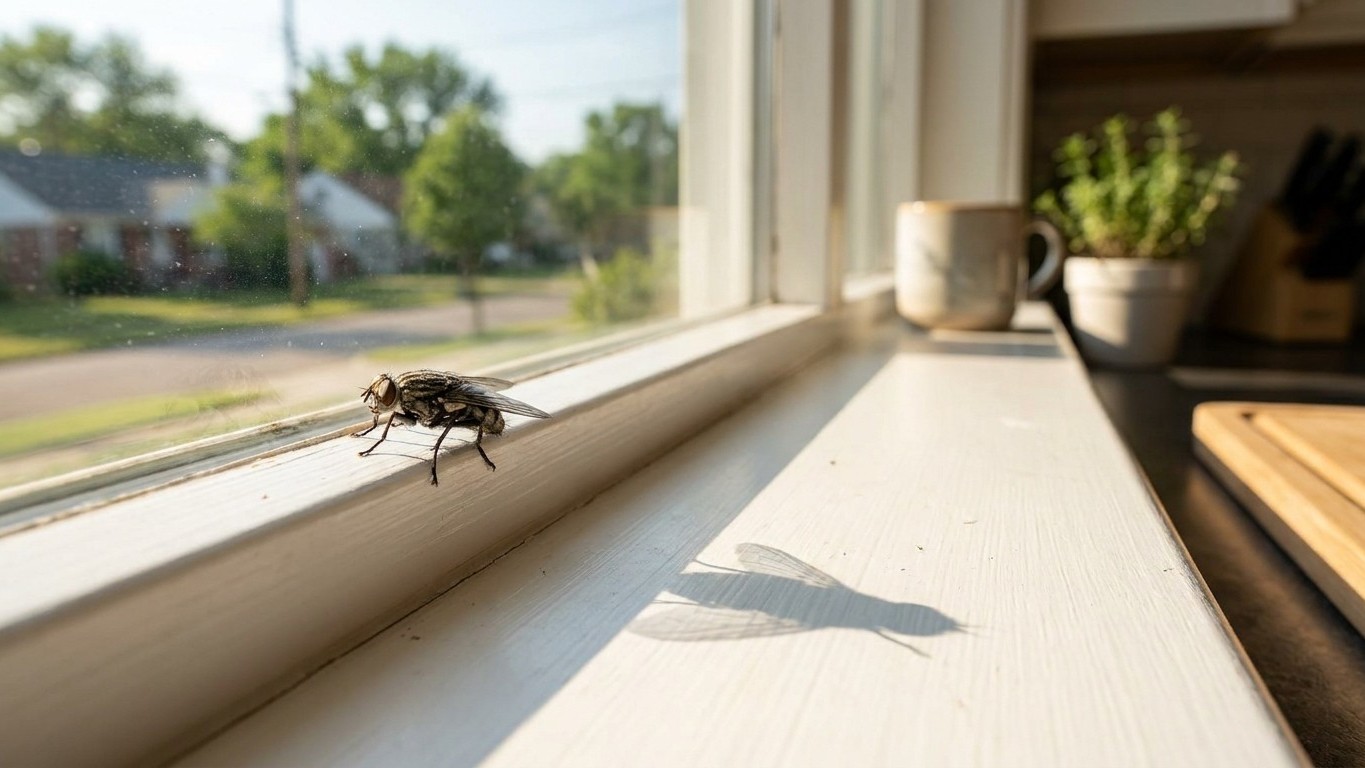

A house fly indoors is rarely a random visitor. It followed a smell to an entry point, and that smell is coming from something decaying, fermenting or rotting close enough for the fly to find it, whether that source sits inside your kitchen or just outside your door. The presence of even two or three flies on a window sill usually means a breeding source already exists somewhere in the house. Three questions decide what you do next: what are you actually seeing, why did it show up, and what will actually get rid of it.
What you are dealing with

The common house fly, Musca domestica, is the species behind almost every fly complaint inside a US home. It’s gray-black, about the size of a grain of rice, with four dark stripes on its thorax and a body built for landing on garbage one minute and your kitchen counter the next. That habit, moving between filth and food, is the whole reason its presence matters beyond annoyance.
What you see buzzing at the window is the last stage of a cycle that began somewhere you probably haven’t checked yet. The adult fly is the visible symptom; the eggs and larvae that produced it were laid in something moist and organic, garbage, animal waste, spoiled food, a compost pile, sometimes a dead rodent behind a wall. Females lay eggs in batches, and a favorable breeding site can turn a single fly into a dozen within a short stretch of warm weather. That’s why swatting the fly you see rarely solves anything. It just removes today’s evidence while tomorrow’s batch keeps developing wherever the source is.
House flies get confused with several look-alikes, and the confusion matters because the fix is different for each. Fruit flies are smaller and tan, drawn to fermenting produce and drains rather than garbage. Cluster flies are slightly larger, sluggish, and show up seasonally in wall voids rather than around food. Drain flies are fuzzy, moth-like, and breed in the gunk lining slow drains. Telling them apart is the first real step, and it’s detailed on the page on recognizing house fly signs.
Once you’ve confirmed it’s the common house fly, the next question is where it’s breeding and what’s feeding it, covered on the house fly causes page. And once you know the source, the actual removal and prevention steps, in the right order, are laid out on the house fly control page. This page connects those three pieces; each one goes deeper into a single part of the problem.
Recognizing them
Identification comes down to a handful of visible clues rather than guesswork. Adult house flies are gray with four narrow dark stripes running down the thorax, red compound eyes, and a single pair of wings held slightly apart at rest. They fly erratically, tend to land repeatedly on the same few spots, food surfaces, trash cans, window frames, and are most active during daylight hours, going still after dark.
Small dark specks on walls, light fixtures or window sills are a sign worth paying attention to. Those are fly specks, a mix of feeding and waste marks left wherever flies rest repeatedly, and a cluster of them near one window or one corner of a room often points straight at the breeding site or entry route. Maggots, the pale, legless larvae, showing up in a garbage can, a compost bin or around pet waste is a more direct sign that a breeding cycle is already underway rather than just passing through.
The confusions are just as informative as the signs themselves. Tiny flies hovering over a fruit bowl or a drain are almost never house flies, they’re fruit flies, and treating them as the same problem wastes effort on the wrong source. Sluggish flies appearing in a sunny window in fall, especially in a house near open fields, are more likely cluster flies overwintering in the walls, a seasonal issue with a different fix entirely. Getting the ID right before doing anything else is the whole point of the identification step in pest management, and it’s why the signs page walks through the visual differences in more detail rather than assuming every fly in the house is the same species.
Why they are here
House flies need three things, and a home almost always supplies at least one without anyone noticing: something to eat, something moist to breed in, and a way inside. Food sources run wider than most people expect, uncovered pet food, a garbage can without a tight lid, grease residue on a stovetop, even a spill that dried under an appliance months ago. Moisture is the breeding requirement that gets missed most often; flies don’t need standing water so much as damp organic matter, which is exactly what a poorly sealed compost bin, a dirty diaper pail, or animal waste left in a yard provides.
Entry points are the third piece, and they’re often smaller than a homeowner assumes reasonable. Gaps around door sweeps, torn window screens, vents without mesh, and doors propped open even briefly during warm months all give an adult fly a clear path in. Once inside, it doesn’t take much to keep it there, a single overripe banana or a trash can that hasn’t been taken out in a few days is enough incentive to stay and lay eggs.
The causes page breaks down each of these sources room by room, because the fix is specific to what’s actually attracting the flies in your house rather than a generic list. The federal approach to pest problems generally backs up that same logic. As the U.S. EPA puts it, “As a first line of pest control, IPM programs work to manage the crop, lawn, or indoor space to prevent pests from becoming a threat.” For house flies, that means managing the space, sealed trash, cleaned drains, repaired screens, before reaching for anything else. Removing the food, water or breeding material a fly needs will do more than any spray applied after the fact.
What works
The U.S. EPA describes Integrated Pest Management as “an effective and environmentally sensitive approach to pest management that relies on a combination of common-sense practices.” For house flies, that combination follows a specific order, and skipping ahead to a spray before doing the earlier steps tends to waste money and only knock down the fly population temporarily while the breeding source keeps producing more.
The first step is deciding whether action is even warranted. As the EPA frames it, “Before taking any pest control action, IPM first sets an action threshold, a point at which pest populations or environmental conditions indicate that pest control action must be taken.” One fly that wandered in through an open door isn’t the same situation as a dozen appearing daily near the kitchen. The second step is identification, confirming it’s actually a house fly and not a fruit fly or drain fly with a different fix, because as the agency notes, “IPM programs work to monitor for pests and identify them accurately, so that appropriate control decisions can be made.”
Only after those two steps does prevention and control come in, and even then, the least aggressive options come first. “Effective, less risky pest controls are chosen first, including highly targeted chemicals, such as pheromones to disrupt pest mating, or mechanical control, such as trapping or weeding.” For a house, that translates to removing the breeding source, sealing entry points, and using traps or fly paper before considering any chemical option. Spraying a general pesticide around the house isn’t step one, and the EPA is direct about that: “Broadcast spraying of non-specific pesticides is a last resort.”
If a product ends up being necessary, the label on that specific product is the only guide that applies, since registered pesticides differ by state and change over time. The EPA is clear that pesticides are meant to be toxic to the pests they target and can be toxic to people when used improperly, and it names children, older adults and people with compromised immune systems as especially vulnerable to exposure. Questions about a specific product are better directed to the National Pesticide Information Center at 1-800-858-7378 than answered by guesswork. The full sequence, with practical steps for each stage, is on the control page.
Most house fly problems resolve once the breeding source is found and removed. A professional becomes the right call when flies keep returning despite a clean kitchen and sealed trash, which often points to a hidden source like a dead animal in a wall cavity or a chronic breeding site in a crawl space that’s beyond what a homeowner can locate or reach on their own.
Common questions
How long does a house fly live?
Life span varies with temperature and food availability, and precise figures depend on conditions in a given home, but the practical point is that even a short adult life span doesn’t matter much when a breeding source keeps producing new flies continuously.
Do house flies bite?
No. The common house fly feeds by regurgitating digestive fluid onto food and sponging it up, it has no biting mouthparts. A fly that bites indoors is a different species, often a stable fly, and worth identifying separately rather than assuming it’s a house fly behaving unusually.
Can house flies make you sick?
House flies move between waste and food surfaces, which is why kitchen sanitation matters so much once they’re present indoors. For specific health concerns tied to a fly problem in your home, a local health department is the right resource rather than guessing at the risk yourself.
Will a few flies go away on their own?
Sometimes, if the fly wandered in through a door and there’s nothing indoors to sustain it. But recurring flies, especially several a day, almost always mean a breeding source exists somewhere nearby, and that source won’t resolve itself without being found and removed.