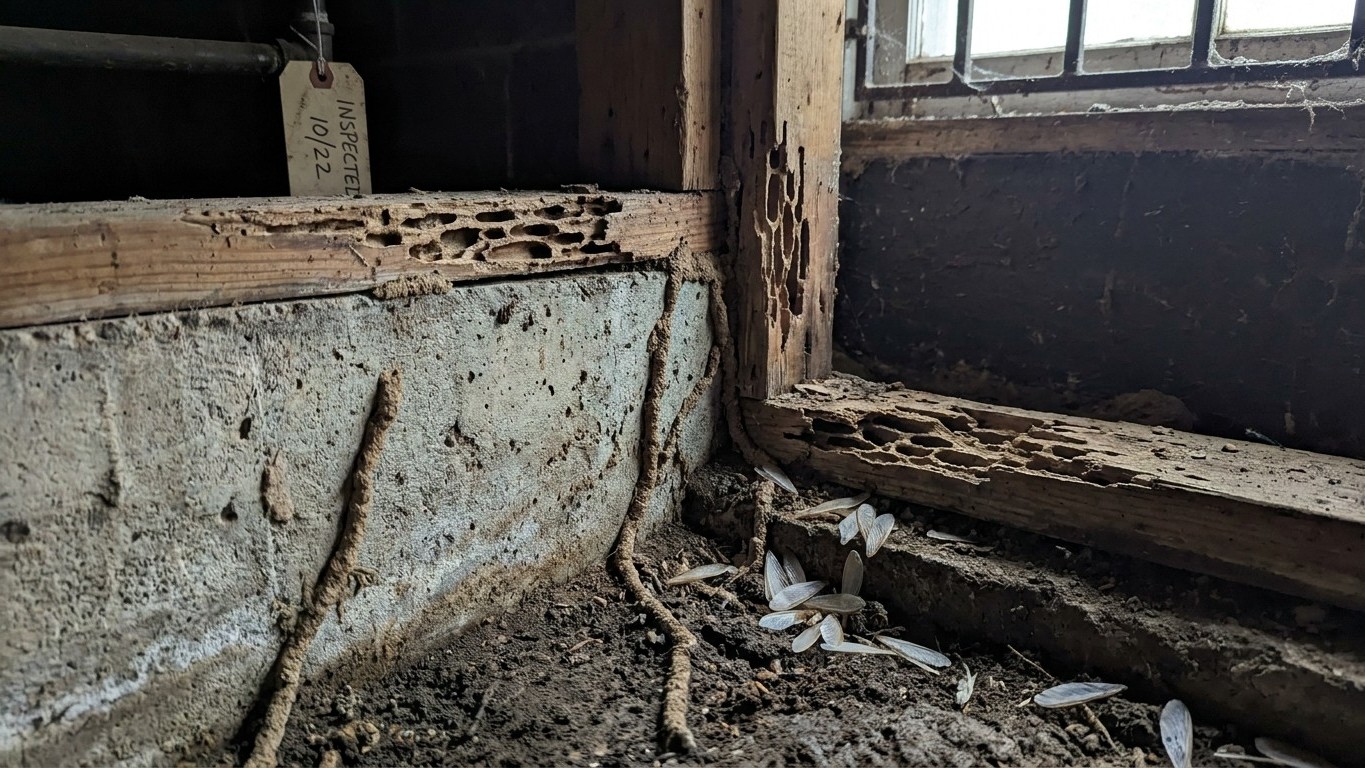

Termites in the house rarely announce themselves until the damage is already done. If you’ve spotted mud tubes along a foundation, hollow-sounding trim, or a scatter of discarded wings near a window, you’re likely looking at an active colony that has been feeding on the wood in your home for months, sometimes years. The direct answer: termites don’t leave on their own, home remedies rarely reach an entire colony, and the fix almost always starts with accurate identification followed by a licensed pest control response. Everything past that point is detail worth getting right.
What you are dealing with

In most of the United States, the termite behind a house call is a subterranean species living in the soil and tunneling up into framing, sill plates, or subfloor wherever wood touches ground or stays damp. In warmer coastal regions, drywood termites take a different path, flying in and colonizing dry lumber directly, no soil contact required. Both groups eat cellulose, and both can hollow out a structural member from the inside while the painted surface looks untouched.
That’s the fact that decides everything else in this guide: the damage is structural, and it’s invisible for years at a time. A joist can lose most of its load-bearing capacity while the drywall over it stays flat and the floor above stays level, right up until it doesn’t. This is the one pest situation in a home where skipping a professional isn’t a cost-saving move, it’s a bet against your own foundation.
| Species | Where it lives | What it needs | Damage pattern |
|---|---|---|---|
| Subterranean termites | Soil, tunneling into wood in contact with ground or moisture | Constant contact with soil moisture | Mud tubes, hollowed sill plates and framing |
| Drywood termites | Directly inside dry structural or furniture wood | No soil contact required | Pellet-like frass, hollow chambers inside beams |
Three questions decide how you handle a suspected infestation: what the signs actually look like, why the colony chose your house in the first place, and what treatment sequence actually stops it. The next three sections work through each one, with links to the fuller pages on recognizing termite signs, what draws termites to a house, and termite control methods for readers who want the detail behind each step.
Recognizing them
The clearest signs are physical evidence of the colony itself, not the insects walking across your kitchen floor, because you’ll rarely see the workers out in the open. Mud tubes, pencil-width tunnels of dirt and saliva running up a foundation wall or support post, are the most reliable subterranean sign. Discarded wings near windowsills or light fixtures point to a swarm that already happened, meaning a colony is nearby whether or not it made it inside. Wood that sounds hollow or papery when tapped, paint that bubbles or looks water-damaged without a leak behind it, and small piles of pellet-like droppings near baseboards round out the list.
The confusion homeowners run into most is mixing up a termite swarm with flying ants, or termite damage with the work of carpenter ants, which chew wood for nesting space but don’t eat it the way termites do. The wings, the body shape, and the texture of the damage all differ once you know what to look for, but under a flashlight in a crawlspace, that difference is easy to miss on a first look. A full breakdown of what separates a termite sign from a lookalike, room by room, is covered on the termite signs page, which is the right next stop for anyone trying to confirm or rule out an infestation before calling anyone out to the house.
One detail worth flagging here: a single swarm event, especially in spring, doesn’t automatically mean your house is infested. Swarmers disperse widely looking for new nest sites, and plenty land on siding or windows without ever getting inside. What matters more is whether the same signs repeat in the same spot over weeks, which points to an established colony rather than a passing swarm.
Why they are here
Termites show up where three things line up at once: a food source, a water source, and a way in that also gives them shelter from the open air. Food means cellulose, which covers structural lumber, siding, fence posts, and the cardboard boxes stacked in a garage. Water means anything that keeps wood damp long enough to soften it, a slow roof leak, a gutter dumping water against the foundation, an AC condensation line draining next to the sill plate. Shelter means the physical bridge between soil and structure, mulch piled against siding, firewood stacked directly on the ground and against the house, or a foundation crack wide enough to tunnel through.
The U.S. Environmental Protection Agency frames prevention as the starting point for any pest problem, not an afterthought to treatment: “As a first line of pest control, IPM programs work to manage the crop, lawn, or indoor space to prevent pests from becoming a threat.” For a termite colony specifically, that translates into removing the wood-to-soil contact and the moisture that let it establish in the first place, well before any product enters the picture.
The specific combinations that invite termites into a given house, by climate, foundation type, and yard layout, are laid out on the causes page, which is worth reading before assuming a treatment alone will solve a problem that a drainage fix or a woodpile relocation actually caused.
What works
The EPA’s Integrated Pest Management framework applies directly to termites, and the order it lays out is the part homeowners skip most often. “Integrated Pest Management (IPM) is an effective and environmentally sensitive approach to pest management that relies on a combination of common-sense practices.” The sequence starts before any product is chosen: “Before taking any pest control action, IPM first sets an action threshold, a point at which pest populations or environmental conditions indicate that pest control action must be taken.”
Next comes identification, because a subterranean colony and a drywood colony call for different treatment approaches entirely: “IPM programs work to monitor for pests and identify them accurately, so that appropriate control decisions can be made.” Only after prevention has been addressed does the framework move to active control, and even then it starts with the least aggressive option available: “Effective, less risky pest controls are chosen first, including highly targeted chemicals, such as pheromones to disrupt pest mating, or mechanical control, such as trapping or weeding.” Broad chemical treatment sits at the very end of that list, not the start of it: “Broadcast spraying of non-specific pesticides is a last resort.”
Termites are one of the clearest cases where that last step belongs to a licensed professional rather than a homeowner. Confirming the species, mapping the extent of an underground colony, and applying a treatment that reaches the whole network rather than the few workers visible at the surface takes equipment and training most households don’t have on hand. The full sequence of options, from monitoring stations to soil treatments to structural repairs, is detailed on the control methods page. Pesticides used against termites are meant to be toxic to the insects, and the EPA notes they can be toxic to people too when handled improperly, with children, older adults, and people with weakened immune systems named as especially at risk. Anyone with questions about a specific product and its label should call the National Pesticide Information Center at 1-800-858-7378 rather than guess.
Common questions
Can I treat termites myself without calling a professional?
Store-bought treatments can kill the termites they directly contact, but a colony can number in the tens of thousands with a nest structure a homeowner can’t fully map. Missing even part of it usually means the damage continues out of sight.
How fast do termites damage a house once they get in?
It varies by colony size and moisture conditions, but structural harm typically builds over months to years rather than days, which is exactly why the damage is often discovered only once it’s significant.
Does seeing one termite mean I have an infestation?
Not necessarily. A single swarmer can land far from any actual colony. Repeated signs in the same location over several weeks are a far stronger indicator than a one-time sighting.
Are termite swarms seasonal?
Swarming tends to cluster around warmer, humid conditions in spring in much of the country, though timing shifts by region and species. A swarm event is a signal to check for other signs, not proof on its own.