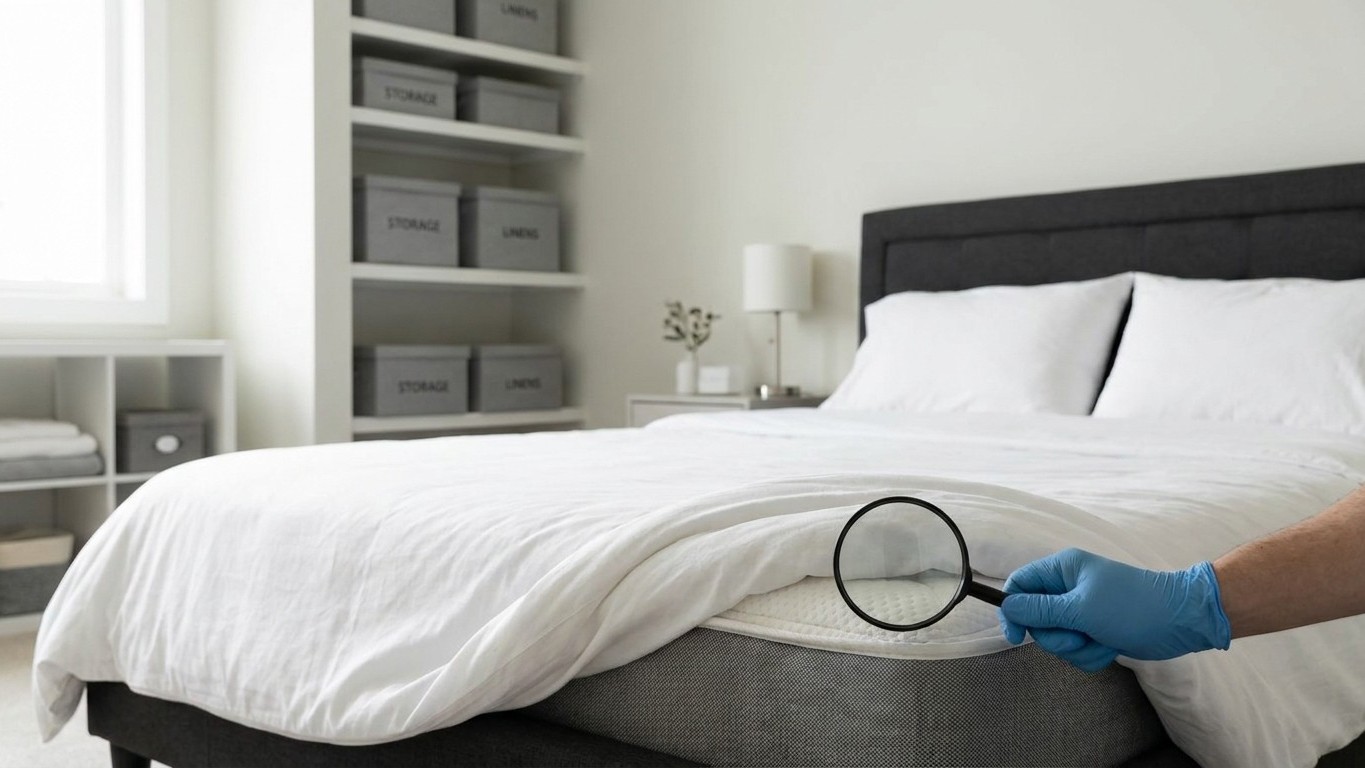

Getting rid of bed bugs starts with reducing the hiding spots, food sources and clutter that let them multiply, confirming you’re actually dealing with bed bugs and not another pest, and only then moving to targeted control. Pesticides come last, applied to a space that’s already been prepared, not sprayed onto a mess and left to work miracles. And for this particular insect, calling a professional is usually the realistic first move rather than a last one.
The order that works

The U.S. Environmental Protection Agency lays out a sequence, and it’s not arbitrary. “Before taking any pest control action, IPM first sets an action threshold, a point at which pest populations or environmental conditions indicate that pest control action must be taken.” That’s step one: confirm the problem is real and significant enough to act on, not just a single bite mark you’re worried about.
Step two is confirming what you’re fighting. The EPA states that “IPM programs work to monitor for pests and identify them accurately, so that appropriate control decisions can be made.” Bed bug bites look a lot like reactions to other insects, and treating the wrong pest wastes time while the real infestation spreads.
Prevention comes before any product
Only after identification does prevention enter the picture: “As a first line of pest control, IPM programs work to manage the crop, lawn, or indoor space to prevent pests from becoming a threat.” For bed bugs, that means removing the clutter they hide in and cutting off the places they can travel between rooms, before anyone reaches for a spray can.
Then, and only then, comes control, and even control has an internal order. “Effective, less risky pest controls are chosen first, including highly targeted chemicals, such as pheromones to disrupt pest mating, or mechanical control, such as trapping or weeding.” The broadest, least targeted option sits at the very bottom of the list: “Broadcast spraying of non-specific pesticides is a last resort.”
A page, or a homeowner, that opens with a spray has inverted this doctrine. Treatment applied to a house that still offers bed bugs food, hiding places and easy travel routes between rooms doesn’t fail because the product was weak. It fails because the conditions that supported the infestation never left. That’s why the same apartment can get “treated” three times and still have bed bugs eight months later: the order was skipped, not the chemistry.
What works without a pesticide
The EPA’s own hierarchy puts mechanical control, trapping, and non-chemical measures ahead of “non-specific pesticides.” For bed bugs, several of these steps are genuinely effective on their own, though none of them is quick.
Exclusion and sanitation
Sealing cracks around baseboards, outlets, and headboards blocks bed bugs from moving between units in multifamily housing, which is often how an infestation starts in the first place. It doesn’t kill existing bugs, and it won’t help at all if the source is inside your own mattress seams.
Sanitation means decluttering the bedroom, washing bedding and clothing on the hottest setting the fabric allows, and running items through a dryer cycle, since heat above the range bed bugs tolerate kills them at every life stage. It reduces hiding spots and can kill bugs already on fabric, but it does nothing for bugs living inside a mattress, box spring, or wall void.
Moisture, traps, and physical removal
Moisture control matters far more for pests like cockroaches and termites than for bed bugs, which don’t depend on damp conditions to survive. It’s worth keeping bedrooms reasonably dry for general pest prevention, but it won’t move the needle on an active bed bug problem by itself.
Interceptor traps placed under bed and furniture legs catch bugs as they try to climb up, and they’re useful for monitoring whether an infestation is shrinking or growing. They don’t eliminate a population on their own. Physical removal, vacuuming mattress seams, furniture joints and baseboards, followed by immediately sealing and disposing of the vacuum bag, removes live bugs and eggs but rarely reaches every hiding spot in a heavily infested room.
Together, these steps line up with the EPA’s guidance that “effective, less risky pest controls are chosen first.” They lower numbers, cut off new entry points, and buy time. For a light, early-stage problem caught fast, that combination sometimes resolves things without a single product label. For anything past that stage, it’s preparation for the next step, not a substitute for it.
When a product is warranted
Once the non-chemical steps are in place and bed bugs are still active, a registered product becomes a reasonable next step, not an admission of failure. This is exactly the point in the EPA’s sequence where targeted control belongs, after threshold, identification, and prevention, and before anything resembling broad spraying.
Why no product name belongs here
What’s registered and legal to use against bed bugs differs from state to state, and formulations change over time as products are approved or withdrawn. Naming a specific product or active ingredient in a general article would be misleading the moment it’s out of date or unavailable where you live. The label on the product you actually buy is the only legal guide for how it can be used, where, and in what amount. That’s not a formality, it’s the law, and it exists because the same active ingredient can carry different use restrictions depending on the formulation and the state.
The EPA is direct about the underlying reason for that caution: pesticides are designed to be toxic to pests, and they can be toxic to people when used improperly. Children, older adults, and people with compromised immune systems are named specifically as more vulnerable to that risk. In a bedroom, where a treated mattress or headboard sits inches from someone’s face for eight hours a night, that’s not a small detail.
Where to get a straight answer
If you’re standing in a store aisle unsure whether a product is appropriate for your situation, or how to use it safely around kids or pets, the right move isn’t guessing from an online forum. The National Pesticide Information Center takes exactly these questions, at 1-800-858-7378. They can walk through what a specific label allows and what it doesn’t, which matters more than any general advice could, since your label is the only one that governs your situation.
When to stop and call someone
Bed bugs sit in a small category of household pests, alongside termites and structural rodent infestations, where doing it entirely yourself usually costs more time and money than it saves. That’s not a sales pitch for pest control companies. It’s a statement about how this particular insect behaves.
Why this species is different
Bed bugs hide in places a determined homeowner can’t easily reach or even find, inside wall voids, under baseboards, behind electrical outlet covers, inside furniture joints. A population reduced by 90% through vacuuming and laundering can rebuild within weeks from the survivors nobody saw. Professionals bring tools most households don’t have access to, including heat treatment equipment that raises an entire room to a temperature lethal to every life stage at once, something a home dryer or space heater can’t replicate at scale.
There’s also a documented pattern of infestations that were declared “handled” after DIY treatment, only to resurface within a couple of months, at which point the population has often grown larger and spread to additional rooms or adjoining units. Waiting to call a professional after a failed first attempt doesn’t just cost the price of that attempt, it costs the extra weeks the infestation had to spread.
What’s documented about health
Bed bugs are not currently documented as transmitting disease to people the way ticks or mosquitoes do. What is documented is that bites can cause itching, welts, and for some people allergic reactions, and that heavy infestations are linked to sleep disruption and psychological stress. For questions specific to your situation, your local health department or the CDC are the sources to check rather than relying on secondhand claims about what bed bugs can or can’t cause.
Saying “just try a spray first” to someone with an active bed bug infestation would be the wrong kind of reassurance. The honest answer is that this is one of the few pests where the first call, not the last one, should often go to a licensed pest control professional who can inspect, confirm the scope, and treat the hiding places a household can’t reach alone.
Common questions
Can bed bugs go away on their own without any treatment?
Rarely. Bed bugs don’t need much to survive, and a small population left alone typically grows rather than dying out, since females can lay eggs continuously as long as they have access to a host to feed on.
Is it worth throwing away an infested mattress?
Sometimes, but not automatically. A mattress can often be treated and encased rather than discarded, and replacing it without addressing the room and furniture around it usually just gives the bugs a new place to spread from.
How long does it usually take to confirm treatment worked?
Interceptor traps and follow-up inspections over several weeks are the usual way to confirm a population is actually gone, since bed bug eggs can take time to hatch and new bites can appear well after a treatment if any survivors remain.
Are bed bugs linked to a dirty home?
No. Bed bugs are drawn to warmth and carbon dioxide from a sleeping host, not dirt, and they spread through travel, secondhand furniture, and shared walls in multifamily housing regardless of how clean a home is.