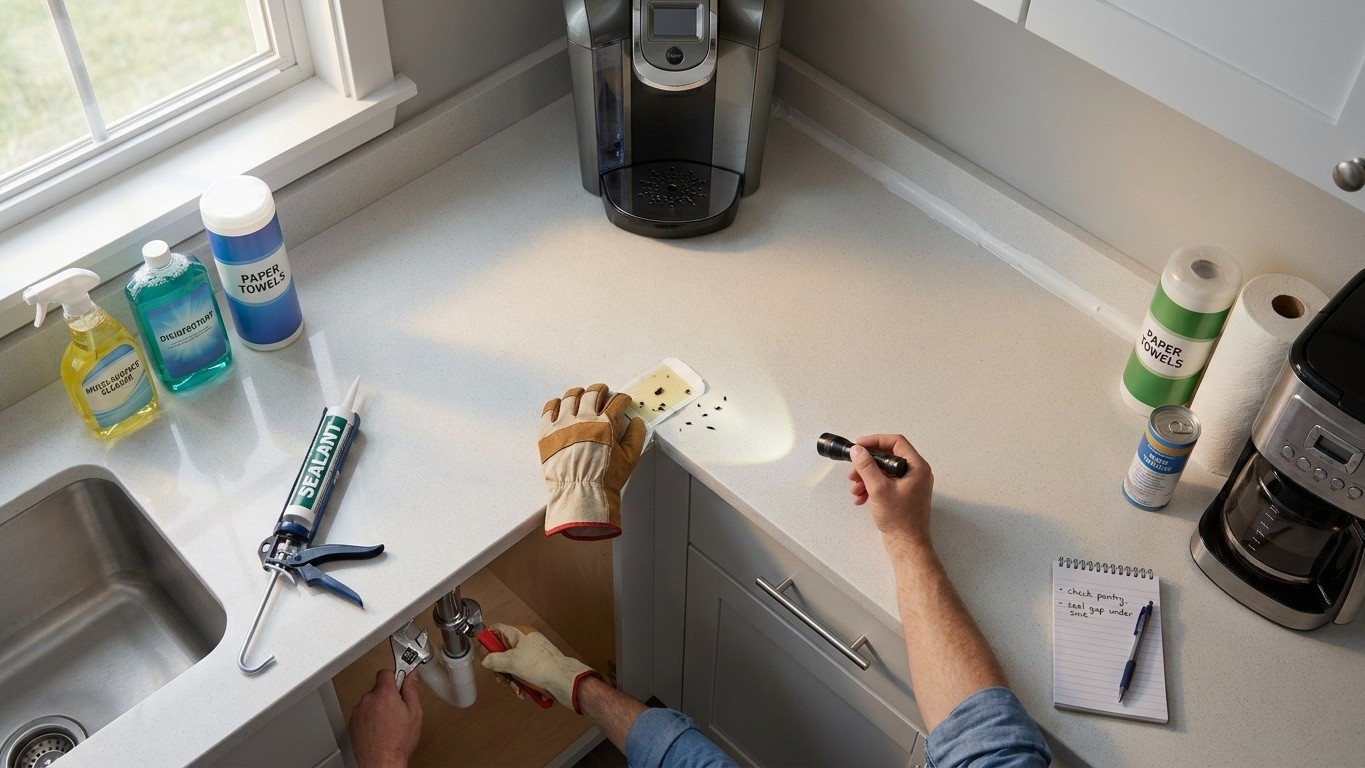

Getting rid of cockroaches for good comes down to sequence, not firepower. Cut off their food, water and hiding spots first, seal the gaps they travel through, and use traps to confirm the population before reaching for any product. A spray applied to a kitchen that still has crumbs under the stove and a leaky pipe under the sink just buys a few weeks of quiet. The infestation returns because nothing about the house actually changed.
The order that works

The U.S. Environmental Protection Agency lays out a specific sequence for handling any pest, cockroaches included, and it does not start with a can of spray. The agency calls it Integrated Pest Management, and describes it this way: “Integrated Pest Management (IPM) is an effective and environmentally sensitive approach to pest management that relies on a combination of common-sense practices.”
The first move isn’t treatment. It’s deciding whether treatment is even warranted yet. As the EPA puts it: “Before taking any pest control action, IPM first sets an action threshold, a point at which pest populations or environmental conditions indicate that pest control action must be taken.” Seeing one roach at 2 a.m. isn’t automatically a crisis. Seeing five a night for a week, in daylight, is a different story.
Once that threshold is crossed, the next step is confirming what’s actually there, because German cockroaches, American cockroaches and oriental cockroaches behave differently and respond to different tactics. The EPA frames it plainly: “IPM programs work to monitor for pests and identify them accurately, so that appropriate control decisions can be made.”
Only after identification does prevention take the lead. The agency states: “As a first line of pest control, IPM programs work to manage the crop, lawn, or indoor space to prevent pests from becoming a threat.” For a house, that means the sealing and sanitation work covered in the next section, done before or alongside anything else.
Treatment sits near the end of that list, not the start, and even then the EPA specifies which kind comes first: “Effective, less risky pest controls are chosen first, including highly targeted chemicals, such as pheromones to disrupt pest mating, or mechanical control, such as trapping or weeding.” Broad, non-targeted spraying is explicitly the last option on the list, not the first: “Broadcast spraying of non-specific pesticides is a last resort.”
The reason this order matters isn’t bureaucratic. A house that still offers food scraps, standing water and dark, undisturbed clutter is a renewable resource for roaches. Kill the visible ones and the survivors, plus whatever egg cases are tucked behind the refrigerator, simply rebuild the colony. Treatment without prevention isn’t a fix. It’s a subscription.
What works without a pesticide
The EPA’s own guidance points here first: “Effective, less risky pest controls are chosen first,” and for cockroaches, several of those controls require no product label at all. Each one does something specific, and each one has a limit worth knowing before you rely on it.
Five methods, five different jobs
- Exclusion means caulking gaps around pipes, baseboards, and cabinet backs, plus fixing torn door sweeps and screens. It stops new roaches from wandering in from outside or from a neighboring unit. It does nothing about a population already established inside the walls.
- Sanitation means nightly cleanup of food residue, sealed trash, and pet food picked up rather than left out. It removes the reward that keeps roaches coming back to the same spots. It won’t remove roaches that already have shelter nearby.
- Moisture control means fixing drips, drying sinks, and running a dehumidifier in damp basements or crawlspaces. Roaches need water more urgently than food, so this often has faster visible effect than cleaning alone. It requires a plumber or real repair work if the leak is inside a wall.
- Traps (sticky or glue boards, not baited stations) tell you where activity is concentrated and roughly how bad it is. They’re a monitoring tool more than a solution. They catch what walks across them and nothing more.
- Physical removal, vacuuming visible roaches and egg cases (oothecae) directly, cuts numbers immediately and removes evidence for anyone squeamish about the problem. It requires repeating the process regularly and disposing of the vacuum bag or canister contents right away, or the eggs simply hatch inside it.
The honest tradeoff
| Method | What it does | What it doesn’t do | Effort level |
|---|---|---|---|
| Exclusion | Blocks new entry points | Remove existing roaches | Moderate, one-time per gap |
| Sanitation | Removes food incentive | Address moisture or hiding spots | High, ongoing daily |
| Moisture control | Removes water source | Fix structural leaks by itself | Moderate to high |
| Traps | Confirms location and severity | Reduce population meaningfully | Low |
| Physical removal | Cuts visible numbers now | Prevent regrowth | High, repeated |
None of these five is a silver bullet on its own. Combined and kept up for several weeks, they’re often enough to bring a light infestation below the point where any product becomes necessary.
When a product is warranted
Sanitation and sealing solve most light problems, but a heavier infestation, one where roaches are active in daylight across multiple rooms, or where trap counts stay high for weeks despite exclusion and cleanup, has usually outgrown what non-chemical steps can manage alone. At that point, a registered product used according to its label is a reasonable next step, not a failure of the earlier work.
The reason for caution isn’t overstated. The EPA is direct about the basic nature of these products: they’re designed to be toxic to pests, and that same toxicity carries risk to people when used improperly. The agency specifically names children, older adults, and people with compromised immune systems as those most vulnerable to that risk. That’s a fact about the chemistry, not a scare tactic, and it’s exactly why the label matters more than any brand reputation or online recommendation.
Why no product gets named here
Registered pest control products differ from state to state, and formulations change over time as registrations are renewed or withdrawn. What’s legally sold and labeled for indoor cockroach use in one state may not be registered the same way elsewhere. The label on the container in front of you, not a name remembered from a forum post, is the only legally binding instruction, and it’s written for your exact product and your exact situation.
That label will specify where the product can go, how much space it treats, how long to stay out of a treated room, and how to store or dispose of it. Skipping those instructions to apply more, or apply it somewhere the label doesn’t cover, is where most household exposure incidents start.
For anyone unsure whether a specific product is appropriate for their household, pregnant occupants, pets, or a home with small children, the right first call isn’t a retail associate or a search engine. It’s the National Pesticide Information Center, reachable at 1-800-858-7378, a service set up specifically to answer public questions about pesticide products and their safe use.
When to stop and call someone
There’s a clear line between a do-it-yourself situation and a job for a licensed pest control operator, and it’s worth naming plainly rather than guessing at it after months of frustration. Three signals mean it’s time to bring in help.
The first is repeated failure. If sealing, sanitation, moisture control and a properly applied, label-compliant product haven’t reduced activity within a few weeks, the infestation is likely established somewhere inaccessible to a homeowner, inside wall voids, under slab cracks, or in a neighboring unit in a multi-family building. A licensed technician has access to monitoring tools and formulations not sold to the public, along with the training to find harborage sites a homeowner would never think to check.
The second is structural involvement. Roaches drawn to a chronic moisture problem sometimes point to rot, a failing vapor barrier, or plumbing damage inside a wall. At that stage the pest issue is secondary to a repair issue, and pest control alone won’t resolve either one. A contractor needs to look at the structure before pest treatment has any lasting effect.
The health question
Cockroach infestations carry a documented health dimension worth taking seriously without exaggerating it. Cockroach droppings, shed skins and saliva are recognized allergens and asthma triggers, particularly in children living in infested housing. This is a matter of public health record, not household lore, and it’s the kind of question best answered by people who track it professionally rather than guessed at online.
Anyone dealing with a household member who has worsening asthma symptoms, unexplained allergic reactions, or general questions about pest-related health exposure should contact the Centers for Disease Control and Prevention or their local health department directly, rather than relying on general advice. Those agencies track documented health effects and can speak to a specific situation in a way a general article can’t.
Common questions
How long does it take to get rid of cockroaches without chemicals?
A light infestation caught early can clear in two to four weeks of consistent sealing, cleaning and moisture control. Heavier infestations rarely resolve without at least a targeted product, and often need professional help.
Do cockroaches mean a house is dirty?
Not necessarily. They’re drawn to any accessible food, water and shelter, which can exist in an otherwise clean home through a single leaky pipe, a cluttered garage, or a shared wall with an infested neighboring unit.
Are over-the-counter roach products safe to use around pets and kids?
It depends entirely on the specific product and how it’s applied. Always follow the label exactly, and call the National Pesticide Information Center at 1-800-858-7378 with any product-specific safety question before use.
Is one cockroach a sign of an infestation?
Not automatically. A single roach, especially one seen at night, may be an isolated wanderer. Repeated sightings, daytime activity, or roaches in multiple rooms are the signals that indicate an established population worth acting on.