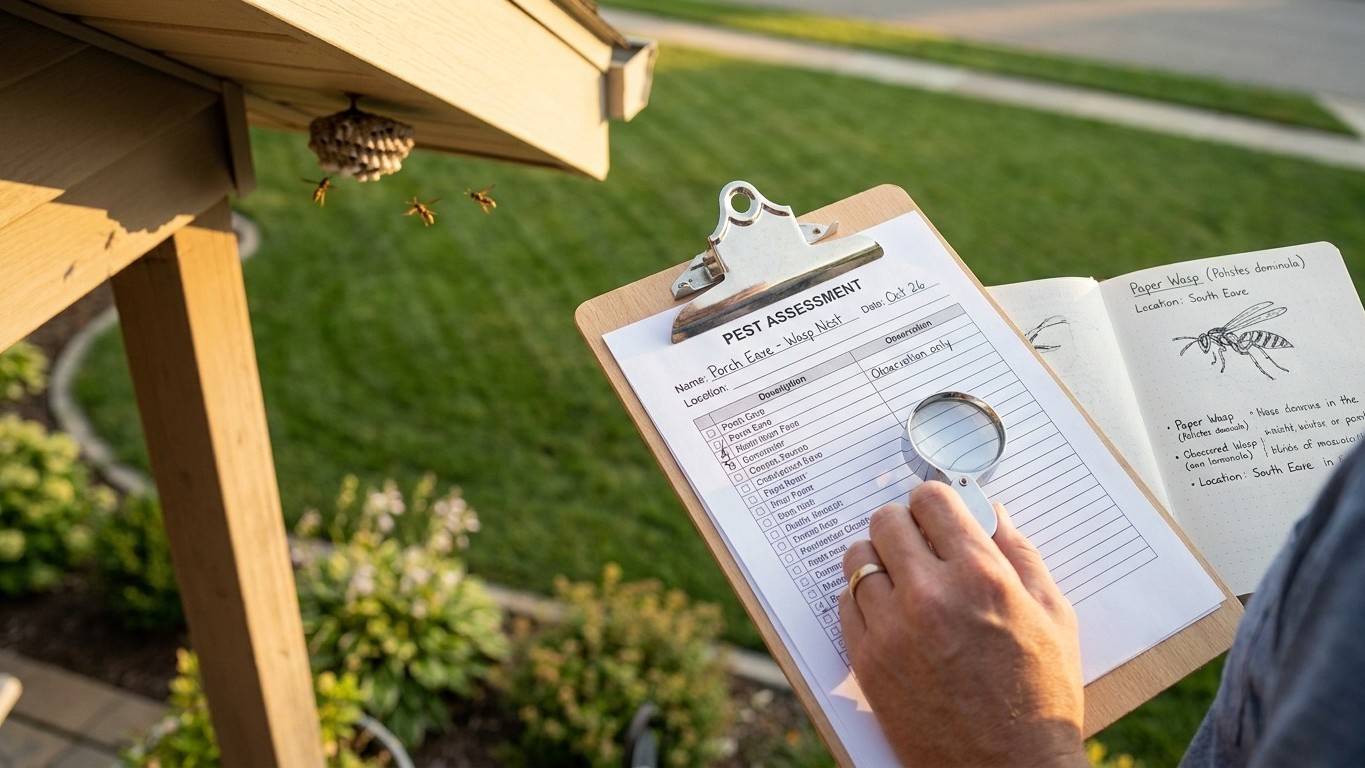

Wasp control that lasts starts with the same sequence pest management agencies apply to any pest: figure out how bad it actually is, identify what you’re dealing with, remove what’s drawing them in, and only then consider a targeted treatment. Spraying first and asking questions later is the most common mistake homeowners make, and it’s usually why the wasps come back within a season.
The order that works

The U.S. Environmental Protection Agency lays out a specific sequence for handling any pest, and it isn’t optional window dressing. As the agency puts it, “Integrated Pest Management (IPM) is an effective and environmentally sensitive approach to pest management that relies on a combination of common-sense practices.” That combination has a strict order, and skipping steps is where most wasp treatments go wrong.
Step one is deciding whether action is even warranted. The EPA states: “Before taking any pest control action, IPM first sets an action threshold, a point at which pest populations or environmental conditions indicate that pest control action must be taken.” A handful of paper wasps building a fist-sized nest under a porch eave isn’t automatically an emergency. A nest six feet from a back door, or a yellowjacket colony expanding fast near a play area, crosses that threshold.
Step two is identification, because “the wrong pest” leads to the wrong plan. The agency notes: “IPM programs work to monitor for pests and identify them accurately, so that appropriate control decisions can be made.” Paper wasps, yellowjackets, and hornets behave differently, nest differently, and respond to different levels of intervention. Mistaking one for another wastes effort and sometimes provokes a colony that didn’t need provoking.
Step three is prevention, described as “the first line of pest control”: IPM programs “work to manage the crop, lawn, or indoor space to prevent pests from becoming a threat.” For a house, that means the food, water, and shelter that make a structure attractive in the first place.
Only after those three steps does the EPA get to control methods, and even then it ranks them by risk: “Effective, less risky pest controls are chosen first, including highly targeted chemicals, such as pheromones to disrupt pest mating, or mechanical control, such as trapping or weeding.” The broad approach comes dead last. “Broadcast spraying of non-specific pesticides is a last resort.”
Here’s why the sequence matters practically, not just procedurally. A treatment applied to a nest while the eaves still leak, the trash can still sits open, and the siding still has gaps a wasp can squeeze through is treating a symptom. The colony you killed gets replaced by the next one that finds the same conditions. Order isn’t bureaucracy here, it’s the difference between a one-time fix and a recurring chore.
What works without a pesticide
Before reaching for any product, the EPA’s own guidance is to choose “less risky pest controls” first, and for wasps around a home, several of those options require no label at all.
Exclusion, sanitation, and moisture
Sealing gaps in siding, soffits, and around utility penetrations closes off the shelter wasps look for when starting a new nest. It does nothing, though, for a nest that’s already established elsewhere on the property. Sanitation, keeping trash cans lidded, cleaning up fallen fruit, rinsing recycling, removes the food scraps and sugar sources that draw foraging wasps to a patio or deck in the first place. It won’t stop wasps that are after protein from other insects rather than sweets. Fixing moisture problems, leaky spigots, clogged gutters, standing water in saucers or low spots, removes a water source many colonies need, particularly in hot months. None of these steps eliminate an existing nest; they reduce the odds a new one forms nearby.
Traps and physical removal
Baited traps can reduce the number of foraging wasps in a specific area, useful around an outdoor eating space, but they rarely make a dent in an established colony’s population and won’t reach a nest tucked in a wall void or attic. Physical removal, knocking down a small, early-stage nest with a pole or brushing it off before it’s occupied by more than a queen and a few workers, can work when done at the right time, typically at dusk when activity is low. It is also the method most likely to end in stings if the nest is bigger than it looks from the ground or if it’s a yellowjacket colony with an underground or wall-void extension that isn’t visible at all. Honest assessment matters here: exclusion and sanitation are steady, low-effort wins over a season, while trapping and manual removal demand more judgment and carry more real risk to the person doing it.
When a product is warranted
Once the action threshold is met, the pest is correctly identified, and prevention hasn’t solved the problem, a targeted treatment becomes a reasonable next step, not a reversion to spraying everything in sight. A nest at head height near an entryway, a colony that’s grown too large for safe manual removal, or repeated stinging incidents are the kinds of situations that justify moving down the EPA’s hierarchy toward a chemical control.
What this article won’t do is name a product, brand, active ingredient, or dose. Registered pesticide products vary by state, get reformulated, and get pulled from shelves. The label on the product in front of you, not a website, not a general guide, is the only legal instruction that applies, and it’s written for the exact formulation you’re holding.
The EPA is direct about why that label matters: pesticides are designed to be toxic to pests, and they can be toxic to people when used incorrectly. The agency specifically flags children, older adults, and people with compromised immune systems as especially vulnerable to improper use. That’s not a reason to avoid treatment when it’s genuinely needed, but it is a reason to read the entire label before buying anything, not just the front panel, and to check who else is in or near the house before applying anything.
Questions about a specific product, whether it’s appropriate for a location near a vegetable garden, a pet run, or a bedroom window, whether reentry intervals apply, or how to handle a spill, don’t need a guess from a blog. The National Pesticide Information Center takes those calls directly: 1-800-858-7378. It’s staffed to answer questions about the exact product a homeowner has in hand, which is more reliable than any general advice about “what usually works.”
When to stop and call someone
Some wasp situations stop being a homeowner project the moment certain conditions show up, and pretending otherwise mostly just delays a call that was going to happen anyway.
Repeated failure is the clearest signal. If a nest has been knocked down or treated more than once and wasps keep rebuilding in the same wall, attic, or eave, there’s likely a colony entry point or a satellite nest that isn’t visible from outside, and a pest management professional has tools, like wall-void treatments and inspection cameras, that a homeowner doesn’t.
Structural involvement is another line. Wasps nesting inside a wall, chimney, or attic space can mean removal work that involves cutting into the structure, which is a job for someone equipped to do both the pest control and the repair, not a weekend project with a ladder and a can of foam sealant.
Health questions deserve a straight answer rather than reassurance. Wasp stings can trigger allergic reactions ranging from localized swelling to, in some individuals, anaphylaxis, a severe and potentially life-threatening response. Multiple stings in a short period, or any sign of difficulty breathing, swelling of the face or throat, dizziness, or hives spreading away from the sting site, is a medical emergency, not a wait-and-see situation. For documented guidance on sting reactions and when to seek care, the CDC and local health departments are the right sources, not general home-remedy advice.
Volume and aggression matter too. A large, established yellowjacket nest, especially one that’s been disturbed and is actively defending itself, is a different problem than a small paper wasp nest under a porch rail. When a colony is large enough that multiple people have already been stung just approaching the area, that’s the threshold where a professional’s protective equipment and experience outweigh any savings from doing it yourself.
Common questions
Does killing the wasps I see get rid of the nest?
Not necessarily. Foraging wasps you see near food or trash are often a small fraction of a colony. The nest itself, wherever it’s located, has to be addressed directly, and if food or moisture sources remain, new wasps will keep showing up even after visible ones are dealt with.
Is it safe to seal a nest entrance without treating it first?
Sealing an active entrance can trap agitated wasps inside a wall or void, sometimes pushing them to find another way into the living space. Exclusion works well for preventing new nests, not for shutting in an occupied one.
How do I know if a nest has reached the point where I should call a professional?
Repeated stings after a first removal attempt, a nest inside a wall or attic rather than in the open, or any nest large enough that approaching it isn’t safely possible without protective gear are all signs it’s past a DIY scope.
Are all wasp species equally aggressive?
No. Paper wasps tend to be less defensive unless the nest is directly disturbed, while yellowjackets and some hornets defend their colonies more aggressively and in larger numbers. Correct identification, the second step in the EPA’s approach, changes how much caution a given nest warrants.