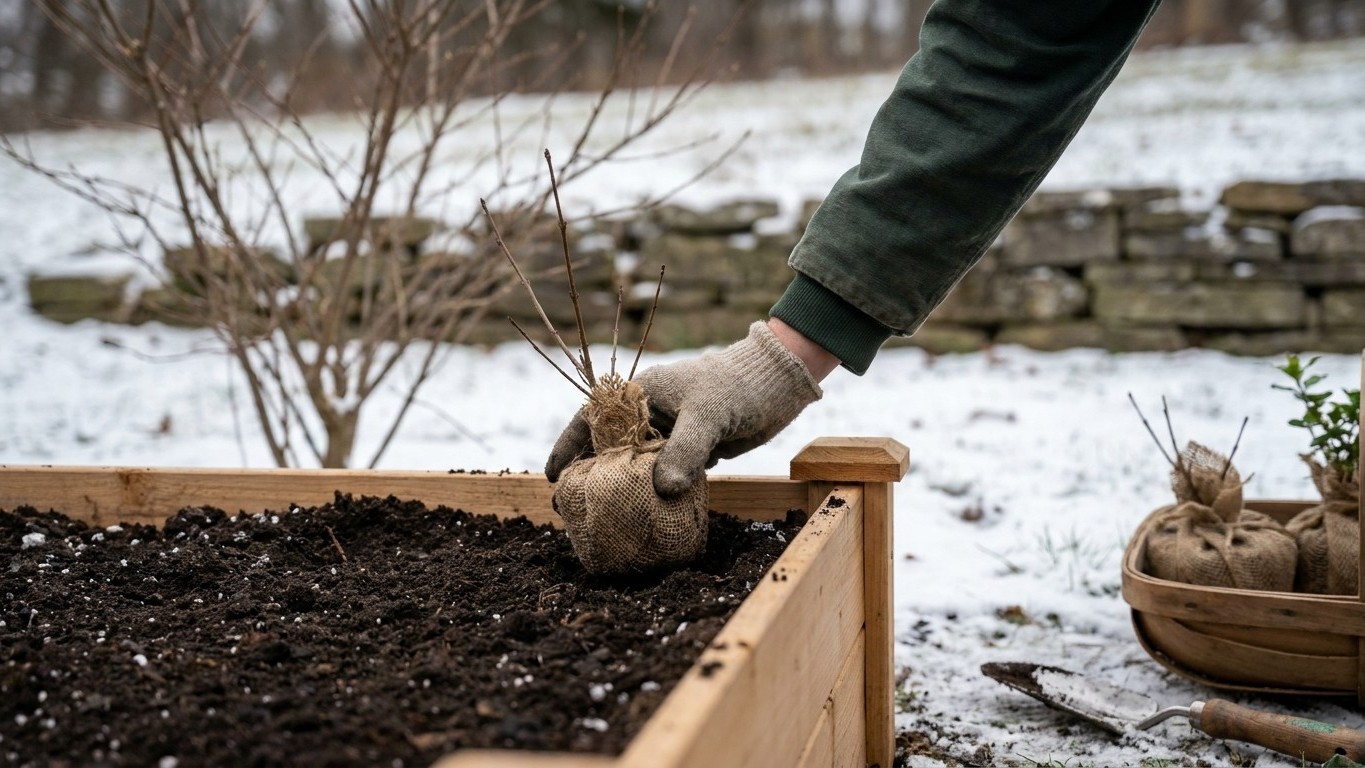

Oklahoma gardens are past both frost windows by December, sitting well beyond the state’s first fall freeze of October 29 to November 8. Open-ground planting is mostly off the table, but garlic and shallots still go in where soil isn’t frozen, cold frames keep greens alive, and bare-root fruit trees and canes can be set out dormant. The real action this month happens in pruning, soil work, and seed orders.
What goes in the ground in December

The decision here isn’t the calendar, it’s soil temperature and whether the ground can be worked at all. Oklahoma’s reference frost data puts the first fall freeze between October 29 and November 8, which means by December the soil has usually cooled well below the range most vegetable roots need to establish. That said, a mild stretch with unfrozen ground still opens a narrow door for a handful of crops built for cold.
Garlic and shallots top that short list. Both want roughly six to eight weeks of cool soil before hard freeze to root in, and gardeners who missed the fall window sometimes still get a workable planting in early December in the warmer pockets of the state, particularly south of Interstate 40. Push cloves and sets 2 inches deep, mulch heavily with straw, and let them sit dormant until spring growth resumes.
Beyond alliums, direct-sown vegetables are a gamble not worth taking. Lettuce, spinach, and other greens sown now will germinate slowly if at all, and any seedling that does emerge faces weeks of freezing nights with no root system to fall back on. Skip them.
What does make sense outdoors is bare-root and dormant planting. Fruit trees, grapevines, blackberries, and roses sold bare-root are dormant by design, and setting them into prepared holes now lets roots start settling before the ground fully locks up. Water in well and mulch the root zone.
Cold frames and low tunnels are the other honest answer. A frame built over an existing bed of kale, spinach, or mâche buys several more weeks of harvest by trapping ground heat and blocking wind. Forcing crops indoors rounds out the list: chicory roots dug and potted in a dark closet will push pale, tender chicons in three to four weeks, and rhubarb crowns lifted and forced in a cool, dark spot will send up stalks well ahead of the outdoor season.
What to start under cover
Counting backward from Oklahoma’s last spring frost window of March 28 to April 10 is the only reliable way to time indoor sowing, not a fixed date on a seed packet. For slow growers like onions and leeks, which need 10 to 12 weeks before transplant, that math points to sowing indoors sometime in December for gardeners aiming at the earlier end of that frost range, and into January for those in cooler northern counties who expect frost closer to April 10.
Peppers follow a similar logic, needing 8 to 10 weeks under lights before they’re ready to harden off. Counting back from late March puts a pepper-sowing window squarely in this stretch of the calendar for gardeners who want peppers transplanted at the earliest safe date. Tomatoes, by contrast, only need 6 to 8 weeks, so starting them now usually runs too early, unless the plan includes potting up into larger containers twice before transplant to keep roots from circling.
The two failure modes bracket this whole exercise. Start too early and seedlings outgrow their pots weeks before the soil and air are warm enough to receive them, turning into leggy, rootbound plants that stall out after transplant and rarely catch up. Start too late and the plant never reaches transplant size before the safe planting window closes, pushing harvest into the hottest, most stressful part of summer.
A cool basement or unheated garage with supplemental lighting works for onions and leeks, which tolerate cooler temperatures and don’t demand the bottom heat that peppers need to germinate reliably. Reserve any heat mat for pepper trays and hold seedlings under strong light 14 to 16 hours a day to keep stems stocky rather than stretched.
What is ready to pick
Little comes out of an open Oklahoma garden this month, and that’s worth saying plainly rather than padding a list with crops that stopped producing weeks earlier. What still feeds a household comes from three places: what’s still standing under cover, what’s stored, and what’s growing indoors.
Kale, collards, and leeks left in the ground often keep going through freezes that would flatten less hardy crops, and a light snow cover actually insulates them rather than harming them. Pull back mulch or snow to harvest as needed, and pick outer leaves of kale rather than pulling whole plants so the crown keeps producing.
Cold frames extend the same logic. Spinach, mâche, and arugula growing under glass or plastic can be cut steadily through the coldest stretch of the year as long as the frame stays sealed on hard-freeze nights and vented on any afternoon that climbs above 50 degrees.
Indoors, sprouts and microgreens fill the gap fastest. Sunflower, pea, and radish microgreens are ready to cut in 10 to 14 days from sowing on a windowsill or under a small light, giving fresh greens on a rolling basis with almost no equipment.
Stored crops need a hands-on check this month. Winter squash should feel hard with no soft spots; any give near the stem end means it’s starting to break down and should be used first. Potatoes showing green skin or sprouting eyes should be pulled from storage, and onions with a soft neck or visible mold need to be used or composted before they spread rot to the rest of the bin.
The jobs that matter this month

The dormant season carries real deadlines even though nothing is actively growing, and the work done now sets up everything that happens once soil temperatures climb back into planting range.
Dormant pruning tops the list. Apple, pear, and peach trees, along with blackberry and raspberry canes, are best cut back while fully dormant and leafless, when the branch structure is easy to see and there’s no active sap flow to stress the plant. Remove dead, crossing, and inward-growing wood, and cut out any spent floricanes on blackberries at ground level.
Seed ordering belongs on this month’s list too, not as an afterthought but as a deadline. Popular varieties, especially heirloom tomatoes and specialty peppers, sell out of seed companies’ catalogs by late winter, and ordering now guarantees the varieties actually planned for spring rather than whatever’s left on the shelf.
Soil testing pays off precisely because nothing is growing to disturb the sample. A basic soil test sent to a lab now gives time for lime or sulfur amendments to adjust pH well before spring planting, something that can’t be rushed once the season starts.
Compost turned now, even in cold weather, keeps breaking down slowly and will be ready sooner in spring than a pile left untouched all winter. Tool maintenance rounds out the list: cleaning soil and sap off pruners and shovels, sharpening blades, and oiling wooden handles prevents rust and cracking that otherwise show up as spring tools that don’t work when needed. Raised beds, fencing, and trellis posts are also easiest to repair now, with no crops in the way and no rush to get seed in the ground.
What not to do in December
A warm afternoon in the 60s doesn’t mean the soil has warmed to match, and that gap causes the most common mistake this month: planting or transplanting anything tender because the air felt like spring. Soil several inches down cools and warms far slower than air temperature, and a seed or transplant that goes in during a warm spell often sits in soil too cold to support root growth, then rots before it ever germinates.
A related mistake is pulling mulch or row cover off overwintering crops during a mild stretch, only to leave them exposed when temperatures drop again days later. Garlic beds, cold-frame greens, and newly planted bare-root stock all depend on consistent insulation through the coldest months; uncovering them “just for a bit” on a warm day and forgetting to replace the cover before the next freeze undoes weeks of protection in one night.
Fertilizing is the third trap. Nitrogen applied to dormant beds or trees this month does nothing for a plant that isn’t actively taking up nutrients, and it can leach out of the soil entirely before spring growth resumes, wasting the input and sometimes feeding weeds instead. Hold nitrogen applications until active growth restarts, and use this month instead for phosphorus and potassium amendments or lime, which work slowly and benefit from months of contact with the soil before roots need them.
Skipping the stored-crop check is a quieter but costly mistake. One soft onion or squash left in a bin can spread mold to everything around it within weeks, turning a month’s worth of stored food into a loss that shows up only when the bin is opened again.
Checking this against your own county
A state-wide frost window is a starting point, not an instruction for a specific yard. Oklahoma spans USDA hardiness zones 6a to 8a, and elevation, local topography, and the long north-south stretch of the state move real planting dates by two to three weeks or more in either direction from the reference figures cited here. A garden in the Panhandle or the northeast highlands runs colder and later than one in the far south, and a low spot that collects cold air overnight will see frost well ahead of a nearby ridge.
The most reliable way to narrow these numbers down to an actual address is the Oklahoma State University Extension service, which tracks local frost data and planting guidance by county rather than by a single statewide average.
Common questions
Can garlic still be planted in December in Oklahoma?
Yes, in the warmer parts of the state, as long as soil isn’t frozen solid. Cloves need several weeks of cool soil to root before hard freeze sets in, so a mild early December still works in southern counties, though it’s a narrower window than October or November planting.
Is it too late to start seeds indoors this month?
Not for slow growers. Onions and leeks need 10 to 12 weeks before transplant, which lines up well with a December start counting back from the state’s last spring frost window of March 28 to April 10. Tomatoes started this early usually get too leggy before it’s safe to move them outside.
What can be harvested from an Oklahoma garden in December?
Very little from open ground beyond hardy kale, collards, and leeks left standing under mulch. Cold frames extend spinach and mâche, and stored winter squash, potatoes, and onions should be checked regularly for soft spots or sprouting.
Should fruit trees be pruned in December?
Yes, this is one of the best months for it. Trees are fully dormant with no leaves to obscure branch structure, and cutting now, before sap starts moving in late winter, reduces stress on the tree compared to pruning during active growth.