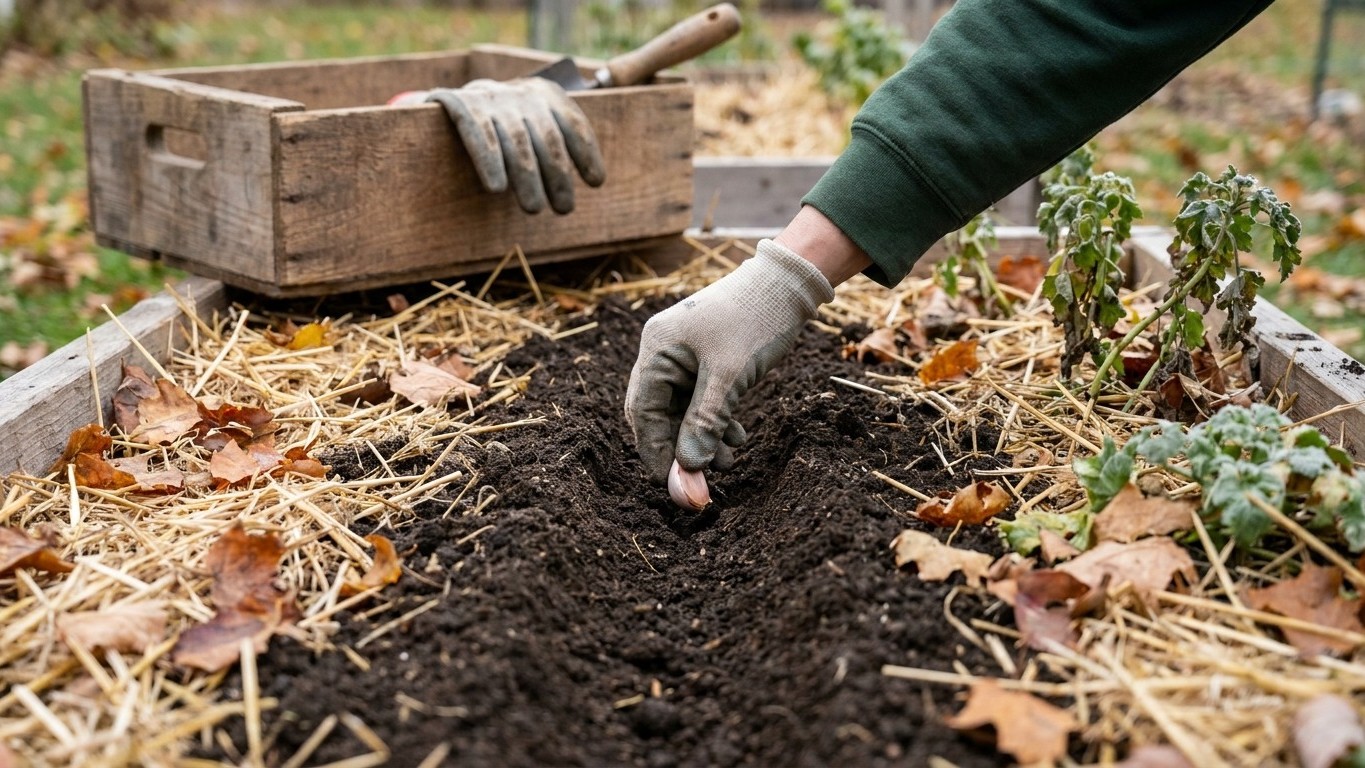

By November, Oklahoma’s open ground is mostly closed to new plantings, but not entirely. Garlic and shallots still go in while soil stays workable, cold frames and low tunnels keep hardy greens producing, and dormant bare-root trees, shrubs and roses can be set out. The real work this month shifts indoors and into planning: pruning, mulching, seed ordering, and protecting what is already stored.
What goes in the ground in November

The decision this month is not the calendar, it’s the soil. Oklahoma’s first fall frost arrives between October 29 and November 8 at the reference station used by NOAA’s Climate Normals (1991-2020), which means by the time November opens, most of the state has already felt its first freeze or is about to. Soil temperature, not air temperature, tells you what survives from here. A 65-degree afternoon two weeks after that first frost does not undo the freeze already logged in the ground.
What tolerates this window is a short but real list: garlic and shallot cloves, which actually need cold soil to root before winter dormancy; spinach and mache seed, which will germinate slowly in cool soil and sit tight until light lengthens; and cover crops like cereal rye or hairy vetch, sown to hold and feed soil that would otherwise sit bare all winter. None of these are gambles. They’re built for this.
What is a gamble: anything tender. Peppers, tomatoes, squash, beans, basil, any of the crops that die at 32 degrees, have no business going into open ground anywhere in the state this month. If a plant catalog or a neighbor suggests otherwise, the soil thermometer settles the argument.
| Crop | Planting method | Depth | Why November works |
|---|---|---|---|
| Garlic | Individual cloves, direct in soil | 2 inches | Needs a cold period to form bulbs |
| Shallots | Individual sets, direct in soil | 1-2 inches | Same cold requirement as garlic |
| Spinach | Seed, under cold frame or low tunnel | 1/2 inch | Germinates in cool soil, holds through winter |
| Cereal rye | Broadcast, direct in soil | 1 inch | Covers bare beds, adds organic matter come spring |
Zone matters here too. The USDA Plant Hardiness Zone Map (2023, built on 1991-2020 averages) puts Oklahoma across zones 6a through 8a, and that range alone explains why a gardener in the Panhandle and one near the Red River are working with different calendars this month. The 6a-8a spread is a state-wide range, not a promise for any one county.
What to start under cover
November is not the month to start seedlings bound for open ground, since the last spring frost at the reference station runs March 28 to April 10, five months out. But under cover is a different conversation. A cold frame or unheated hoop house lets a gardener sow spinach, mache, and claytonia now for harvest through the coldest stretch of winter, since these crops germinate and hold at soil temperatures that would stall anything else.
Count backward from that spring frost window if you’re starting onions from seed rather than sets. Onion transplants generally go into the garden four to six weeks before the last frost, which lands in mid-February to early March for most of the state. Seeds started 8 to 10 weeks before that transplant date put the sowing window in early to mid-December, not November, so the plants don’t sit rootbound in trays waiting for soil to warm.
The two failure modes run in opposite directions. Start too early under cover and seedlings stretch and weaken before there’s anywhere to plant them out. Start too late and there’s not enough daylight left to build real root mass before the coldest weeks hit. Herbs and microgreens dodge both problems, since they’re harvested indoors on their own schedule and never wait on a transplant date at all.
What is ready to pick
Little to nothing comes fresh from open, uncovered ground in most of Oklahoma this month, and that’s worth saying plainly rather than padding a harvest list with crops that stopped producing weeks ago. What still feeds a household comes from three places: cold frames, storage, and indoors.
Kale, collards, and leeds actually improve after a freeze or two, since cold converts stored starches to sugars and takes the bitter edge off the leaves. If a bed of kale is still standing, it’s worth picking now rather than later, before repeated hard freezes turn the leaves to mush. Cold frame lettuce, spinach, and mache planted in fall come out a handful at a time, checked every few days rather than harvested all at once.
Sprouts and microgreens grown on a windowsill or under grow lights fill the gap for anyone without a cold frame, ready in one to two weeks from seed. And this is the month to walk the storage shelf: winter squash should feel firm with no soft spots near the stem, potatoes should show no green tinge or sprouting, and onions with any give at the neck should get used first, before they turn on the shelf and take their neighbors with them.
The jobs that matter this month

The garden work in November happens away from the beds themselves, and skipping it costs real ground come spring. Dormant pruning on fruit trees and cane berries is safest done once leaves have dropped and the plant has gone fully dormant, cutting back to shape structure without the stress of active growth. Wait too long into a warm spell and pruning cuts can push new growth that a later freeze will kill outright.
Seed ordering belongs on this month’s list too, and not as an afterthought. Popular varieties, especially open-pollinated and heirloom types, sell out from catalogs weeks before spring planting season, so ordering now guarantees the varieties actually planned for rather than whatever’s left on the shelf in February.
- Turn and top off compost piles before hard freeze slows the microbes down
- Test soil pH and nutrient levels, since amendments applied now have all winter to work into the soil
- Clean and sharpen pruners, loppers, and hoes, and oil any wood handles before they sit unused
- Repair raised bed frames, fencing, and trellis hardware while the ground is workable
- Mulch garlic beds and any overwintering perennials with straw or shredded leaves
Rotation planning also earns its place on this list. Sketching next season’s bed layout now, while last season’s results are still fresh, catches problems like tomatoes returning to the same bed for a third year running, a habit that builds up soil-borne disease pressure quietly until it becomes a real problem.
What not to do in November
The most common mistake is trusting the air over the soil. A stretch of 70-degree afternoons after the first frost feels like an invitation to plant something tender, but the ground below stays cold, and any crop that needs warm soil to germinate or root will simply sit and rot rather than grow. Wait for spring, not a warm week.
A close second: uncovering cold frames or low tunnels too readily during a mild spell. Ventilating on a warm afternoon prevents cooking the greens inside, but leaving the cover off overnight exposes plants to a hard freeze they were otherwise protected from. Prop the lid, don’t remove it.
Nitrogen fertilizer is the other trap. Feeding nitrogen to perennials, lawns, or overwintering vegetables this late pushes soft new growth right before the coldest weeks of the year, and that new growth is exactly what a hard freeze kills first. If soil testing calls for nitrogen, spring application does the job without the risk. Last, don’t leave spent summer crop debris in the beds. Tomato and squash foliage left to overwinter in place gives fungal spores and insect eggs a place to ride out the cold, right where next year’s crop goes back in.
Checking this against your own county
A state-wide frost window is a starting point, not an instruction for any one garden. Elevation, local terrain, and the simple distance between the Panhandle and the Red River valley shift these dates by a week or more in either direction, and a garden in a low spot that collects cold air will freeze earlier than one on a slope nearby. The NOAA figures cited here come from a single reference station, and most home gardens run cooler in fall and warmer in spring than that station shows.
The Oklahoma State University Extension Service tracks these local variations county by county and is worth checking directly at extension.okstate.edu before locking in a planting date based on a state-wide range alone.
Common questions
Is it too late to plant garlic in November in Oklahoma?
Not usually. Garlic cloves need a cold period to form proper bulbs, and as long as the soil is still workable, cloves planted in November have time to root before hard winter sets in, emerging with the first warmth of late winter.
Can I still start a fall vegetable garden in November?
Direct seeding of anything but the hardiest greens is a poor bet this late, since the first fall frost has already arrived or is imminent across most of the state. A cold frame or low tunnel extends the option for spinach, mache, and similar cold-tolerant greens.
Should I fertilize my lawn or garden beds in November?
Skip nitrogen this late. It encourages tender new growth right before the coldest stretch of the year, and that growth is the first thing a hard freeze damages. Save nitrogen applications for spring, once soil testing has confirmed what’s actually needed.
What vegetables are still producing in an Oklahoma garden in November?
Kale, collards, and leeks left standing in the ground often taste better after a light freeze, since cold converts starches to sugar in the leaves. Beyond that, cold frame greens and stored winter squash, potatoes, and onions carry most households through the month.
Gardeners who plant by the Moon can check the November 2026 moon planting calendar, a tradition rather than a proven method.
Related guides
Elsewhere? See what to plant in November in every state and province.