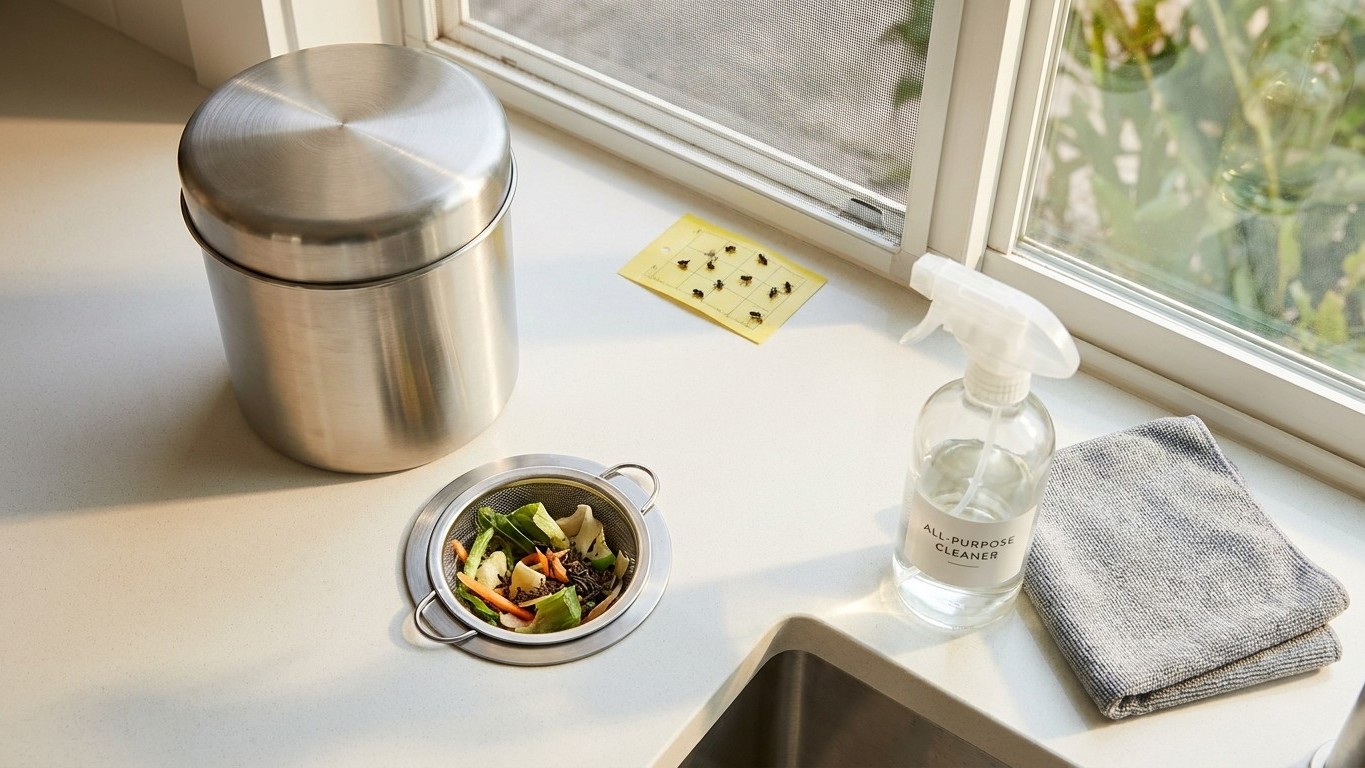

House flies control that actually works starts with reducing what draws them in, not with reaching for a spray. Flies breed in decaying organic matter and moisture, so sealing entry points, tightening up trash and drain habits, and using traps for existing adults solves most household problems within a week or two. A pesticide product has a role, but only after those steps and only when the label matches the exact situation. The order matters more than the tool.
The order that works

The U.S. Environmental Protection Agency lays out a specific sequence for dealing with pests, and it isn’t spray-first. The agency calls this Integrated Pest Management, describing it as “an effective and environmentally sensitive approach to pest management that relies on a combination of common-sense practices.” That phrase, common-sense practices, is doing a lot of work. It means the starting point is observation and housekeeping, not a can of insecticide.
The first actual step, according to the EPA, is a threshold: “Before taking any pest control action, IPM first sets an action threshold, a point at which pest populations or environmental conditions indicate that pest control action must be taken.” A few flies drifting in through a screen door on a summer afternoon isn’t an infestation. A dozen clustered on a kitchen window every morning is a different situation, and it changes what you do next.
Step two is identification. The EPA notes that “IPM programs work to monitor for pests and identify them accurately, so that appropriate control decisions can be made.” A house fly, a fruit fly, and a cluster fly call for different responses, and treating the wrong one wastes time and money.
Step three is prevention, which the agency places ahead of any product: “As a first line of pest control, IPM programs work to manage the crop, lawn, or indoor space to prevent pests from becoming a threat.” Only after that does the EPA get to active control, and even then it favors the gentlest option: “Effective, less risky pest controls are chosen first, including highly targeted chemicals, such as pheromones to disrupt pest mating, or mechanical control, such as trapping or weeding.” Broadcast spraying sits at the bottom of the list, not the top. The agency is direct about it: “Broadcast spraying of non-specific pesticides is a last resort.”
A page, or a homeowner, that opens with a spray has inverted that doctrine. Here’s why the sequence actually matters in practice: a treatment applied to a house that still offers flies food, standing moisture, and a way to get inside has to be repeated forever. Kill the adults today, and a new generation hatches from the same trash can or drain in a week. The order isn’t a bureaucratic preference. It’s the difference between solving the problem once and paying for it monthly.
What works without a pesticide
Most house fly problems resolve with five approaches, none of which require a product label. The EPA’s own guidance backs this up directly, favoring “mechanical control, such as trapping” over chemical intervention whenever it can do the job.
Exclusion, sanitation, and moisture
Exclusion means fixing torn screens, adding door sweeps, and closing gaps around utility lines. It stops new flies from entering but does nothing about flies already breeding inside, so it works best paired with the next step.
Sanitation is the highest-leverage move available. Sealed trash cans, cleaned recycling bins, and prompt removal of pet waste eliminate the larval food source. A single overripe bag of garbage or a neglected compost bin can sustain a breeding cycle that no amount of swatting will outpace. The effort here is real: it’s a daily habit, not a one-time chore, and it has to extend to garages and outbuildings, not just the kitchen.
Moisture control matters because flies need damp organic material to lay eggs, whether that’s a leaky drain, a soggy welcome mat, or grass clippings left against the foundation. Drying out those spots removes a breeding site, but it won’t affect adult flies already in the house, only future generations.
Traps and physical removal
Traps, whether sticky ribbons, light traps, or baited jar traps, catch existing adults without introducing any chemical into living space. They’re effective for reducing numbers but won’t stop a breeding source from producing more flies, so they work as a symptom manager, not a cure.
Physical removal, meaning fly swatters and vacuuming up clusters near windows, is unglamorous but genuinely useful for fast knockdown when a batch has already made it inside. It takes time and repetition, and it does nothing to prevent the next wave.
Used together, these five methods handle the overwhelming majority of house fly situations. The honest caveat is that they require sustained attention rather than a single afternoon’s effort.
When a product is warranted
There’s a legitimate case for a pesticide product, and it shows up when sanitation and exclusion have been genuinely addressed and flies are still present in numbers above whatever threshold a household has decided is unacceptable, in the EPA’s own language, when “pest control action must be taken.” That’s a real scenario: a persistent breeding site that can’t be located, an infestation that started before the house was occupied, or a situation where the volume of flies is affecting daily life despite reasonable prevention.
What this article won’t do is name a product, brand, or active ingredient, and there’s a specific reason for that restraint. Registered pesticide products differ from state to state, formulations change, and the only label that applies to a given situation is the one on the product actually in a reader’s hands. The label is the legal document governing that product’s use, not a suggestion, and it overrides any general advice found online.
The EPA is also clear that these products carry real risk. Pesticides are designed to be toxic to pests, and that toxicity doesn’t stop being a hazard once it’s inside a house. The agency identifies children, older adults, and people with compromised immune systems as especially vulnerable to improper use. That’s not a footnote. It means ventilation, application in the amounts the label specifies, and keeping treated areas away from where kids or pets spend time aren’t optional precautions, they’re the difference between solving a fly problem and creating a poisoning risk.
Anyone unsure which product fits their situation, how to read a label correctly, or whether a specific active ingredient is safe around a particular member of the household has a direct resource for that question: the National Pesticide Information Center, reachable at 1-800-858-7378. That line exists precisely for this kind of question, staffed by people who can speak to a specific product and a specific situation in a way a general article can’t. Calling them beats guessing, and it beats trusting a recommendation that wasn’t written with a reader’s actual house, climate, or family in mind.
When to stop and call someone
There’s a point where sanitation, exclusion, and traps stop being enough, and it’s worth naming plainly rather than hedging around it. Three situations call for outside help rather than another round of home remedies.
Repeated failure is the first. If exclusion has been done, trash and drains are clean, traps are in use, and flies keep reappearing in the same numbers after several weeks, the breeding source is almost certainly somewhere inaccessible: inside a wall void, under a floor, in a crawlspace, or in a dead animal that hasn’t been located. A pest control professional has tools, including inspection cameras and experience with fly biology, that a homeowner searching by flashlight doesn’t.
Structural damage is the second trigger. Large fly populations sometimes point to a bigger problem behind the walls, like a decomposing rodent, a sewage line issue, or persistent moisture damage that’s created an ideal breeding environment. Treating the flies without addressing that underlying damage means the infestation returns as soon as the treatment wears off, and the structural issue keeps getting worse in the meantime.
A health question is the third, and it deserves a direct answer rather than reassurance either way. House flies are documented carriers of bacteria picked up from the surfaces they land on, and concerns about contamination in food-handling areas, or about a member of the household getting sick after a heavy infestation, are reasonable ones to raise. Those questions belong with the Centers for Disease Control and Prevention or a local health department, not with general pest-control advice, because they can assess a specific exposure and a specific set of symptoms in a way this article isn’t positioned to do.
None of this means calling a professional is a failure. It means the problem has moved past what sanitation and traps are designed to fix, and recognizing that boundary early saves both time and the cost of repeating ineffective treatments.
Common questions
How long does it take to get rid of house flies without a pesticide?
Most households see a noticeable drop within one to two weeks once the breeding source is removed and entry points are sealed, since existing adult flies have a short lifespan and traps reduce their numbers while sanitation stops new ones from developing.
Do house flies mean the house is dirty?
Not necessarily. A single unsealed trash can, a pet’s water dish left out too long, or a gap under a door can support a fly population even in an otherwise clean house. The source is usually narrow and findable, not a sign of overall housekeeping.
Can house flies bite?
Common house flies don’t bite; they land, feed on surface residue, and leave. Biting incidents in a home are more often a different insect, which is part of why the EPA’s identification step matters before choosing any control method.
Is it safe to use a fogger for house flies indoors?
That depends entirely on the specific product’s label, which will state whether it’s intended for indoor use, what ventilation it requires, and how long a space needs to stay unoccupied afterward. Anyone unsure should call the National Pesticide Information Center at 1-800-858-7378 before applying it, rather than assuming one fogger’s instructions apply to another.