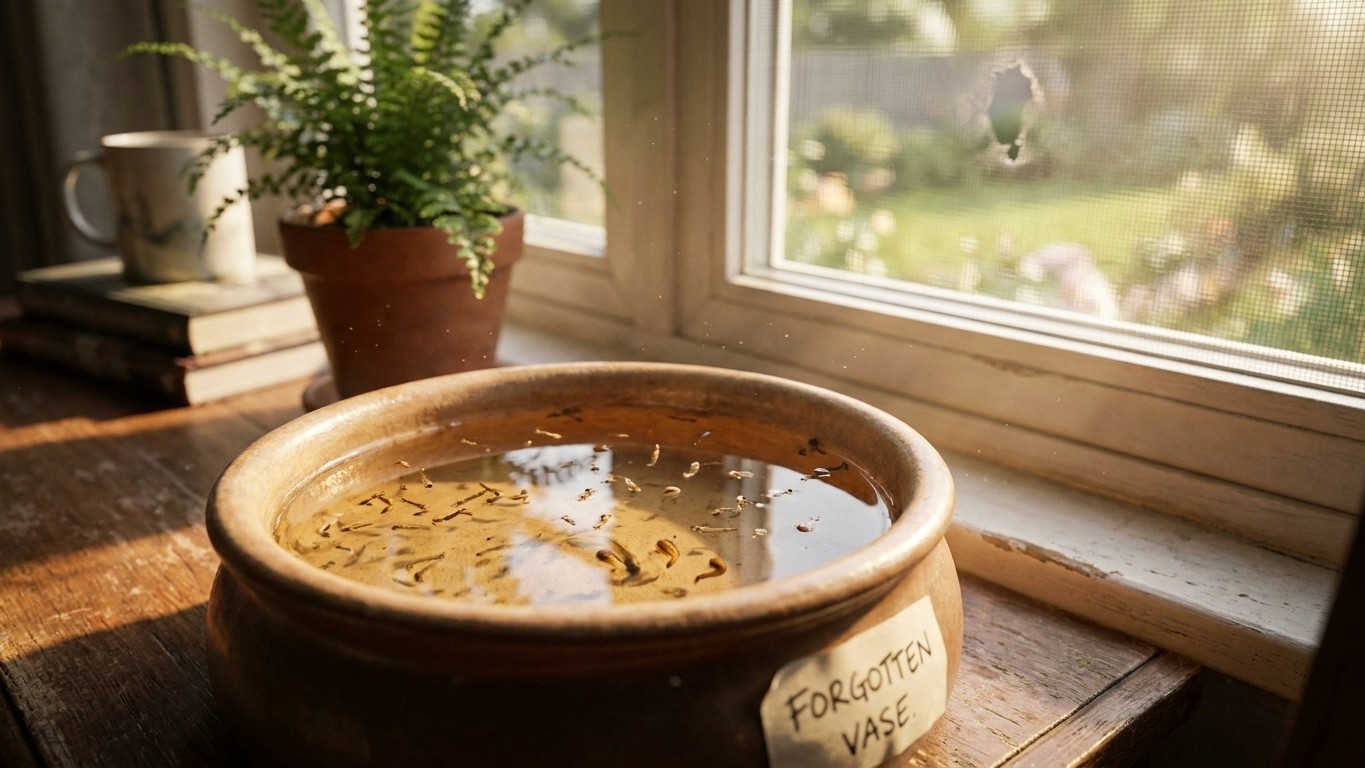

A house doesn’t need dirty dishes or open food to draw mosquitoes. It needs damp air, a dark corner to rest in during the heat of the day, and any amount of standing water nearby, even a capful in a saucer. Once those conditions exist, a screen with one small tear or a door that doesn’t seal is all the invitation they need.
What they are actually looking for

Every pest that shows up in a home is chasing one of three things: food, water, or shelter. For mosquitoes, the calculus is different from almost every other household invader. They aren’t hunting crumbs on the counter or grease behind the stove. Adult females need a blood meal to reproduce, but the thing that actually determines whether a property has a mosquito problem is water, standing and still, even in amounts most people wouldn’t think to check.
A clogged gutter holding an inch of rainwater. A saucer under a potted plant. A bucket left upside down that still pools at the rim. A birdbath that hasn’t been dumped in a week. Each of these is a nursery, not a puddle. Mosquito eggs hatch, and the larvae mature, in water that never moves, sometimes in less time than a homeowner would expect between one weekend chore and the next. Indoors, the same logic applies on a smaller scale, a forgotten vase, a drain pan under a window unit, a floor drain that stays damp.
This is the detail that changes how a homeowner should think about the whole problem. A species that comes for food is deterred by a clean kitchen. A species that comes for water is not, no matter how spotless the house looks, if there’s a damp corner it hasn’t found yet. That’s why the federal guidance on pest management doesn’t start with a spray can. The U.S. Environmental Protection Agency states plainly: “As a first line of pest control, IPM programs work to manage the crop, lawn, or indoor space to prevent pests from becoming a threat.”
For mosquitoes, managing the space means walking the property with water in mind rather than mess. Check anything that can hold liquid for more than a few days: gutters, flowerpot trays, tarps, kiddie pools, recycling bins left outside without lids, even tire swings. Indoors, look at anything with a drain or a reservoir, humidifiers, dehumidifier collection tanks left unemptied, sink traps that stay wet under an unused fixture. None of this is glamorous work, and none of it involves a single product. It’s also the only step that addresses the actual reason mosquitoes are on the property in the first place, rather than just the ones that happened to wander inside on a given evening.
How they get in
Mosquitoes are small fliers, and the gaps that let them through a home’s defenses are often ones a homeowner would call negligible for anything else. Working the exterior in a deliberate order catches most of what matters.
- Torn or missing window screens. A hole doesn’t need to be visible from across the room. Mosquitoes can pass through openings smaller than the mesh gaps in some older or sun-damaged screening, and a screen that looks intact from a few feet away can still have a seam pulled loose at a corner.
- Door sweeps and thresholds. The gap under an exterior door, especially one leading to a patio, garage, or basement walkout, is often wide enough for a mosquito to walk or fly through without brushing either edge.
- Gaps around pipes and cables. Anywhere a utility line, spigot, or vent pipe passes through an exterior wall, there’s usually a small unsealed opening around it, cut for the installation and never closed up afterward.
- Vents without fine mesh. Dryer vents, foundation vents, and attic vents are built to move air, not to keep out insects this small, unless they’ve been fitted with a mesh screen sized for the purpose.
- Riding in on the resident. A mosquito that’s already resting on clothing, or one that follows a person or pet through an open door during the few seconds it takes to step inside, doesn’t need a structural gap at all.
The surprising part for most homeowners is the first item on that list. Window screens are trusted the way a locked door is trusted, as a solid barrier, when in practice a screen is only as good as its weakest few square inches. A single season of sun exposure, a pet pushing against a corner, or a frame that’s warped slightly out of true can open a gap that’s invisible at a glance but entirely usable by something this size.
When they come, and why
Mosquito activity around a home tracks water and warmth, not a calendar date. Rain events matter more than the season on the wall calendar, because a heavy rain fills the low spots, clogged gutters, tire ruts, tarps, that were dry the week before, and those pools become breeding sites within days. A stretch of drought can do the opposite for open water but push mosquitoes toward the few remaining damp spots close to a house, including anything under an eave or near an AC condensate line.
Temperature drives the pace of the life cycle rather than simply switching activity on or off. Warmer conditions speed up how quickly eggs become larvae and larvae become biting adults, which is why a single rain event followed by warm days can produce a noticeable jump in mosquitoes at a property in a short window. Cooler stretches slow that cycle down without necessarily stopping it, since some species and life stages tolerate cold far better than homeowners assume.
None of this plays out the same way in every region. What counts as a wet spell, a dry spell, or a warm stretch, and what that means for the timing of mosquito pressure at a given address, depends heavily on the local climate and the species common to that area. Rather than pin a season or a temperature to this page, the more useful move is checking the regional page on this site that covers the reader’s own part of the country, since that’s where the timing detail that actually applies will be found.
What stays constant everywhere is the sequence: water collects, it sits long enough to matter, and mosquitoes find it before most homeowners do. Watching for that sequence, rather than waiting for a specific date on the calendar, is the more reliable way to anticipate pressure at any address.
Fixing the reason rather than the symptom
A house that offers nothing, no standing water, no gaps a mosquito can use, no damp resting spots near doors and windows, simply gets fewer mosquitoes. That’s the whole logic this page has been building toward. Every treatment applied to a house that still offers all three keeps having to be repeated, because the conditions that drew mosquitoes in the first time are still there drawing in the next generation.
The EPA’s own framework backs this order up directly. “Integrated Pest Management (IPM) is an effective and environmentally sensitive approach to pest management that relies on a combination of common-sense practices.” The sequence starts before any product is even considered: “Before taking any pest control action, IPM first sets an action threshold, a point at which pest populations or environmental conditions indicate that pest control action must be taken.” From there, “IPM programs work to monitor for pests and identify them accurately, so that appropriate control decisions can be made.” Prevention comes next, and only after prevention does control enter the picture, with the least risky options first: “Effective, less risky pest controls are chosen first, including highly targeted chemicals, such as pheromones to disrupt pest mating, or mechanical control, such as trapping or weeding.” Wide, blanket chemical treatment sits at the bottom of that list on purpose. “Broadcast spraying of non-specific pesticides is a last resort.”
That order matters because pesticides are built to be toxic to the pests they target, and the EPA is direct that they can be toxic to people when used improperly, with children, older adults, and people with compromised immune systems named as especially vulnerable. A homeowner weighing a specific product should call the National Pesticide Information Center at 1-800-858-7378 rather than guess, since the right answer depends on the exact label in hand.
Mosquitoes also carry a documented health question that ants or spiders don’t. Certain species are known vectors for diseases tracked by public health agencies, and a reader with concerns about symptoms or local outbreak activity should go to the CDC’s mosquito information or their local health department rather than rely on a general guess. For the practical, right-now steps, treatments, traps, and what to do about an active problem, the site’s dedicated mosquito control guide covers that ground. This page is the one that stops the problem from coming back once it’s handled.
Common questions
Do mosquitoes actually live inside a house, or just pass through?
Most that end up indoors are passing through, resting in a cool, dark spot during the day before heading back out to feed and breed. They don’t typically set up an indoor breeding site unless there’s standing water inside the home itself, such as an unemptied humidifier tray or a damp basement drain.
Can a mosquito breed in water that’s only been standing a few days?
Yes, and that’s the detail most homeowners underestimate. Once conditions are warm enough, the cycle from egg to biting adult can complete faster than a typical week between chores, which is why a gutter or saucer that gets checked only occasionally can still produce mosquitoes.
Is it worth fixing screens if the real source is a puddle outside?
Both matter, and neither replaces the other. Eliminating standing water reduces how many mosquitoes are ever produced on the property, while sealing screens and gaps stops the ones that do exist, including any coming from a neighbor’s yard, from getting inside.
Should a homeowner ever call an exterminator for mosquitoes instead of handling it themselves?
A single yard with a water problem is usually a homeowner job of elimination and sealing. A property with a persistent, unexplained population despite no obvious standing water, or a health concern tied to local disease activity, is a case for a licensed pest professional or the local health department rather than trial and error with home remedies.