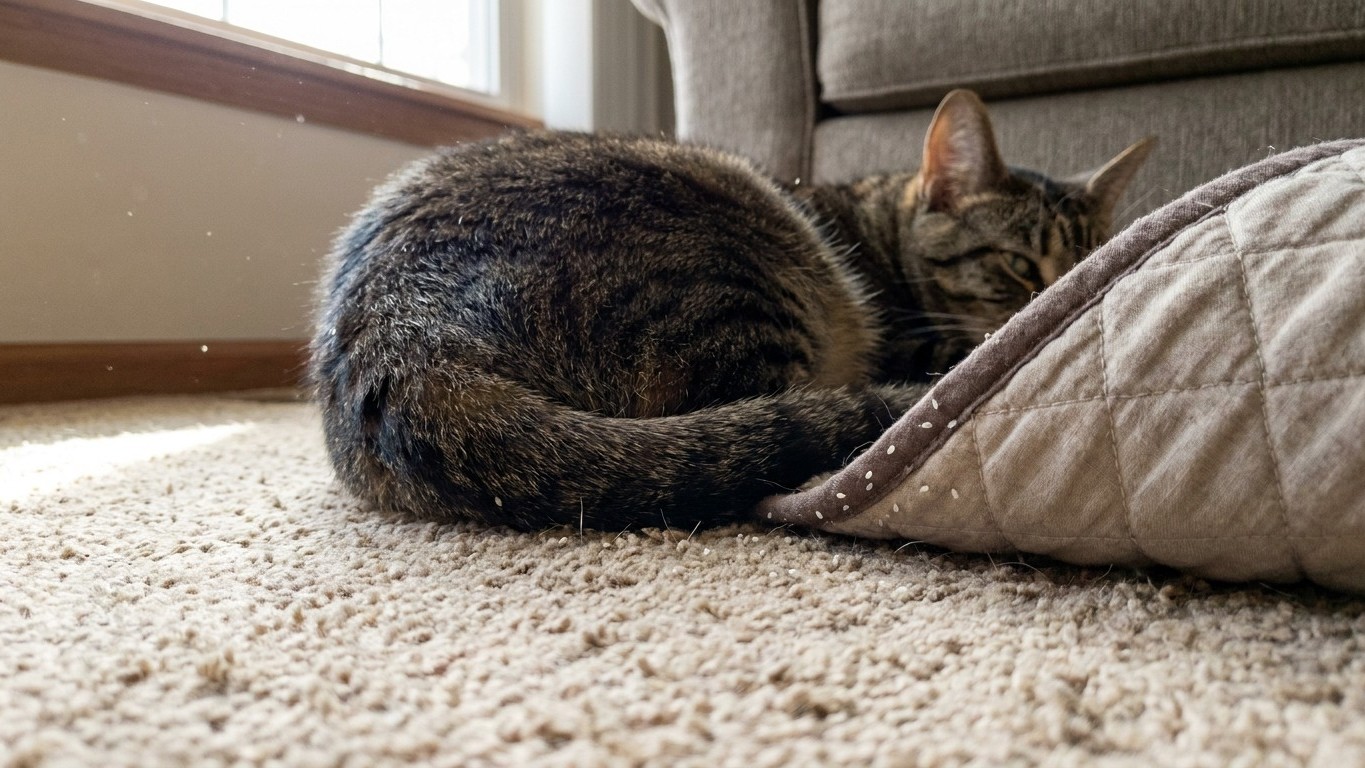

Fleas get inside because something inside is worth the trip: a warm-blooded host to feed on and a humid, protected spot to lay eggs. That host is almost always a pet, or a person’s ankles when no pet is around. Once a female flea rides in on fur, she can lay eggs that fall off into carpet fibers, pet bedding, and baseboard cracks within hours, starting an indoor population that has nothing to do with the yard anymore.
What they are actually looking for

Every pest that shows up indoors is chasing one of three things: food, water, or shelter. For fleas, the answer is lopsided. Water barely matters, shelter matters some, but food, meaning a blood meal, is the whole game. A flea that can’t feed within a few days of emerging as an adult dies. That single fact explains almost every flea problem in a house that has a dog or cat.
The pet is the food source. The carpet, the couch cushions, and the pet’s own bed are the shelter, because flea eggs and larvae need the kind of dark, undisturbed, slightly humid microclimate that carpet fibers and upholstery seams provide far better than bare floor. An adult flea can jump onto a host in seconds, feed, then hop off and lay eggs loose in the surrounding fibers. Those eggs aren’t sticky. They fall wherever the pet happens to be lying down, which is usually the same two or three spots in the house every day.
This is why a species that comes for water is not deterred by cleaning up crumbs, and why flea problems don’t respond to the same fixes that work on ants or roaches. Vacuuming up food debris does nothing for fleas. What matters is the pet’s exposure to fleas outdoors, and how much of the house functions as flea habitat once one gets inside. The U.S. EPA’s framework for pest management makes prevention the starting point, not an afterthought: “As a first line of pest control, IPM programs work to manage the crop, lawn, or indoor space to prevent pests from becoming a threat.”
For fleas, managing the indoor space means reducing the shelter value of carpet and bedding before reaching for any product. That means:
- Washing pet bedding on a hot cycle regularly, since it’s the single densest flea habitat in most homes
- Vacuuming carpet edges, under furniture, and along baseboards where larvae migrate away from light
- Checking pets for fleas after time outdoors, especially in tall grass or near other animals
None of that is control in the pesticide sense. It’s the difference between a house that offers a flea nowhere to finish its life cycle and one that offers everything it needs.
How they get in
Fleas don’t wander in through a gap in the foundation looking for warmth the way a mouse does. They almost always arrive attached to something alive, then spread from that point. Walking the entry points in the order worth checking looks like this:
- The pet itself. This is the dominant path by a wide margin. A dog or cat that spends time in the yard, at a park, or near other animals can pick up fleas in minutes, and a single hitchhiker female is enough to start an indoor population.
- Wildlife and rodents that get close to the house. Raccoons, opossums, feral cats, and rodents nesting under a porch or in a crawlspace carry their own flea populations, and those fleas will happily transfer to a pet or a person who comes near.
- Secondhand furniture, rugs, and pet crates. Flea eggs and pupae can survive in fabric and carpet fibers away from a host for a surprisingly long stretch, which makes used furniture and rugs from an unknown source a real risk, particularly anything upholstered.
- Gaps at pipes, cables, and the foundation. Less common for fleas than for rodents or crawling insects, but relevant where a crawlspace or sub-floor area hosts wildlife whose fleas can migrate upward through utility penetrations.
- Door sweeps, window screens, and vents. These matter more for keeping wildlife and rodents out than for stopping fleas directly, since a flea rarely crosses a threshold on its own. Closing these gaps cuts the population of animal hosts that bring fleas near the house in the first place.
The gap that’s surprisingly large for this species isn’t a crack in the wall. It’s behavioral: a pet let out unsupervised in an area frequented by strays or wildlife is a wider opening than any physical gap in the house.
When they come, and why
Flea activity tracks two things: the life cycle of the flea itself and the behavior of the host animals that carry them. Warm, humid conditions favor faster egg, larval, and pupal development, so populations build faster when the outdoor environment supports that cycle. Cooler, drier stretches slow the cycle down but don’t eliminate it indoors, because a heated home with carpet and pet bedding can sustain a flea population through conditions that would kill it outdoors.
Drought pushes wildlife closer to houses in search of water and shade, and that proximity brings their fleas closer too. Rain and humidity extend the window during which flea eggs and larvae survive outdoors long enough to reach the pupal stage, which is the most resilient part of the life cycle and can wait for a host to walk by. Neither of these is a fixed calendar event. It shifts with the specific weather pattern a region sees in a given year, not a date on a chart.
The end-of-season pattern matters too. As outdoor host activity (wildlife foraging, stray cat movement, rodent nesting) intensifies, so does the chance a pet picks something up on a walk or in the yard. That’s less about a single trigger date and more about cumulative exposure building over weeks.
None of this comes with a universal threshold. What triggers flea activity in a humid southern state looks different from what triggers it in a dry mountain climate or a northern state with a hard winter. The site’s page for your specific territory is the place to check what that pattern looks like locally, rather than relying on a generic date or temperature that won’t hold true everywhere.
Fixing the reason rather than the symptom
A house that offers fleas nothing gets fewer fleas. That’s the whole logic of this page, and it’s the same logic the U.S. EPA lays out for pest management generally: “Integrated Pest Management (IPM) is an effective and environmentally sensitive approach to pest management that relies on a combination of common-sense practices.” The order in that approach matters as much as the practices themselves.
The first step isn’t a product. It’s assessment: “Before taking any pest control action, IPM first sets an action threshold, a point at which pest populations or environmental conditions indicate that pest control action must be taken.” Then comes identification, because guessing wastes time and money: “IPM programs work to monitor for pests and identify them accurately, so that appropriate control decisions can be made.” Only after that does the framework turn to intervention, and even then it starts with the least aggressive tools available: “Effective, less risky pest controls are chosen first, including highly targeted chemicals, such as pheromones to disrupt pest mating, or mechanical control, such as trapping or weeding.” Broad, untargeted pesticide use sits at the very end of that list, not the beginning: “Broadcast spraying of non-specific pesticides is a last resort.”
Applied to fleas, that order means treating carpets, pet bedding, and the pet itself only after reducing the shelter and food value of the home, not instead of it. Any treatment applied to a house that still offers full run of unwashed pet bedding and undisturbed carpet has to be repeated, because the conditions that supported the first population are still there. Pesticides are formulated to be toxic to the pests they target, and the EPA notes they can be toxic to people when used improperly, with children, older adults, and people with compromised immune systems named as especially vulnerable. Questions about a specific product and its label are best answered by the National Pesticide Information Center at 1-800-858-7378, not by guesswork.
The flea control page covers what to do about an active infestation right now. This page is what keeps that work from having to happen again next season, by addressing why fleas showed up in the first place rather than only where they ended up.
Common questions
Can fleas live in a house with no pets?
Yes, though it’s less common. Fleas will feed on people if no other host is available, and they can also arrive on clothing, secondhand furniture, or via wildlife that gets close to the house, such as rodents nesting in a crawlspace.
How long can flea eggs survive in carpet without a host nearby?
Flea eggs, larvae, and especially pupae can persist in carpet fibers and fabric for an extended stretch, with the pupal stage in particular able to wait for a host to pass by before an adult emerges to feed.
Does a clean house prevent fleas the way it prevents ants?
Not in the same way. Fleas aren’t drawn by food debris or crumbs, they’re drawn by a host to feed on and fabric to shelter in. Reducing carpet and bedding as flea habitat matters more than general food cleanup.
When is a flea problem too big to handle without a professional?
If an infestation persists after thorough cleaning, pet treatment, and repeated vacuuming over several weeks, or if bites on household members continue, it’s reasonable to involve a pest control professional rather than continuing to repeat home treatments on a population that keeps rebuilding.