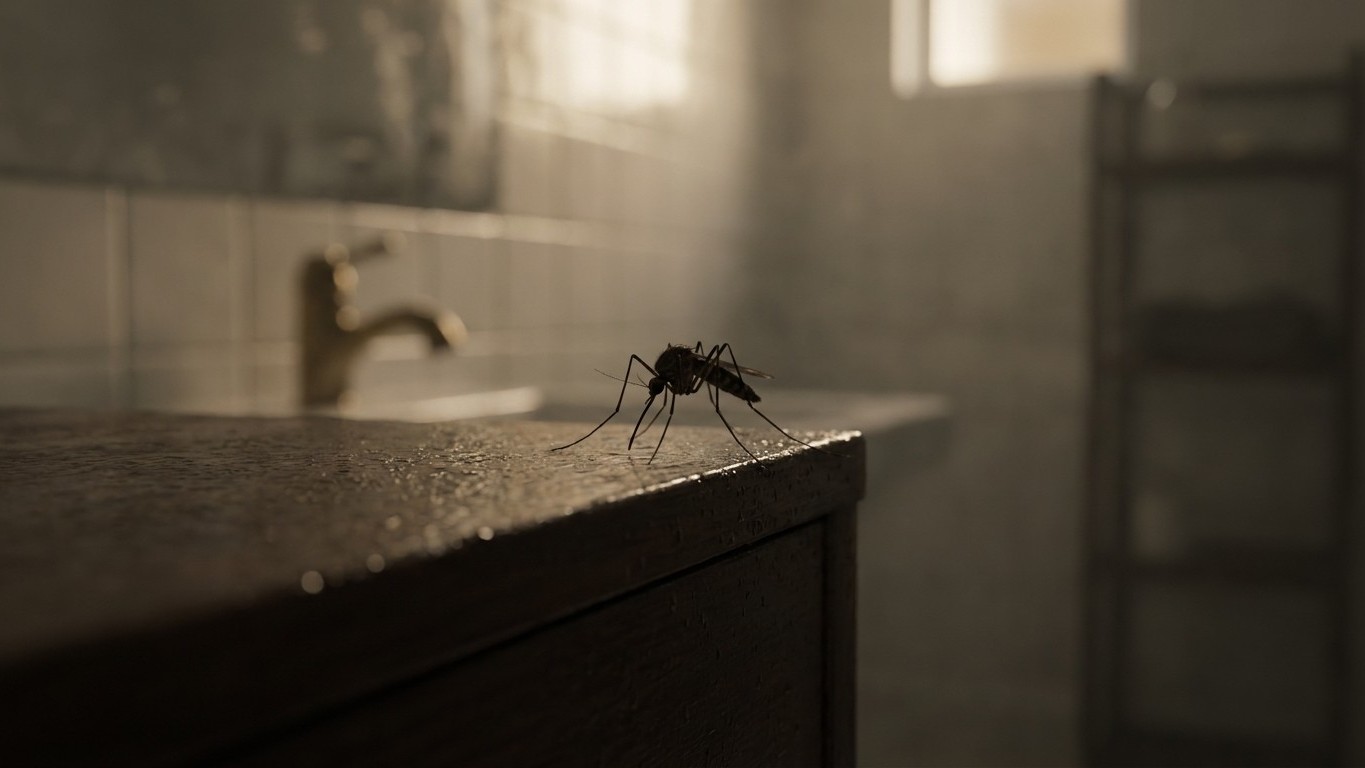

The clearest sign of mosquitoes indoors is a high-pitched whine near your ear at dusk, followed by a bite you feel minutes later and see as a raised, itchy welt within an hour. But a single mosquito flying through an open door is not the same problem as a house that keeps producing them. The signs that matter are the ones tied to where they rest, when they’re active, and whether a breeding source sits nearby.
What you notice first

Bites are the sign almost everyone reports first, but they’re also the least useful for figuring out what’s going on. A bite tells you a mosquito found you. It doesn’t tell you whether that mosquito lives in your yard, your neighbor’s gutter, or a bottle cap of rainwater on your porch. The whine is the second sign, and it’s more diagnostic than most people realize: female mosquitoes (the only ones that bite) produce a wing-beat frequency that’s audible when they’re close, usually right before or after landing.
Resting behavior is the sign homeowners miss most often. Adult mosquitoes don’t fly constantly. Between meals, they rest on vertical surfaces in cool, shaded, humid spots: behind curtains, under sink cabinets, in closets, along the underside of porch furniture. If you’re finding one or two mosquitoes a day in the same corner of a bathroom or basement, that’s not random traffic. That’s a resting site close to an entry point, and possibly close to a breeding source.
The sign that’s easiest to overlook entirely is standing water within a few feet of where the bites happen. Mosquitoes don’t need a pond. A clogged gutter, a saucer under a potted plant, a tarp with a low spot, or a five-gallon bucket left outside after a storm holds enough water for a full breeding cycle. Adults rarely fly far from where they hatched, so the presence of biting mosquitoes near a specific door or window is itself a clue about where to look outside.
Why identification comes before anything else
Confirming that what you’re seeing is actually a mosquito, and not a gnat or a midge, is the step people skip because it feels obvious. It isn’t always. The U.S. Environmental Protection Agency notes that “IPM programs work to monitor for pests and identify them accurately, so that appropriate control decisions can be made.” That sequence, monitor first, identify accurately, then decide, exists because the wrong identification leads to a control choice that was never going to work in the first place.
What it is confused with
Several small flying insects get mistaken for mosquitoes, and the mix-up usually happens because people react to size and behavior rather than looking closely at the insect itself. The confusion matters because each look-alike has a different source, and treating the wrong source wastes money without solving anything.
| Insect | How it differs | Where it actually comes from |
|---|---|---|
| Fungus gnats | Smaller, weaker flyers, cluster near soil rather than biting | Overwatered houseplant soil |
| No-see-ums (biting midges) | Nearly invisible, bite is sharper and more painful for the size | Marshy or sandy outdoor areas, not indoor water |
| Crane flies | Much larger, long legs, do not bite | Lawns and damp soil outdoors |
| Drain flies (moth flies) | Fuzzy, moth-like wings, slow and erratic flight | Organic buildup in drains and pipes |
The most costly confusion is between mosquitoes and fungus gnats. Both show up as small flying insects in the house, both seem to appear from nowhere, and both get blamed on “the yard.” But fungus gnats breed in wet potting soil, not standing water outdoors, so an outdoor yard treatment does nothing for them. Homeowners who spray for mosquitoes based on a gnat problem spend money on the wrong end of the house and see no improvement, because the source was a houseplant saucer the entire time.
Another common mix-up: assuming any biting insect indoors is a mosquito, when it’s actually a biting midge that came in on clothing after time outdoors near water. Midges don’t breed indoors and don’t respond to the same monitoring approach mosquitoes do. Getting this wrong means checking the wrong places for standing water and missing the real issue, which is exposure outside rather than a source inside the home.
Telling a sighting from an infestation
One mosquito getting into the house through a torn screen is not an infestation. It’s an entry. An infestation means a breeding source is active and adults are emerging on a schedule, not as a one-time event. The difference is measurable, and it’s worth checking before assuming the worst or, just as often, before assuming there’s nothing to worry about.
Three things separate a sighting from a real problem. First, location: are the mosquitoes showing up in one room near a specific window, or throughout the house? A whole-house pattern points to an outdoor source feeding multiple entry points. Second, frequency: is it one mosquito this week, or several every evening at the same time? Mosquitoes are most active at dawn and dusk for most species, so a repeating pattern at those hours is a stronger signal than random daytime sightings. Third, and most telling, whether you can find larvae or pupae in standing water nearby. Adults biting you prove mosquitoes exist somewhere. Larvae wriggling in a bucket prove they’re breeding on your property right now.
When to act, and when to wait
The EPA’s integrated pest management framework is built around this exact judgment call. As the agency puts it, “Before taking any pest control action, IPM first sets an action threshold, a point at which pest populations or environmental conditions indicate that pest control action must be taken.” Applied here, that means a stray mosquito or two doesn’t justify yard-wide treatment, chemical fogging, or a service contract. A standing-water source with visible larvae, or repeated bites happening daily near a specific entry point, does. Acting before there’s anything measurable to act on wastes effort and, in the case of chemical controls, introduces risk without a corresponding benefit.
What to do once you are sure
Once you’ve confirmed a real source rather than a stray insect, the next steps split into two directions: removing what’s attracting them, and deciding how to control the ones already present. Standing water is the attractant that matters most for mosquitoes specifically, more than scent, more than light, more than most of what people assume drives them indoors. Eliminating containers that hold water for more than a few days removes the breeding source directly, which does more than any spray applied after the fact.
There’s a documented health dimension here that shouldn’t be minimized or exaggerated. Mosquitoes in the United States can carry viruses that cause illness in people, and the risk varies by region, season, and species present locally. The Centers for Disease Control and Prevention tracks these risks and publishes current guidance for specific areas, and your local or state health department is the right source for what’s circulating in your county this season. That’s not a substitute for pest control at home, but it’s the accurate way to gauge how seriously to treat repeated bites, rather than guessing.
If you’re considering a chemical product for mosquito control, know that the EPA is direct about the tradeoff: pesticides are designed to be toxic to pests, and they can be toxic to people when used incorrectly, with children, older adults, and people with weakened immune systems named as especially vulnerable. The label on the product you’re holding is the only one that applies to your situation, since registered products and allowed uses differ by state. If you have questions about a specific product, the National Pesticide Information Center takes calls at 1-800-858-7378 and will give you a straight answer instead of a guess.
For a large property, a persistent breeding source you can’t locate, or a yard bordering standing water you don’t control (a retention pond, a neighbor’s unmaintained pool), a professional mosquito control service is a reasonable first call rather than a last resort. They have access to broader monitoring and targeted treatment options than a homeowner does, and for mosquitoes specifically, that’s often the faster route to an actual fix.
Common questions
How can I tell mosquito bites from other bug bites?
Mosquito bites are usually round, raised, and itchy within minutes to an hour, often appearing on exposed skin like ankles, arms, and necks. Bites that appear in a tight cluster or line, or that show up only after sleeping, point more toward bed bugs or fleas than mosquitoes.
Do mosquitoes leave any visible trace besides bites?
Occasionally, but rarely anything as clear as droppings from other pests. The most reliable non-bite evidence is finding the insects themselves resting on walls or curtains, or finding larvae in standing water nearby.
Can mosquitoes actually breed inside a house?
Yes, if there’s standing water indoors for more than a few days, such as a clogged floor drain, an unused humidifier reservoir, or a neglected houseplant saucer. It’s less common than outdoor breeding but not rare in humid climates or during long periods of high indoor humidity.
Is one mosquito in the house something to worry about?
Not on its own. A single mosquito getting in through a door or screen gap is normal and doesn’t indicate an infestation. Repeated sightings at the same time each day, or any life stage other than an adult found indoors, are the signs that warrant a closer look.