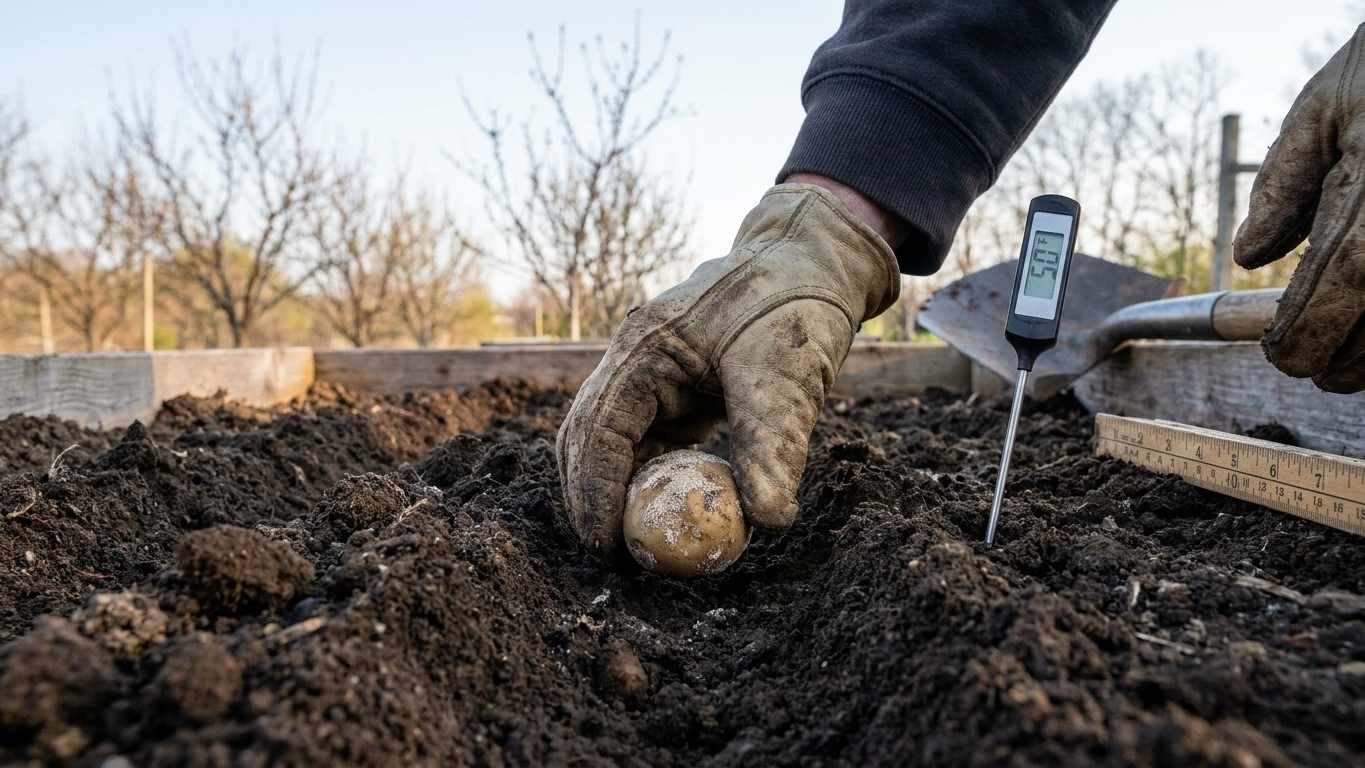

For the Oklahoma City area, the planting window runs roughly from March 7 to March 27, counting 14 to 21 days back from the last spring frost date of March 28 to April 10 (NOAA NCEI 1991-2020 Climate Normals). Potatoes go in the ground once soil hits 50 F, not on a fixed calendar date. Your own yard may run a week or two behind that airport station.
The short answer
NOAA NCEI’s 1991-2020 Climate Normals put the last spring frost at the Oklahoma City station in a band between March 28 and April 10. That’s a 30 to 70 percent freeze probability range, not a single guaranteed date. Utah State University Extension and the University of Maine Cooperative Extension both frame potato planting the same way: get seed potatoes into ground that has warmed to 50 F, and that point typically falls 14 to 21 days before the last frost date for your area.
Run the math against the Oklahoma City window and you land on a planting range of about March 7 to March 27. Count 21 days back from the early end of the frost window (March 28) and you get March 7. Count 14 days back from the late end (April 10) and you get March 27. Everything in between is fair game, and the exact day depends on where your last frost tends to fall and how quickly your particular soil warms.
That’s the reference-city figure, not a statewide rule. NOAA’s normals are measured at a specific weather station, in this case the one serving Oklahoma City. A garden in the Panhandle, in the Ozark foothills, or at higher elevation anywhere in the state will run on a different frost calendar; often a week or two later in spring and earlier in fall than what an airport station fifty or a hundred miles away records. If you garden outside the immediate Oklahoma City area, the honest move is to check your own county’s frost history rather than borrow this one wholesale.
What doesn’t change, regardless of which county you’re in, is the underlying rule from Utah State and University of Maine: soil temperature decides the planting date, not the calendar. The 14-to-21-day count before your last frost is just a shortcut for guessing when soil crosses 50 F, because most gardeners don’t own a soil thermometer and check it daily. If you do own one, use it. It beats counting backward from a date that’s really a probability, not a promise.
What actually decides it
Two temperature thresholds run the entire potato season in Oklahoma, and they pull in opposite directions. One tells you when to start. The other tells you when the crop stops working, no matter what you do about it.
Soil temperature triggers planting, not air temperature
Potatoes don’t care what the thermometer on your porch says. What matters is the temperature a few inches down, where the seed piece actually sits. Utah State University Extension and the University of Maine Cooperative Extension both peg 50 F soil as the planting threshold. Below that, seed pieces sit in cold, wet ground and rot before they sprout. The 14-to-21-day window before last frost exists because that’s roughly how long it takes spring sun to push soil from winter cold up to 50 F in most temperate gardens, but a heavy clay soil warms slower than a sandy one, and a south-facing raised bed warms faster than a shaded, low-lying plot. Two gardens ten miles apart, same last-frost date, can hit 50 F soil a full week apart because of exposure and drainage alone.
Heat shuts down tuber fill, and no amount of watering reverses it
This is the mechanism Oklahoma gardeners can’t out-manage, and it’s the reason “just plant late and hope” doesn’t work here the way it might in a cooler state. Once soil temperatures climb above 90 F, tuber set and fill are inhibited. That’s not a slowdown you water your way out of. The plant’s below-ground machinery for sizing potatoes simply stops functioning efficiently at that soil temperature, and it doesn’t restart once the heat breaks unless the plant still has enough season left to recover.
Oklahoma summers push soil past that 90 F mark reliably and for extended stretches. That single fact reframes the whole planting decision. In a state where hot soil arrives early and lingers, the logic isn’t to time planting for a long summer harvest. It’s to get seed potatoes in the ground as early as that 50 F soil threshold allows, so the crop sizes up and finishes before the heat ceiling shuts tuber development down. A spring-dug crop, timed to mature ahead of peak summer soil heat, is the workable strategy this mechanism points to.
How to do it
- Check your own county’s frost history, not just the Oklahoma City station figure. The March 28 to April 10 window applies to that reference city; your last frost may run later, especially at elevation or away from urban heat.
- Buy certified seed potatoes. Uncertified seed can carry viruses that stunt yield and spread to future plantings. Certification is the one line item worth never skipping.
- Choose a season class suited to an early finish. Utah State and University of Maine both classify varieties as early, mid-season, or late. Given Oklahoma’s heat ceiling, an early or mid-season class gives the crop the best shot at sizing tubers before soil temperatures climb past 90 F.
- Test soil temperature directly if you can, rather than relying only on the frost-date count. A simple soil thermometer, checked at planting depth, removes the guesswork.
- Cut seed potatoes into pieces with at least one eye each, and let cut surfaces callus for a day or two before planting, if your seed potatoes are large enough to need cutting.
- Plant once soil reaches 50 F, which for the Oklahoma City area typically falls between March 7 and March 27, counting 14 to 21 days ahead of the last frost window.
- Plan the harvest around the heat ceiling, not a maturity date on a seed packet. Watch soil temperature through late spring and plan to dig before extended stretches above 90 F set in.
What goes wrong
- Planting by calendar date instead of soil temperature. A gardener who plants on a fixed date every season, ignoring how cold or warm that particular spring has run, risks rotted seed pieces in a late-warming year or a rushed, underdeveloped crop in an early one. Check soil temperature, or at minimum track your own local frost pattern, rather than repeating the same date regardless of conditions.
- Using saved supermarket potatoes as seed. Grocery-store potatoes aren’t certified and often carry viruses that certified seed programs screen out. The fix is buying certified seed potatoes each season, even though it costs more than saving your own.
- Assuming the whole state shares one frost date. The March 28 to April 10 window is measured at the Oklahoma City station. Gardens elsewhere in the state, particularly at higher elevation or in more rural, less urban-heated locations, tend to see later spring frosts and earlier fall frosts than that reference figure. Pull your own county’s data before counting backward.
- Trying to push a summer harvest through Oklahoma’s heat. Once soil passes 90 F, tuber fill is inhibited, and no irrigation schedule reverses that. Gardeners who plant late, expecting to just water through the hot months, often end up with small, poorly-filled tubers. Planting as early as soil allows and digging in late spring or early summer, ahead of the worst heat, avoids the problem entirely.
- Skipping the soil-temperature check because the last-frost date already passed. Frost passing doesn’t mean soil has reached 50 F, especially in a cold, wet spring. Planting into soil still under 50 F invites rot. When in doubt, wait a few more days and check again rather than planting on the frost date alone.
Common questions
Is March 28 to April 10 the frost date for the whole state of Oklahoma?
No. That window comes from NOAA NCEI’s 1991-2020 Climate Normals for the Oklahoma City station specifically. Other parts of the state, especially at higher elevation or in more rural areas away from urban heat, commonly see later spring frosts and earlier fall frosts than this reference figure. Check your own county’s frost history before relying on it.
Can I plant potatoes before the last frost date in Oklahoma?
Yes, and it’s expected. Utah State University Extension and University of Maine Cooperative Extension both note that potatoes go in 14 to 21 days before the last frost, once soil has warmed to 50 F. Potato plants tolerate light frost on emerging foliage far better than many other garden crops.
What happens if I plant potatoes too late in Oklahoma?
The risk isn’t frost, it’s heat. Soil temperatures above 90 F inhibit tuber set and fill, and Oklahoma summers reach that threshold reliably. A late-planted crop may still be trying to size tubers just as soil heat shuts that process down, resulting in small or poorly-filled potatoes.
How do I know which potato variety to choose for Oklahoma’s climate?
Utah State and University of Maine classify varieties by season class, meaning early, mid-season, or late, along with what each variety is suited for, such as baking or boiling. Given Oklahoma’s heat ceiling, an early or mid-season class gives tubers more time to size before soil temperatures climb past the 90 F threshold that halts tuber fill.