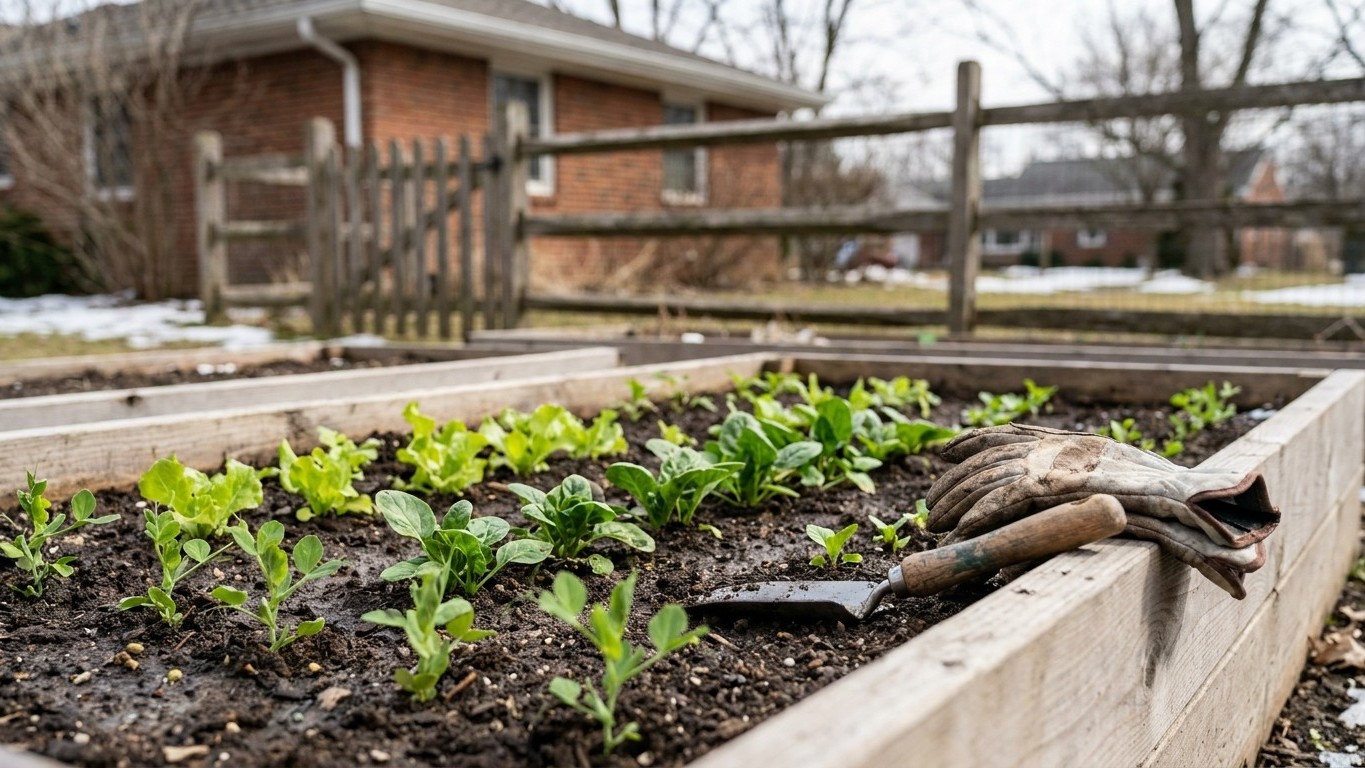

March in Ontario sits well ahead of the average last spring frost, so the open garden stays mostly closed this month. What works is narrow and specific: bare-root plantings, cold frames, dormant pruning, and the first seed-starting under lights. Nothing tender goes outside yet, but the next eight weeks of prep decide how the whole season runs.
What goes in the ground in March

The number that governs everything here is the average last spring frost for the Toronto area: April 30. That’s a mean date from Environment and Climate Change Canada’s climate normals, which means in roughly half of all years frost arrives later than that, not earlier. March lands four to eight weeks ahead of that midpoint, which is why almost nothing tender belongs in open soil yet, and why soil temperature, not the page of a calendar, is the real gatekeeper.
For most of the province, ground in March is still cold, often still frozen at depth, and frequently too wet to work without compacting it. Say that plainly: for the bulk of Ontario gardeners, open-ground planting in March is not the move. What does fit the month is narrower and worth naming precisely.
Bare-root fruit trees, cane fruits like raspberries, and dormant roses can go in as soon as the soil thaws enough to dig a hole and drains freely when squeezed. Shallot and onion sets can follow in the same late-March window in sheltered, well-drained beds in the milder pockets of the south and southwest, but only once the ground has stopped being a mud puddle. Cold frames and low tunnels let a gardener push spinach, arugula, and other hardy greens a few weeks earlier than the open bed would allow, because the cover buys several degrees of soil warmth. Rhubarb and chicory can be forced indoors in a dark, cool space for an early harvest that has nothing to do with outdoor frost risk at all.
What doesn’t belong in March: peas, favas, and other so-called frost-hardy direct-sown crops are safer held for the weeks closer to the last frost window, once soil has genuinely warmed and dried rather than merely thawed on the surface.
What to start under cover
Seed starting indoors runs on its own clock, counted backward from that April 30 average last frost rather than from any fixed date on the wall. The arithmetic is simple once it’s laid out: tomatoes, peppers, and eggplant typically need six to eight weeks under lights before they’re ready to go outside, which puts their start date in the middle of March for most of southern Ontario. Broccoli, cabbage, and other brassicas run on a similar six-to-eight-week clock, so they share the same window.
Onions and leeks started from seed rather than sets need considerably more lead time, often ten to twelve weeks, which means that timing has typically already passed by March for gardeners working toward the April 30 mean frost. That’s worth knowing even after the fact, since it explains why onion sets exist as a shortcut for anyone who missed the earlier seed-starting window.
The two ways this goes wrong are opposite but equally common. Start too early, and by the time the ground is actually safe, tomato and pepper seedlings have gone leggy and rootbound in their trays, stretching for light and stalling once transplanted. Start too late, working backward less carefully, and the plants never build enough root mass or stem thickness to handle transplant shock when the window finally opens. The fix in both directions is the same: count weeks from April 30, not from the first warm afternoon that makes spring feel closer than it is.
What is ready to pick
Little comes out of an Ontario garden bed in March, and that’s worth saying outright rather than dressing up. But a few things keep a kitchen supplied. Kale and other cold-hardy greens that overwintered under snow cover or row fabric often still have usable leaves once the snow retreats, especially in a season with steady cover rather than repeated freeze-thaw cycles. Leeks left in the ground over winter behave the same way, pulling out sweeter after the cold than they were in fall.
Anything under a cold frame or low tunnel is worth checking regularly, since those covered greens, spinach and lettuce mixes in particular, can produce a light but genuine harvest weeks before open beds do anything at all. Indoors, sprouts and microgreens fill the gap entirely on their own schedule, ready within one to two weeks of sowing regardless of what the weather is doing outside.
March is also the month to walk the root cellar or storage area and be honest about what’s turning. Squash with a soft spot near the stem, potatoes that have started sprouting or gone soft, and onions with any sign of mold at the neck should come out and get used first, before the problem spreads to the rest of the batch. A few minutes of checking now saves a much larger loss later in spring.
The jobs that matter this month

March carries more weight in the garden than the empty beds suggest, and the deadlines here are real. Dormant pruning of fruit trees, grapevines, and cane berries needs to happen before buds break, which for most of Ontario means finishing this work by month’s end. Prune after growth starts and the plant wastes energy healing cuts instead of pushing new wood, and the wound closes more slowly besides.
Seed ordering belongs here too, and later than expected costs selection: popular varieties of tomatoes, peppers, and specialty greens sell out from suppliers well before the actual sowing dates arrive, so placing an order in March instead of April often means the difference between getting the variety wanted and settling for what’s left.
Soil work pays off disproportionately this month. A soil test taken now gives enough lead time to correct pH or add amendments before the first transplants go in, and compost piles turned in March, once they’ve thawed enough to work, finish breaking down faster with the returning warmth. Tools benefit from the same slack window: pruners, hoes, and shovels cleaned and sharpened now save fumbling with dull, rusted edges once the planting rush actually starts.
Bed edges, raised bed frames, and fencing are easier to repair now, before crops are in the ground and before soil is soft enough that foot traffic compacts it. Planning next season’s crop rotation on paper, while the beds are still empty, avoids the more common mistake of repeating the same family in the same spot two years running, which builds up soil-borne pests and disease over time.
What not to do in March
The single most common mistake this month is reading a warm afternoon as a signal that the season has arrived. Air temperature in the 60s does not mean soil temperature has followed, and tomato, pepper, or squash transplants set into cold, damp soil sit there stalled, sometimes for weeks, sometimes permanently stunted, well after the air itself has warmed further. The fix is to check the ground, not the thermometer on the porch, and to remember the April 30 average last frost is a midpoint, not a starting gun.
A close second is uncovering cold frames, low tunnels, or mulched beds too early after a mild stretch. A few warm days in March are routinely followed by a hard freeze, and plants that were hardening off nicely under cover can take real damage once that protection comes off too soon. Leave the cover on longer than feels necessary rather than shorter.
Feeding nitrogen at the wrong point in the season is the third trap. High-nitrogen fertilizer applied to dormant perennials or to beds that won’t see a crop for weeks pushes soft, premature growth that a late frost then damages, and it does nothing for soil that plants aren’t yet actively drawing from. Save the nitrogen for when transplants are actually in the ground and growing, not for the empty bed waiting for them.
Checking this against your own county
Everything above is a provincial starting point, not a county-by-county instruction. Ontario runs from the Carolinian pockets along Lake Erie to the far north, and elevation, lake effect, and simple latitude shift these windows by weeks in either direction. A garden in the Niagara peninsula can be workable a full month before one in the same province further north or at higher elevation. The Canadian hardiness zone of 7a cited for the Toronto area reflects that one reference station, using a Canadian system built on seven climate variables rather than the single-variable USDA scale, and it does not describe the whole province.
For local frost records, soil conditions, and variety recommendations tuned to a specific county, the Ontario Ministry of Agriculture, Food and Rural Affairs is the reference point worth checking before finalizing any planting date.
Common questions
Is March too early to plant vegetables outside in Ontario?
For nearly all of the province, yes. The average last spring frost sits around April 30, and March lands weeks ahead of that midpoint, so open-ground planting of anything tender is premature. Cold frames, bare-root plantings, and dormant pruning are the realistic work for the month.
When should tomato seeds be started for an Ontario garden?
Counting back six to eight weeks from the April 30 average last frost puts the start date for most southern Ontario gardeners in the middle of March, under lights, indoors.
Can garlic still be planted in March in Ontario?
Garlic is typically a fall-planted crop in Ontario, going into the ground months before winter to establish roots. March is better suited to shallot and onion sets once soil has thawed and drained, rather than to garlic itself.
What Canadian hardiness zone does Ontario fall into?
It varies widely across the province. The Toronto area sits at 7a on the Canadian system, which measures seven climate variables and does not convert directly to the USDA scale used elsewhere. Northern and upland parts of Ontario run several zones colder than that figure.